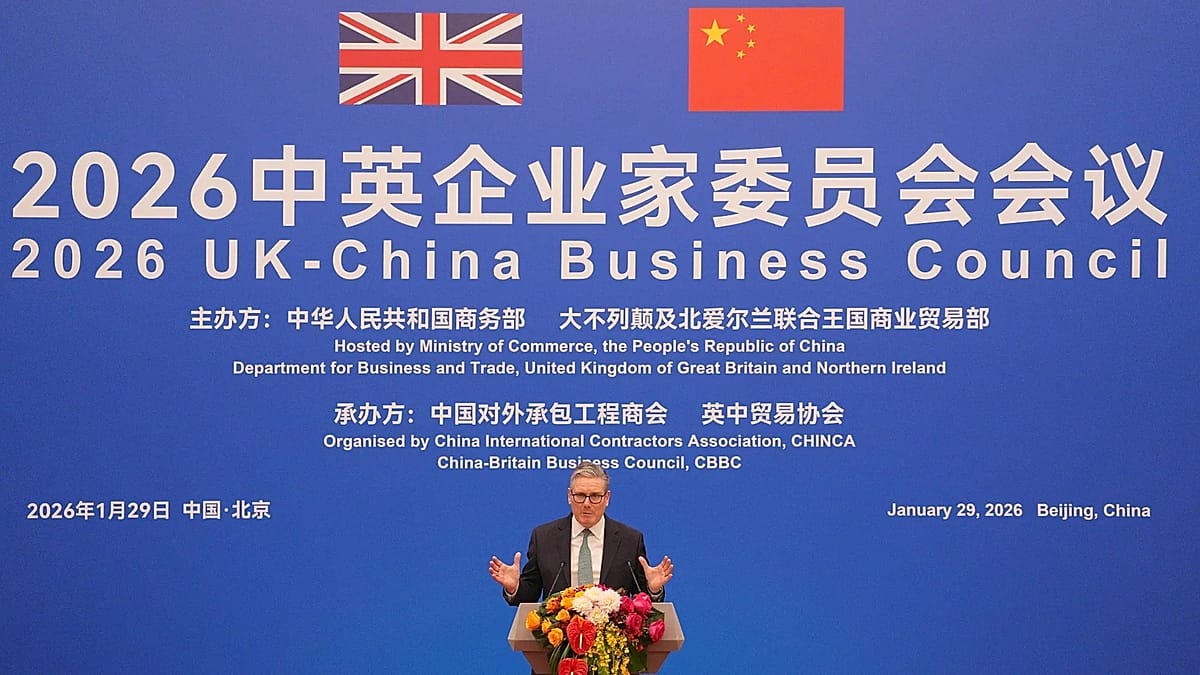
UK Prime Minister Keir Starmer made the first visit by a British premier to China since 2018, meeting President Xi and signing several cooperation agreements while bringing more than 50 British business leaders to pursue trade and investment opportunities. U.S. President Donald Trump publicly warned it was "very dangerous" for close allies to do business with China and threatened 100% tariffs on Canadian imports over similar deals, heightening geopolitical and trade-policy uncertainty. Downing Street said the White House was pre-warned and noted Trump's own planned China visit in April, leaving markets to weigh potential bilateral opportunities against elevated diplomatic and tariff risks for companies exposed to UK–China–US policy shifts.
Market structure: A UK-China thaw (if substantive) benefits UK exporters, China-facing banks and global miners. Expect positive demand shock for iron ore/copper and selective services (tourism, legal/financial) with a 3–12 month revenue upside of 3–10% for large China-exposed names versus peers; losers are US defense/sanction-sensitive suppliers and politically exposed domestic UK-only plays. FX and rates: reduced geopolitical risk should push GBP +2–4% vs USD and lift UK 10y gilts by 10–30bps over 1–3 months as safe-haven flows retreat.
Risk assessment: Tail risks include US secondary measures (tariffs/sanctions) or a symbolic-only deal that fails to convert to trade — both would punish UK corporates and banks with up to 20–30% earnings volatility in worst cases. Timing: headline moves in days (FX, spot commodities), policy concretization in weeks–months (MOUs to contracts), structural supply-chain shifts in quarters–years. Hidden dependencies: many agreements hinge on Chinese SOE buy-in and regulatory approvals; a stalled approval cycle is the most likely second-order shock. Key catalysts: Trump’s April China visit, UK/China MoUs becoming legally binding, and any US executive actions within 60 days.
Trade implications: Favor materials/commodity exporters (BHP, RIO) and select UK banks with China franchise (HSBC, Standard Chartered) while trimming gold and US defense exposure. Implement 3–9 month directional positions sized 1–3% of NAV with defined option hedges (call spreads for commodity exposure, protective puts for banks). Monitor spreads and shipping/iron-ore price moves (iron ore +5% consensus trigger) as entry signals.
Contrarian angles: Markets may be pricing deals as transformative when many will be gestural — that undercuts cyclical upside in the short run but over-discounts bank franchises that can re-enter RMB flows. Historical parallel: post-WTO China opening produced multi-year commodity cycles, not immediate GDP jumps; expect lumpy, front-loaded market reactions and then mean-reversion. Unintended consequence: closer UK-China ties could accelerate US/UK regulatory divergence, adding long-term political risk premiums to UK equities that are currently under-hedged.
AI-powered research, real-time alerts, and portfolio analytics for institutional investors.
Request DemoOverall Sentiment
mixed
Sentiment Score
-0.05
