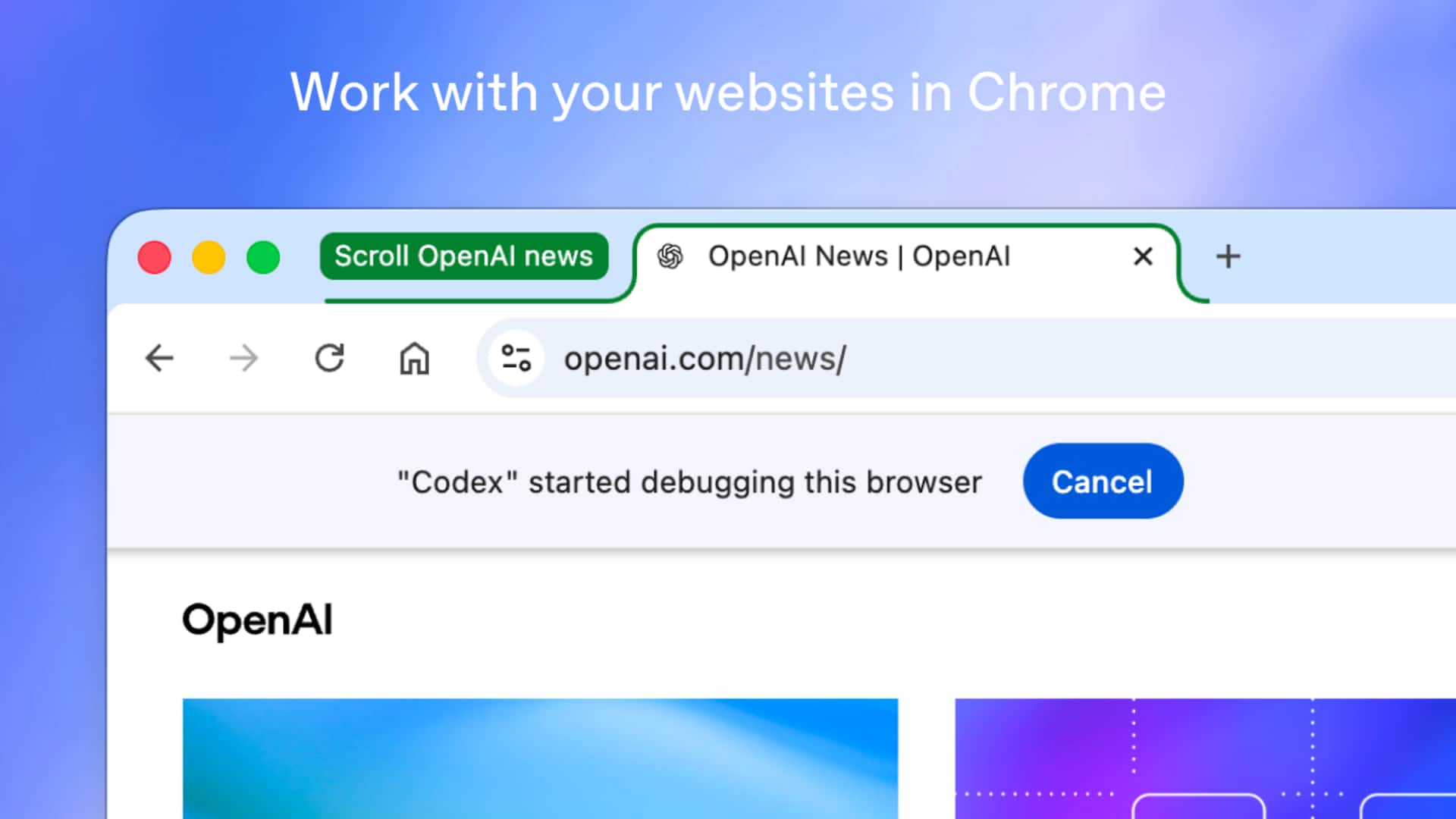
OpenAI launched a Chrome extension for Codex that expands browser-based capabilities, including testing web apps, gathering context across multiple tabs, and using Chrome DevTools in parallel. OpenAI said Codex now has more than 4 million weekly active users, up eight-fold since January. The rollout to Windows and Mac and future integration plans with ChatGPT and Atlas are incremental positives, but the article is primarily a product update rather than a material financial catalyst.
This is less about a single product feature and more about distribution leverage: putting agentic software inside Chrome lowers adoption friction at the exact layer where knowledge work already lives. The second-order winner is whoever can turn browser context into a persistent workflow moat; the loser is any point solution whose value proposition is “I help with web tasks” without owning the ambient interface. In practical terms, this increases the odds that AI assistants shift from discretionary tools to default work surfaces, expanding engagement and weakening standalone SaaS retention at the margin.
The near-term market reaction may underprice the competitive implication for browser and endpoint ecosystems. If Codex becomes a better in-browser operator, it strengthens the case for AI-enabled browser consolidation and puts pressure on adjacent productivity tools whose differentiation depends on tab juggling, QA, research, and lightweight automation. Over 6-18 months, the real economic impact is not just higher AI usage but more paid conversion from casual users who previously bounced off developer-centric workflows; that supports monetization mix improvement if usage intensity persists.
The main risk is that browser-native agents still face reliability and permissions friction, so the adoption curve can stall if error rates, security prompts, or enterprise policy blocks are high. The consensus may be too focused on feature release cadence and not enough on platform capture: once a user trusts an assistant with multi-tab context, switching costs rise materially. If this expands into a unified app with browser + chat + coding, the strategic endpoint is a broader operating layer that could compress usage of competing search, note-taking, and workflow software over the next 12-24 months.
AI-powered research, real-time alerts, and portfolio analytics for institutional investors.
Request DemoOverall Sentiment
mildly positive
Sentiment Score
0.36
