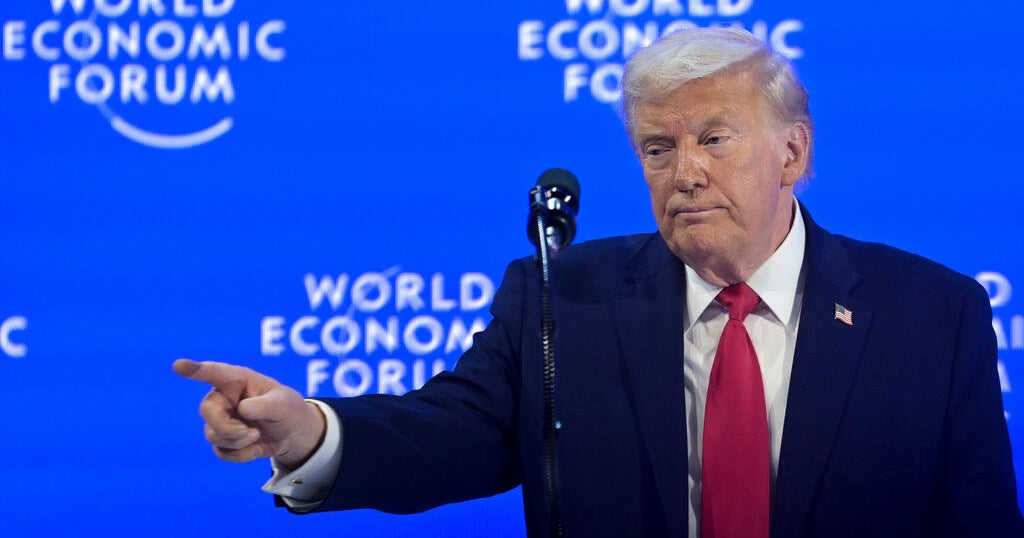
President Trump will unveil the charter for a U.S.-led “Board of Peace” in Davos aimed at overseeing Gaza’s reconstruction and transition, with an executive committee reportedly including Marco Rubio, Jared Kushner, Tony Blair and World Bank President Ajay Banga and membership buy-in options of $1 billion for permanent status. More than 50 countries were invited and 20–25 have reportedly agreed to join, though several European nations including the U.K., Norway and Sweden have paused over legal and political concerns (including potential Russian involvement), leaving the board’s authority and funding mechanisms uncertain. Separately, Trump suspended threatened tariffs over Denmark’s objections to his Greenland proposal and said a security “framework” could expand U.S. bases there, a claim Danish and Greenlandic officials say has not been agreed — developments that increase geopolitical and policy uncertainty for investors monitoring regional security, defense contractors and potential trade frictions.
Market structure: Trump's Davos moves tilt flows toward defense, heavy civil-construction and selective commodities. Short-term winners: U.S. defense primes (LMT, RTX, NOC) and heavy-equipment/materials (CAT, MLM, VMC) if Greenland security and Gaza reconstruction budgets materialize; losers include EU exporters sensitive to tariff rhetoric and tourism/travel sectors if diplomatic friction persists. Pricing power will shift toward firms with government-contracted backlog where orderbooks can be expanded by +5–20% annually if multi-year security/rebuild programs are funded.
Risk assessment: Tail risks include rapid escalation in Middle East (military strikes on Iran or a breakdown of ceasefire) or EU retaliatory trade measures; both would push safe-haven demand (USD, USTs, gold) and spike oil +$5–$15/barrel in weeks. Immediate (days) volatility driven by headlines; short-term (weeks–months) driven by membership/funding announcements (watch for $1B+ pledges within 30–90 days); long-term (quarters–years) driven by formal treaties or sustained NATO/Arctic base build-outs that reallocate CAPEX.
Trade implications: Favor 2–3% tactical longs in defense equities/ETF (ITA or equal-weight LMT/RTX/NOC) and 1–2% longs in construction/materials (CAT, MLM) scaled on confirmed funding. Hedging: allocate 1–2% to TLT or 3-month GLD call spreads to protect against risk-off; consider short European equities (VGK) or EURUSD put structures if tariff rhetoric resumes.
Contrarian angles: Consensus assumes politics, not cash—watch for private-sector and sovereign commitments (World Bank/Arab Gulf states) that could catalyze multi-year rebuild contracts and leave markets underexposed; undervalued are mid-cap engineering contractors (J, AECOM) that can win large fixed-price rebuild work and rerate 20–40% on several $100M+ awards. The market may underprice a benign outcome: if the Board secures $10–20B in staged commitments within 90 days, construction/materials could outperform defense due to faster deployability of capital.
AI-powered research, real-time alerts, and portfolio analytics for institutional investors.
Request DemoOverall Sentiment
neutral
Sentiment Score
-0.05
