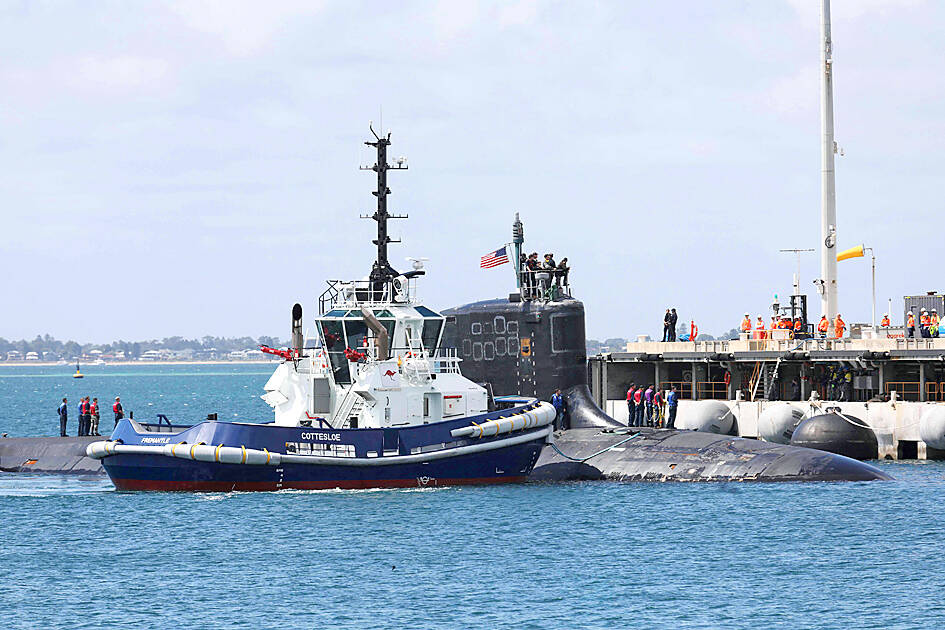
The U.S. is considering deploying up to four nuclear-powered submarines to HMAS Stirling in Western Australia from 2027 as a forward maintenance and operational hub to strengthen deterrence against China; Australia is investing A$5.6 billion (US$3.93bn) to upgrade Stirling and A$8.4 billion to develop Henderson Naval Base, with ~1,200 U.S./U.K. personnel expected to rotate through and permanent-style maintenance facilities (including dry docks) planned. For investors, the plan increases near-term demand visibility for defense contractors, shipbuilding and base-infrastructure suppliers and heightens strategic supply‑chain risk in the Indo-Pacific; separately, TSMC’s decision to upgrade its Kumamoto second fab to advanced 3nm capacity accelerates high-end semiconductor manufacturing in Japan, with implications for semiconductor equipment and materials suppliers.
Market structure: Forward-basing nuclear submarines at HMAS Stirling is a direct positive for defense contractors, shipbuilders and specialty industrial suppliers (steel, dry-dock services, radioactive-waste management) and an explicit positive for advanced-semiconductor supply chains (TSMC’s 3nm in Japan). Expect 5–15% revenue tailwinds over 3–5 years for exposed mid/small-cap shipbuilders and maintenance contractors; global defense primes see margin expansion from multi-year service contracts, supporting a higher defense-sector risk premium. Cross-asset: term premium on US Treasuries should drift up in a 6–24 month window, AUD should appreciate modestly (1–3%) as A$ facility spending accelerates, and commodity inputs (steel, copper) should rally 3–10% on incremental demand.
Risk assessment: Tail risks include kinetic escalation that disrupts Asia-Pacific trade (low probability, high impact) which would crater TSM/TSMC-dependent names and spike shipping rates; regulatory risks include Australian political reversal or export-control escalation that re-routes capex. Immediate (days) market moves will be limited; short-term (weeks–months) sees re-rating on defense headlines; long-term (years) depends on realized capex and base-operational cadence. Hidden dependency: Australia’s “rotational” legal framework could be reversed by political change — capex sunk costs are illiquid and risk overruns are likely (20–40% typical for infrastructure).
Trade implications: Specific plays: establish 2–3% long position in TSM (TSM) with a 6–12 month horizon to capture 3nm production upside; add 1–2% long in a US shipbuilder (HII) or defense prime (LMT) for direct maintenance/drydock exposure over 12–36 months. Implement a 9–12 month call-spread on TSM (buy 1% OTM call, sell 10% OTM) to cap cost; hedge geo-risk by shorting 1–2% FXI (China large-cap ETF) or buying 3–6 month puts on Taiwan-focused indices if conflict probability rises >15% in next 12 months.
AI-powered research, real-time alerts, and portfolio analytics for institutional investors.
Request DemoOverall Sentiment
mixed
Sentiment Score
-0.05
Ticker Sentiment
Contrarian angles: The market prices defense as binary upside; that may be overdone — large primes are already expensive (forward P/E premiums >20% vs market). Equally, consensus underestimates semiconductor geographic diversification benefits: TSM’s Japan 3nm line materially cuts single-point-of-failure risk and is underpriced. Historical parallel: Cold-War basing programs often produced political pushback and cost overruns that capped stock returns; watch project-level KPIs (A$ spend milestones, dry-dock commissioning) — miss of >20% vs plan should be a sell signal.
