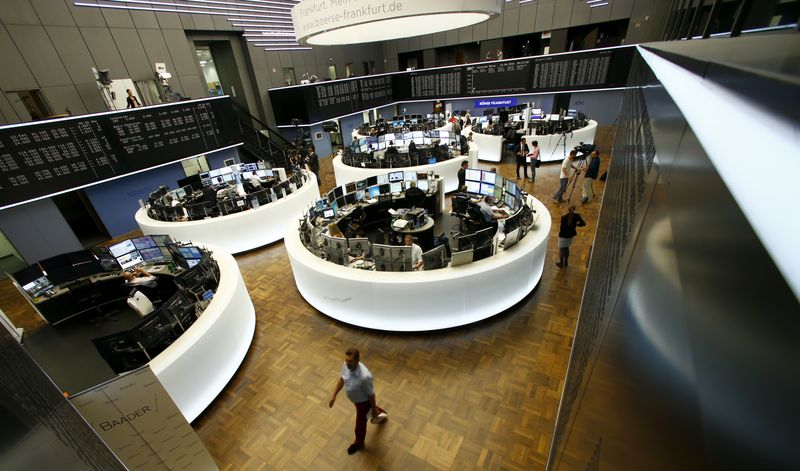
Brent crude rose 5.2% to $95.04 a barrel after the U.S. seized an Iranian cargo ship and tensions escalated around the Strait of Hormuz, through which roughly one-fifth of global oil flows. European equities opened lower, with the Stoxx 600 down 1.0%, Germany's DAX off 1.3%, France's CAC 40 down 1.1%, and the FTSE 100 lower by 0.4%. The disruption risk is pressuring travel, leisure, and luxury stocks while keeping broader markets in a risk-off posture.
The market is still treating Hormuz as a headline risk rather than a physical supply shock, which is why the reaction is uneven: energy up, but not a full de-risking across cyclicals. The second-order effect is that every incremental escalation now raises the probability of insurers, shipowners, and charterers demanding a materially higher war-risk premium even if tankers keep moving; that can tighten effective supply before barrels actually disappear. In other words, the real transmission mechanism over the next 1-3 weeks is freight/insurance bottlenecks, not just crude prices. This favors upstream energy and the parts of transportation most exposed to fuel pass-through, but it is more nuanced for broad shipping/logistics. A sustained move in Brent toward the high-$90s usually compresses margins in consumer-discretionary travel and low-price power users faster than it boosts the market's confidence in an eventual reopening; that creates a lagged hit to European cyclicals and airlines even if the conflict cools. The market is likely underestimating how quickly a risk-off tape can force systematic selling in momentum and high beta names if oil remains above $90 into the next data/EPS cycle. For SMCI and APP, the direct macro link is not fundamental demand destruction but multiple compression: both are high-duration names that trade off liquidity and risk appetite, so a sharper geopolitics-driven rise in rates/energy can hit them through factor de-rating. The contrarian angle is that if Hormuz remains intermittently open and crude settles below the weekend spike, these names can snap back hard because positioning is still vulnerable and investors have not fully priced a sustained growth scare. That makes the next 5-10 trading days a tape-driven opportunity rather than a thesis-driven one. Net: this is a good environment to own hard-asset convexity and be selective on leveraged growth exposure until there is clarity on shipping continuity. The biggest risk to the bearish risk-off view is rapid diplomatic de-escalation or verified tanker flow normalization, which would unwind the energy bid and force short covering in crowded defensives.
AI-powered research, real-time alerts, and portfolio analytics for institutional investors.
Request DemoOverall Sentiment
strongly negative
Sentiment Score
-0.55
Ticker Sentiment
