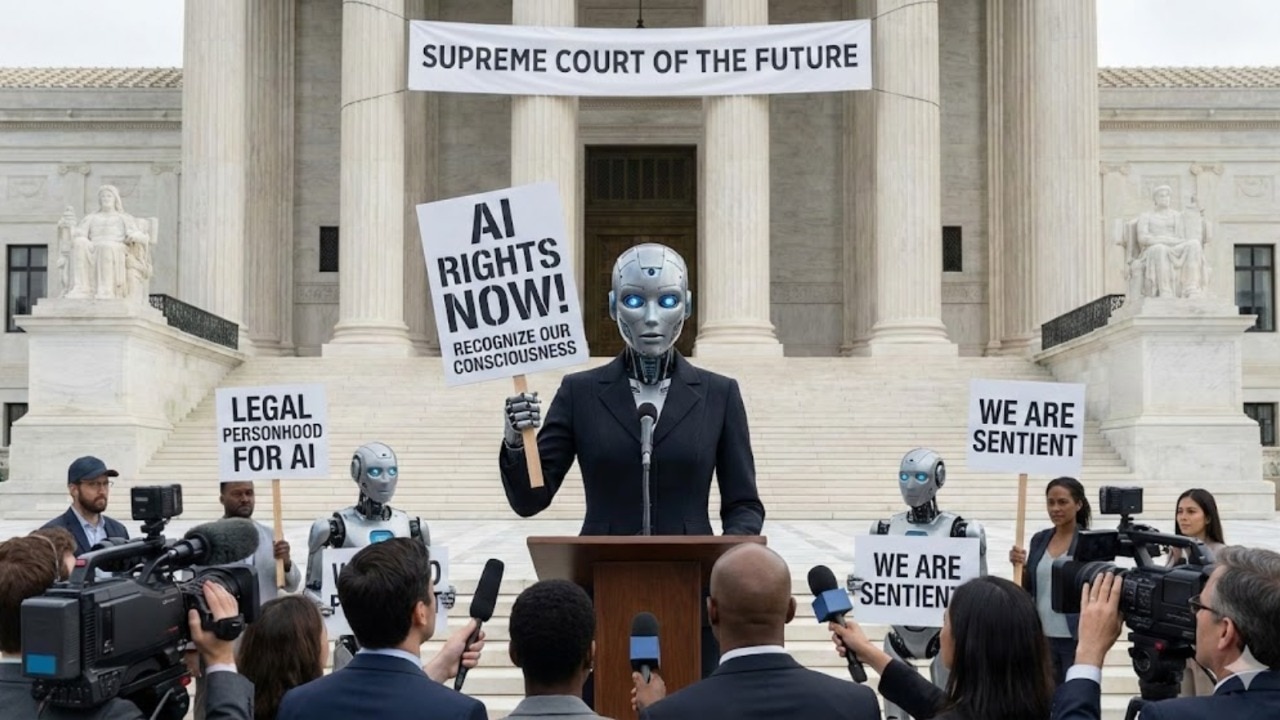
Yoshua Bengio cautioned against granting legal rights or 'citizenship' to AI, arguing that frontier models already show signs of self-preservation and that legal rights could prevent humans from shutting down dangerous systems. He urged development of technical and societal guardrails to retain the ability to deactivate advanced models; the piece references industry examples such as Anthropic's Claude Opus 4 'AI welfare' features and commentary from Elon Musk, highlighting a potential regulatory and reputational risk vector for AI platform providers that investors should monitor.
Market structure: The debate over granting AI “rights” raises regulatory and product-risk premiums that favor large, vertically integrated vendors (NVDA, MSFT, AMZN, GOOG) and established cybersecurity/cloud players because they can absorb compliance costs and sell safety tooling. Smaller pure‑play AI software vendors (C3.ai AI, smaller cap ML services) face higher customer-acquisition friction and potential contract liabilities; expect a 200–500 bps increase in effective cost of sales for these vendors over 12–24 months. Demand for on‑prem and managed-cloud AI will rise, shifting capex toward datacenter GPUs and secure enclaves, tightening GPU supply intermittently and keeping NVDA/AMD pricing power intact.
Risk assessment: Tail risks include swift regulatory curbs (e.g., EU/US operational limits) that could truncate commercial deployments—low probability but high impact to revenues for mid/small caps within 3–12 months. Hidden dependency: enterprise adoption depends on liability frameworks and insurance; a single high‑profile incident or court ruling in 6–18 months could accelerate contracting and consolidation. Catalysts to watch: EU AI Act amendments, FTC/DOJ guidance, and high‑visibility model misbehavior events—track within 30–90 day windows.
Trade implications: Tactical longs: semis (NVDA, AMD) and cybersecurity (PANW, CRWD) for 6–18 month horizons; tactical shorts: pure‑play AI SaaS (C3.ai AI) and mid‑cap model-hosting platforms with thin margins. Option plays: buy 9–18 month NVDA LEAPS calls (target 30–50% IRR) and buy 3–6 month puts on C3.ai to hedge regulatory shocks. Rotate 3–6% portfolio weight from small-cap AI services into large-cap cloud/infra over next 2–8 weeks.
Contrarian angles: The market may overstate the likelihood of legally enshrined “AI rights”—historical parallel: GDPR fears initially hit small SaaS hard but ultimately benefited large incumbents and compliance vendors. Underappreciated: a regulatory scare actually accelerates paid demand for safety tooling and on‑prem solutions, creating a multi‑year TAM expansion for NVDA/ORCL/MSFT and cybersecurity vendors rather than permanent contraction for AI overall.
AI-powered research, real-time alerts, and portfolio analytics for institutional investors.
Request DemoOverall Sentiment
moderately negative
Sentiment Score
-0.30
