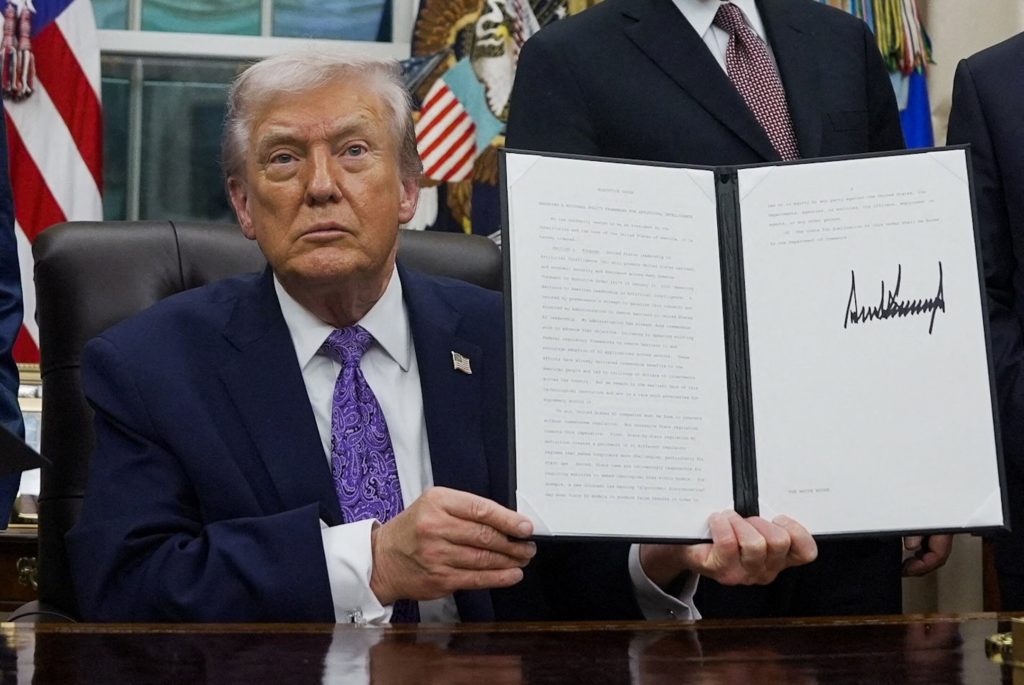
President Trump signed an executive order preempting state AI laws by giving the Justice Department authority to block state regulations and allowing the federal government to withhold funding for projects like broadband, a move framed as creating a single, minimally burdensome national standard to preserve U.S. competitiveness in AI and backed publicly by White House AI adviser David Sacks. The order targets a growing patchwork of state rules—more than 100 measures cited by supporters and examples like Colorado’s algorithmic-discrimination limits and Illinois’s restrictions on AI therapy—and is likely to prompt immediate legal challenges from state attorneys general on federalism and commerce-clause grounds. Market and policy implications: the directive is a near-term win for large tech firms by reducing compliance fragmentation and accelerating deployment, but it risks rolling back state-level protections for privacy, fairness and consumer safety, faces uncertain judicial outcomes, and runs counter to public polling showing broad voter support for AI regulation.
President Trump signed an executive order preempting state AI laws by granting the Justice Department authority to block state regulations and permitting the federal government to withhold funding for broadband and other projects, a move publicly defended by White House AI adviser David Sacks as creating a single, minimally burdensome national standard. Supporters cite a fragmented landscape—"over 100" state measures with roughly 25% concentrated in California, New York and Illinois—and point to examples such as Colorado's ban on algorithmic discrimination and Illinois' restrictions on AI therapy as creating a compliance patchwork.
Legal and political risk is high: state attorneys general are expected to sue on federalism and commerce-clause grounds and the order explicitly raises a major constitutional question; Congress could also intervene, and broad public polling cited in the coverage shows most voters favor AI regulation even if it slows development. The article notes societal impacts—one in five teenagers report deep emotional attachment to chatbots—underscoring why states moved first.
Market implications favor large technology firms that can exploit reduced multistate compliance burdens while smaller AI startups face relative disadvantage; the news is scored as mixed with a cautious tone and a market impact score above neutral. Outcomes hinge on litigation and potential federal legislation, so sector revenue and compliance-cost assumptions remain materially uncertain; per-ticker signal shows neutral sentiment for PINS.
AI-powered research, real-time alerts, and portfolio analytics for institutional investors.
Request DemoOverall Sentiment
mixed
Sentiment Score
0.05
Ticker Sentiment
