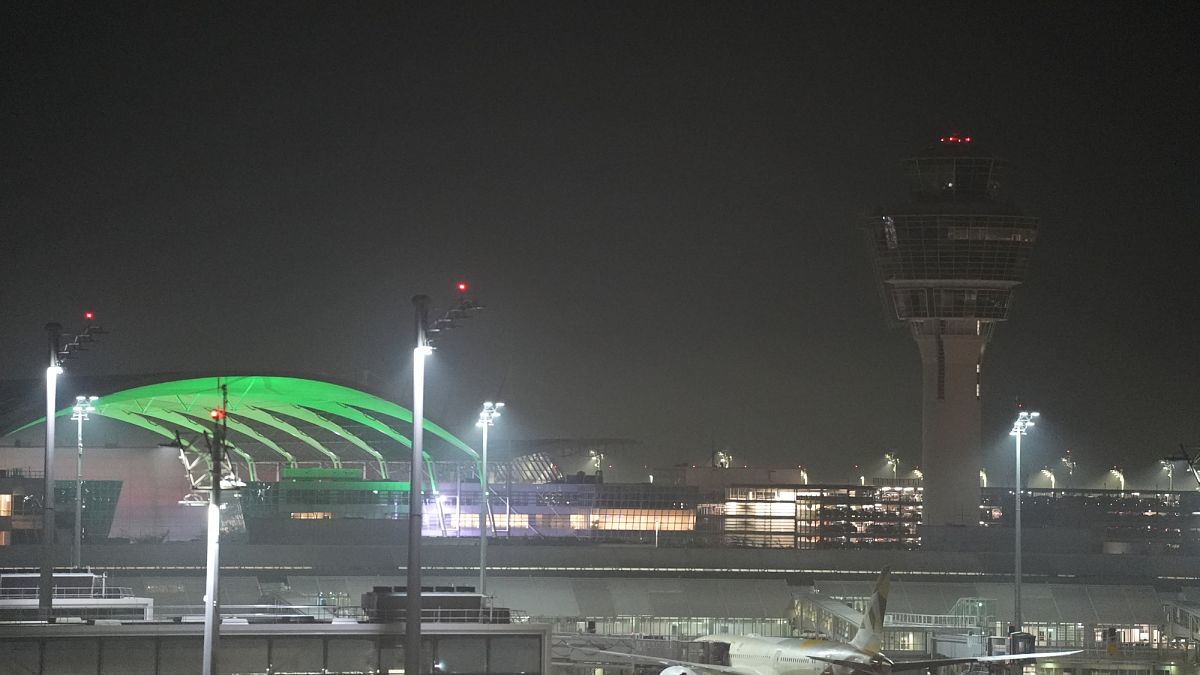
Munich Airport has deployed a laser installation to detect and counter drone threats, following significant operational disruptions last week that resulted in nearly 200 flights being cancelled or diverted due to suspicious drone sightings. This local action underscores a growing security concern across Europe, with at least 11 countries experiencing recent drone incursions, prompting European leaders to discuss a 'drone wall' along the bloc's eastern border, indicating a potential for continued air travel impacts and increased investment in counter-drone technologies.
German newspaper Bild said authorities deployed a laser installation near the Munich Airport in case of additional drone sightings. A laser installation is deployed near the Munich airport to protect the German airport from any additional drone sightings, according to local media. German newspaper Bild cites anonymous security sources that the laser equipment will allow authorities to find the drone’s distance from the airport. Euronews Next contacted Germany’s Federal Police to independently verify this claim but did not hear back at the time of publication. The news comes after Munich airport closed for two consecutive days last week over suspicious drone flights. The first sightings came around 8:30 pm local time on 2 October in areas around the airport, including the towns of Freising and Erding. Drones were later seen near the airport fence and two hours later around the airport, according to an airport statement. A preventative closure was then put in place that saw 17 flights cancelled and 15 flights diverted to Stuttgart, Nuremberg, Vienna, and Frankfurt as police launched “extensive search operations” in the area. Officials at the time set up camp beds with blankets, drinks and snacks provided to passengers on cancelled flights. A day later, German police said they spotted two drone sightings shortly before 11 pm near the airport’s north and south runways, the agency said in a statement, but flew away before they could be identified, according to the Associated Press news agency. More drone sightings on the morning of 4 October saw another 170 flights cancelled or diverted, the airport said. Munich just wrapped up Oktoberfest celebrations, a popular annual event that sees millions of people flock to the city.. At the same time, the city is hosting a so-called government-held Munich Migration Meeting, where most of the discussion was concentrated on drone response. Munich is just the latest place in Europe that has seen drone incursions in recent weeks. At least 11 countries, including Lithuania, Latvia, Denmark, Norway, Romania, Poland, Estonia, Germany, Belgium, and France, have seen drones or disruptions over their territory in the past three months. European leaders agreed at meetings in Copenhagen last week to push ahead with plans for a so-called “drone wall” along the bloc’s eastern border. The deployment of a laser detection system at Munich Airport is a direct material response to significant operational disruptions caused by drone incursions. These events resulted in the cancellation or diversion of over 180 flights across two days, highlighting a critical vulnerability in major aviation infrastructure. The article frames this not as an isolated incident but as part of a broader, systemic security threat, noting that at least 11 European countries have experienced similar issues recently. The discussion among European leaders about a potential 'drone wall' signifies that this risk is escalating to a geopolitical level, likely foreshadowing increased regulation and substantial government investment in counter-UAS (Unmanned Aircraft Systems) technologies. While the immediate impact is localized disruption and increased operational costs for the transportation sector, the overarching trend points to the emergence of a new, mandatory security-spending category for critical infrastructure across the continent.
AI-powered research, real-time alerts, and portfolio analytics for institutional investors.
Request DemoOverall Sentiment
moderately negative
Sentiment Score
-0.55
