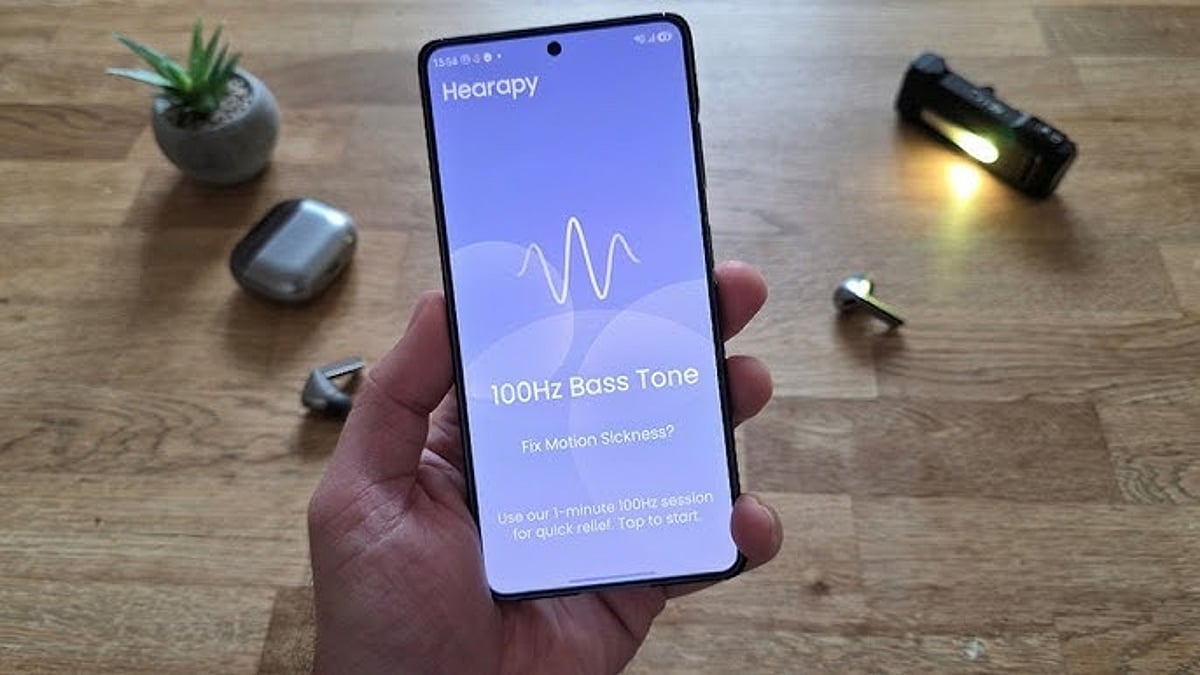
Samsung launched Hearapy, an Android app that plays a 100Hz low-frequency tone at 75–85 dB to reduce motion sickness, claiming one minute of listening can provide relief for up to two hours. The app is positioned as a non-pharmacological, eyes-free solution optimized for Samsung Galaxy Buds 4 Pro, implying potential ecosystem-driven adoption but limited immediate revenue impact until broader compatibility or monetization is confirmed.
Samsung’s Hearapy repositions motion-sickness mitigation from phone-screen features to an audio-hardware-led experience, creating a demand shock that accrues to premium earbud makers and chip vendors more than to software incumbents. Because the therapy requires specific low-frequency fidelity and sustained volume, adoption will preferentially reward OEMs with high-margin earbuds (Samsung, Sony, Apple partners) and SOC suppliers (Qualcomm) that can guarantee accurate LF playback — expect a 6–18 month upgrade/replace cycle uplift for consumers who repeatedly suffer motion sickness.
Second-order winners include travel/leisure companies (marginal increase in discretionary travel frequency) and in-cabin hardware suppliers (auto OEMs and accessory makers integrating certified audio therapy presets). Conversely, Google’s visual-based Motion Cues approach is at risk of being perceived as inferior in “eyes-free” use-cases; that creates a modest negative read-through for GOOGL/GOOG at the product-competition level over the next 3–12 months even if core ad revenues remain insulated. Regulatory and safety scrutiny is the key tail risk: sustained 75–85 dB exposure invites public-health attention and potential labeling/usage limits that would materially constrain addressable usage and slow adoption.
Key catalysts to watch in the coming 90–180 days are (1) peer-reviewed replication of efficacy in independent cohorts, (2) Samsung announcing broadening support beyond Galaxy Buds (or licensing to third parties), and (3) Apple or Google counter-measures (native AirPods integration or Pixel audio features). Any of these will flip adoption dynamics quickly; lack of replication or a safety advisory would be a fast negative.
The consensus risk is overestimating product-lock: Samsung’s current ecosystem advantage is real but transient. If Apple or platform-agnostic players integrate similar tones at OS or SoC level, the incremental hardware advantage erodes and this becomes a horizontal feature rather than a Samsung moat — position sizing should reflect that 6–24 month uncertainty.
AI-powered research, real-time alerts, and portfolio analytics for institutional investors.
Request DemoOverall Sentiment
mildly positive
Sentiment Score
0.25
Ticker Sentiment
