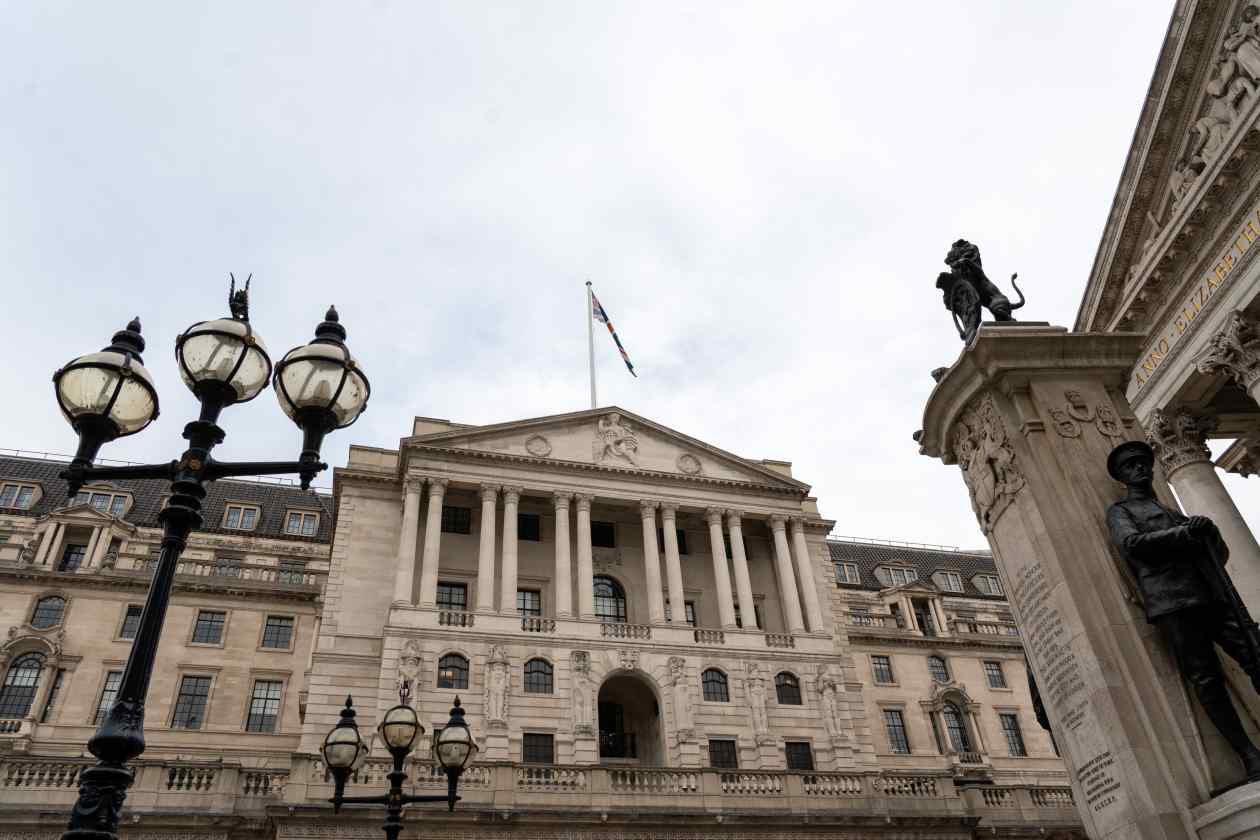
The Bank of England's financial-policy committee has flagged increasing risks of a sharp market correction due to stretched U.S. stock valuations and unprecedented market concentration, with the top five companies holding their highest share in 50 years, drawing parallels to the dot-com bubble. The central bank warned that potential AI-led price adjustments could significantly impact aggregate indices and cited other U.S. risks, including auto sector defaults, noting that the crystallization of these global risks could materially affect the U.K. as an open economy and global financial center, even as U.S. indices like the S&P 500 and Nasdaq trade near record highs.
One central bank seems worried about U.S. tech valuations. It’s not the Fed. Referenced Symbols The Bank of England says the risks of a sharp market correction have increased as stock-market valuations look stretched. In a report released Wednesday, the financial-policy committee of the central bank flagged concerns shared by many observers: the increased concentration in the U.S. stock markets, with the market share of the top five companies at the highest it’s been in 50 years; and “stretched” valuations that were comparable to the dot-com bubble. The cyclically adjusted price-to-earnings ratio is nearing its lowest level in 25 years, while the forward-looking price-to-earnings ratio of 25 is elevated — though below dot-com peaks. “Concentrations within U.S. equity indices meant that any AI-led price adjustment would have a high level of pass-through into the returns for investors exposed to the aggregate index,” the central bank said. The Bank of England’s worries are blunter than what U.S. officials have seen — Fed Chair Jerome Powell, for instance, said equity prices were “fairly highly valued” last month. The Bank of England flagged more U.S.-focused worries, like the Trump administration’s encroachment on Federal Reserve independence and recent credit defaults in the automotive sector. First Brands, an auto-parts supplier, defaulted on more than $5 billion of loans, according to Fitch Ratings. The central bank flagged other risks besides those from the U.S., such as the political deadlocks in France and Japan, which increase the vulnerability of sovereign-debt markets. It was pretty sanguine on the threats from the U.K., noting resilient households and corporations, but also pressures from higher debt servicing and costs of living. Why should the U.K. care about the U.S. valuations? “A crystallization of such global risks could have a material impact on the U.K. as an open economy and global financial center,” said the central bank. The S&P 500 finished Tuesday at its fourth-highest level ever, as did the tech-focused Nasdaq composite .About the Author Steven Goldstein is based in London and responsible for MarketWatch's coverage of financial markets in Europe, with a particular focus on global macro and commodities. Previously, he was Washington bureau chief, directing MarketWatch's economic, political and regulatory coverage. Follow Steve on Twitter: @MKTWgoldstein. The Bank of England (BoE) has issued a "strongly negative" assessment regarding U.S. equity valuations, flagging an increased risk of a sharp market correction. The financial policy committee highlighted "stretched" valuations akin to the dot-com bubble and unprecedented market concentration, with the top five companies holding their highest share in 50 years. This is despite the cyclically adjusted P/E nearing a 25-year low, even as the forward P/E of 25 remains elevated. This high market concentration, particularly in technology, suggests any AI-led price adjustment could significantly impact aggregate index returns, a concern reflected in negative sentiment for SPY, QQQ, and QQQM. The BoE also pointed to U.S. credit defaults, citing First Brands' $5 billion loan default in the automotive sector, alongside political deadlocks in France and Japan as additional systemic risks. Despite observing resilient U.K. households, the BoE underscored that the "crystallization of such global risks" would materially impact the U.K. as an open economy. This cautious outlook emerges while the S&P 500 and Nasdaq Composite recently traded near all-time highs, indicating a potential disconnect between central bank warnings and current market performance.
AI-powered research, real-time alerts, and portfolio analytics for institutional investors.
Request DemoOverall Sentiment
strongly negative
Sentiment Score
-0.70
Ticker Sentiment
