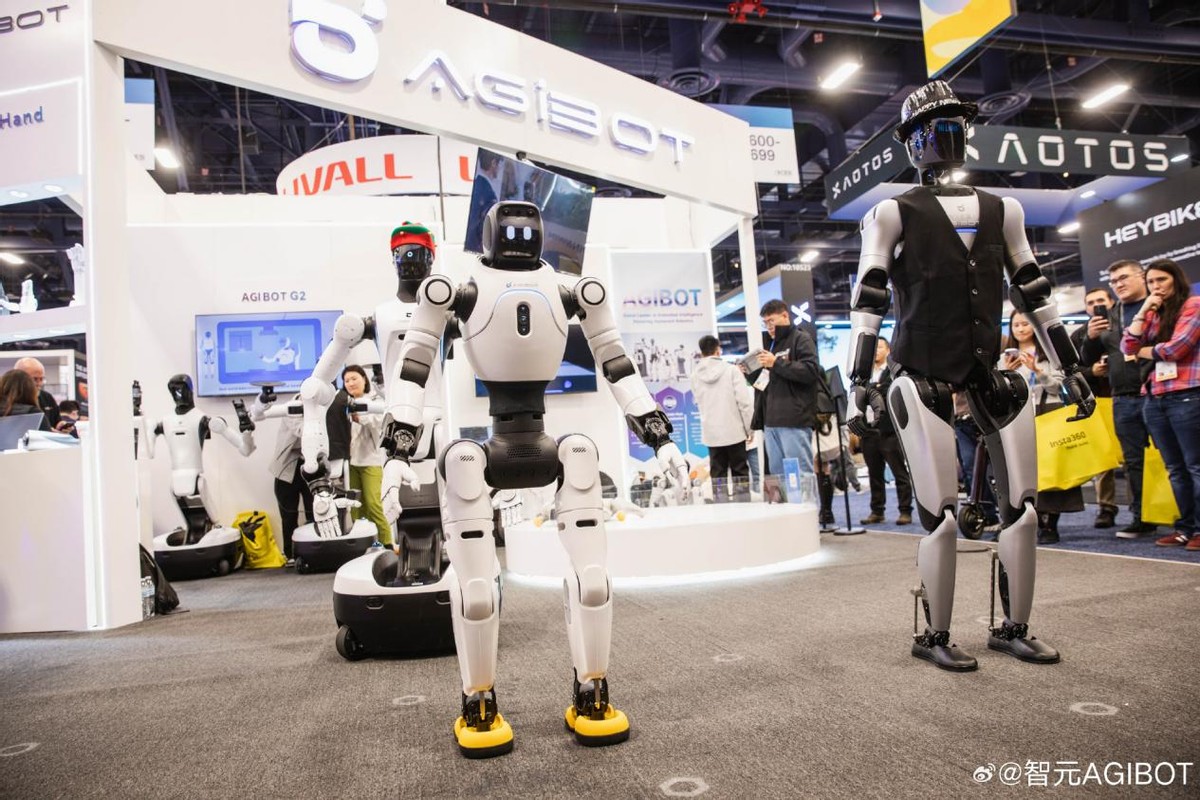
Zhipu Robotics shipped over 5,100 humanoid units in 2025—about 39% of Omdia's reported global total of ~13,000—and recorded roughly RMB1.0 billion in revenue, positioning it ahead of Unitree, Ubtech and Tesla in early commercialization. The piece frames this as a milestone signaling a shift from lab demonstrations to deliverable industrial products, while noting current deployments are concentrated in structured, low-risk scenarios (entertainment, exhibitions, training) and that future growth to Omdia's 2.6m units (2035) or Citigroup's longer-term forecasts will hinge on supply-chain stability, cross‑scenario adaptability, platform/ecosystem development and the ability to sustain margins as competition intensifies.
Market structure: Winners are execution-focused manufacturers and upstream suppliers — think companies with stable supply chains, recurring maintenance revenue and sensor/motor exposure (semiconductor and motion-control suppliers). Losers are single-route consumer plays and project-only integrators that lack repeatable service revenue; pricing power is limited today because demand is concentrated in structured, low-effort scenarios (13k units in 2025 vs Omdia 2.6M in 2035). Expect hardware unit costs to decline meaningfully with scale (rule-of-thumb: 20–40% cost reduction per 2–3x cumulative volume) which pressures margins for low-priced entrants but benefits platform owners.
Risk assessment: Tail risks include regulatory/export controls on key sensors or safety standards within 6–18 months, a high-profile field failure that could cut order momentum by 30–50%, or a supply-shock (motors/actuators) that increases lead times >50%. Immediate (days) — headline-driven volatility; short-term (months) — orderbook/earnings cadence; long-term (years) — platform/ecosystem endurance. Hidden dependencies: data pipelines, service margins and local procurement (China) concentration; loss of recurring service revenue is a single-point failure.
Trade implications: Direct plays — small, concentrated longs in high-execution names (KRKR) and upstream semiconductors/actuators (SMH or select suppliers) with 6–18 month horizons; tactical TSLA optionality for Optimus progress. Pair trade — long KRKR (2% portfolio) / short TSLA (1% notional) to express execution-over-hype; use limited-debit option spreads (TSLA 12m call spread) to cap downside. Rotate overweight into industrial automation and semiconductors, underweight consumer robotics; enter on pullbacks >10% or positive order-readout, exit if QoQ order growth <10%.
Contrarian angles: Consensus overweights shipment counts as moats; it misses that data/ecosystem accumulation (software, service attach rate >25%) will decide winners. Reaction to Zhipu’s 5,100 units is likely overdone for valuation — expect mean reversion if execution stalls. Historical parallel: early 3D-printing hype led to consolidation and platform winners—same pattern likely here. Unintended consequence: aggressive low-pricing to gain share (Unitree) can trigger margin compression industry-wide, creating acquisition opportunities but painful near-term returns.
AI-powered research, real-time alerts, and portfolio analytics for institutional investors.
Request DemoOverall Sentiment
mildly positive
Sentiment Score
0.30
Ticker Sentiment
