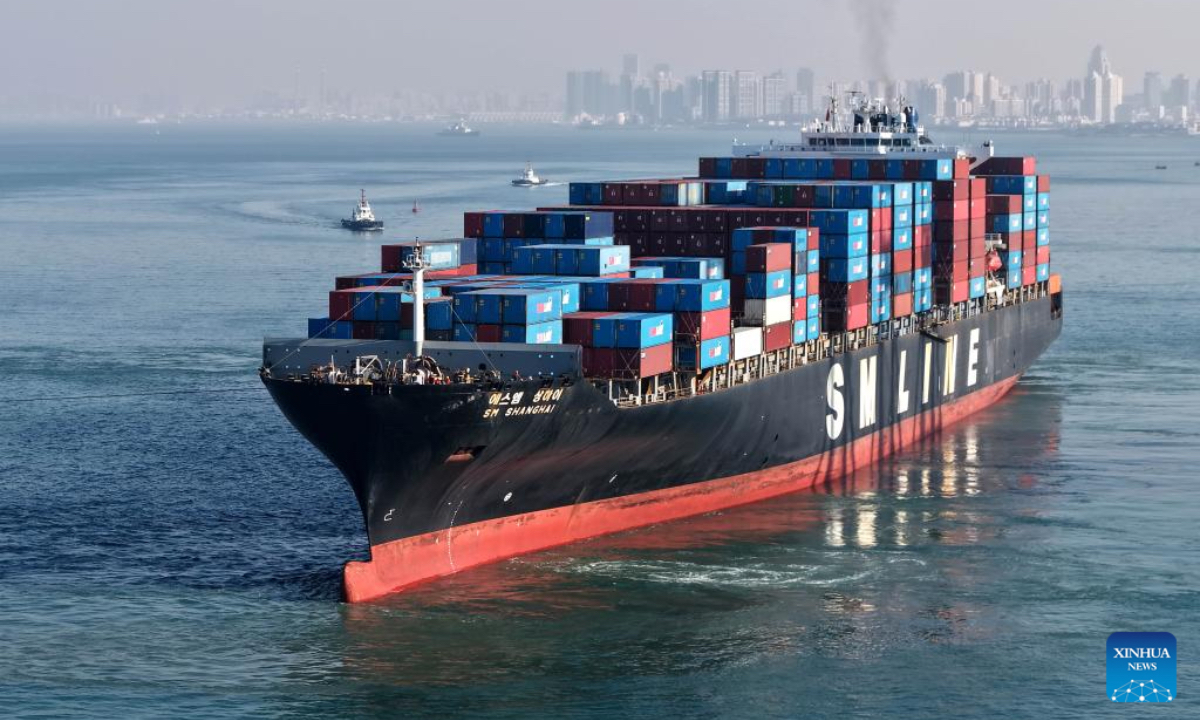
China's National People's Congress Standing Committee approved a revised Foreign Trade Law that will take effect on March 1, 2026, expanding to 11 chapters and adding provisions to promote a 'strong trading nation', strengthen trade facilitation (including cross-border financial services and international recognition of digital certificates/e-signatures), develop green trade standards, and bolster foreign trade talent. Officials and experts say the changes aim to improve cross-border settlement/payment mechanisms and support digital and green trade competitiveness. Customs data show China's goods trade reached 41.21 trillion yuan in the first 11 months of 2025, up 3.6% year-on-year, with November growth rebounding to 4.1%, underscoring policymakers' focus on stabilizing and raising the quality of foreign trade.
Market-structure: The law tilts benefits toward large Chinese trade infrastructure and banks that handle cross-border settlement and certification — think ports, integrated logistics and state banks which gain pricing power from streamlined settlement and digital certification. Expect 6–18 month volume tailwinds: if GAC trade growth sustains >3% YoY post-Mar-2026, ports/logistics could see EBITDA improvements of +5–15% as dwell times fall and fees reprice. Smaller exporters and niche freight forwarders may lose share to platformized SOEs that absorb compliance costs.
Risk assessment: Key tail-risks are geopolitical escalation (new sanctions) or slow international recognition of digital certificates — either can wipe projected gains; assign a 10–15% downside probability over 12 months. Near-term (0–3 months) effects are limited; main regime changes and measurable financial flows will materialize 3–18 months after implementing regulations and bilateral MOUs. Hidden dependency: success hinges on coordinating PBOC/SAFE, customs, and foreign counterparties; failure in any link delays trade facilitation.
Trade implications: Directly favor long Chinese port/logistics (1919.HK, 144.HK), select parcel/logistics (ZTO US) and state banks (1398.HK, 3988.HK) for trade finance fee capture. Use relative-value: long large SOE ports vs short volatile global carriers (ZIM US) to capture share shift. Options: buy 9–15 month call spreads on core names rather than naked calls to limit theta erosion.
Contrarian view: The market may overstate speed of benefit; compliance and green-labeling raise costs, favoring large incumbents and certification providers while squeezing SMEs. Monitor customs data: if cross-border e-payments and digital certificate MOUs are not published within 90 days after Mar‑1‑2026, the consensus upside is likely overstated and trades should be reweighted.
AI-powered research, real-time alerts, and portfolio analytics for institutional investors.
Request DemoOverall Sentiment
mildly positive
Sentiment Score
0.27
