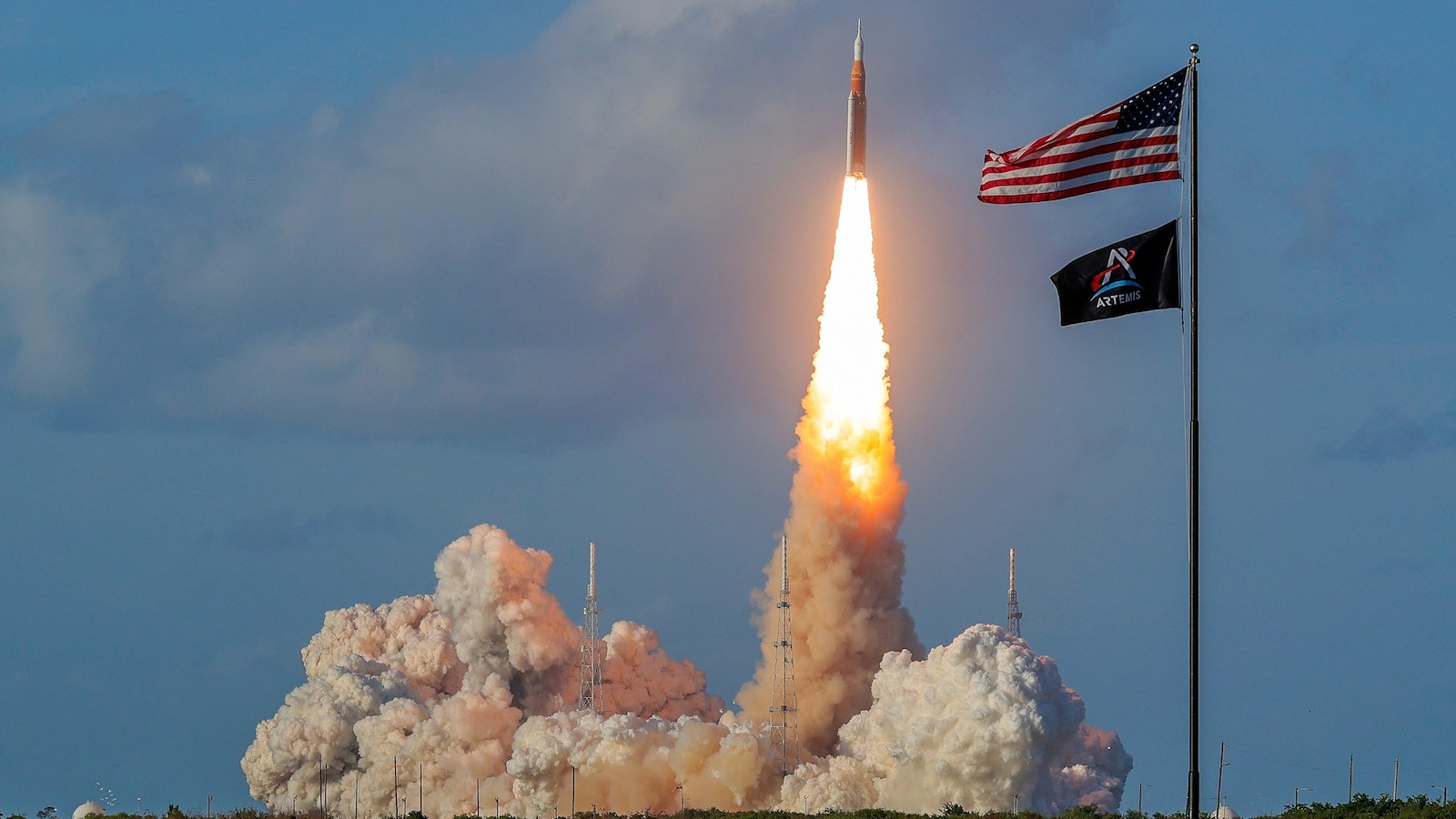
Artemis II completed a historic crewed lunar flyby — the first human mission to the Moon in nearly 54 years. The article attributes the long gap primarily to cost and shifting priorities: Apollo once consumed about 5% of the federal budget versus less than 0.5% today, and programs were repeatedly canceled or re-scoped (e.g., Constellation), though Constellation's Orion capsule lives on in Artemis. Sustained bipartisan presidential support across multiple administrations and incremental program milestones (Artemis I: 25-day uncrewed test in Nov 2022) enabled the recent return.
Sustained, bipartisan political backing for a lunar program creates a multi-year, low-volatility revenue stream for prime contractors and selected subsystem suppliers; treat this as durable procurement rather than a one-off prestige program. That reduces revenue uncertainty for contractors with existing backlog (lockstep award cadence over 3–7 years) and increases visibility for capex-heavy suppliers (propulsion, composites, rad‑hard electronics), which can reprice from project-to-project procurement to multi-year awarded schedules.
The near-term winners are firms supplying flight hardware and mission sustainment services (propulsion, avionics, thermal systems) and satellite/infrastructure integrators building lunar communications and mapping assets; second-order beneficiaries include specialized materials and test houses where barriers to entry are high (radiation testing, cryogenics). Conversely, firms relying on single-product launch economics or legacy, high-cost platforms face margin compression if commercial heavy-lift (Starship-like) capacity scales; incumbents with high fixed costs and program overruns are second-order losers.
Key catalysts and risks split on timeframes: within 3–12 months, watch NASA appropriations, prime contract awards and protest outcomes — these move share prices and options implied vol. Over 1–5 years, technical successes/failures and commercial heavy‑lift scale will determine whether government incumbents keep pricing power; tail risk is a technical failure or a political re‑prioritization after an election that could pause new awards.
The consensus underestimates the pace of commoditization from commercial heavy lift; while primes win near-term awards, a 30–50% contraction in launch-related margins over 3–5 years is plausible if repeatable commercial launch economics displace legacy systems. That argues for trading the incumbents’ near-term cashflow certainty against medium‑term competitive erosion from commercial entrants.
AI-powered research, real-time alerts, and portfolio analytics for institutional investors.
Request DemoOverall Sentiment
neutral
Sentiment Score
0.05
