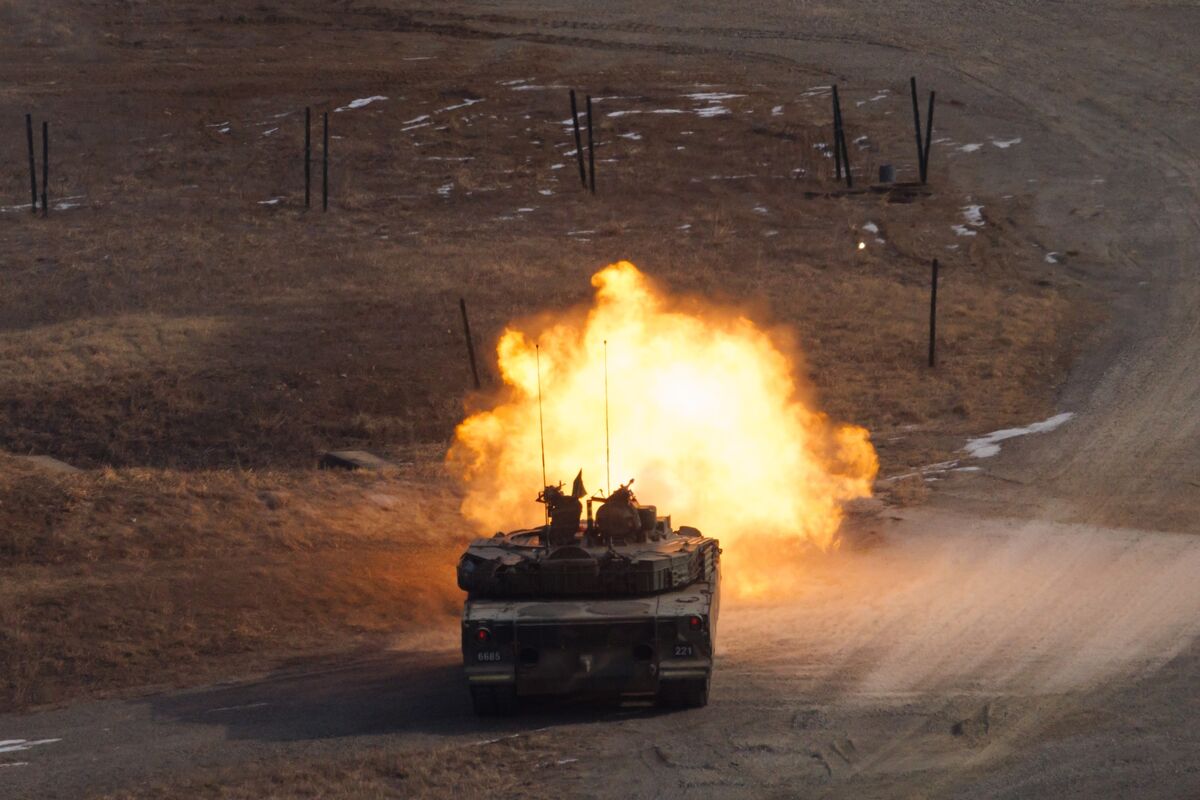
South Korean President Lee Jae Myung said Seoul is willing to review regular joint military drills with the US if doing so creates conditions for dialogue with North Korea, framing the move as an olive branch while seeking to reduce regional tensions. Delivered at a press conference marking the one-year anniversary of his predecessor's failed martial-law bid, the statement could modestly lower regional geopolitical risk premia and affect sentiment for defense-related assets, but contains no immediate policy changes or implementation timetable.
Market structure: A South Korean willingness to review joint US drills is a de-escalation signal that should favor Korean assets (large exporters and local financials) and pressure defense and tactical training demand. Expect a 1–3% narrowing in Korea risk premium (KRW appreciation, KOSPI +1–4%) if talks progress over 1–3 months; defense contractors could see a 2–6% headline-driven repricing on news flow. Competitive dynamics: lower near-term demand for exercise-related services (logistics, training contractors) but unchanged long-cycle weapons procurement — incumbents keep pricing power on large platforms while tactical-services firms are most exposed. Supply/demand: reduced near-term operational tempo eases logistical/consumables demand (fuel, temporary support), marginally easing short-term commodity traders’ positioning.
Risk assessment: Tail risks include a misinterpreted lull leading to a North Korean provocation that spikes safe-haven flows (JPY, USD, gold) and widens KRW spreads by >200bp; probability low-medium but impact high. Immediate (days) reaction likely muted; short-term (weeks–months) depends on US response and concrete drill changes; long-term (quarters+) hinges on whether Seoul secures sustained diplomatic outcomes that reduce alliance operational tempo. Hidden dependencies: US approval is required — US policy reversal would reverse market moves quickly. Catalysts: US-South Korea joint statements, scheduled drills, North Korean tests, and US congressional defense signaling.
Trade implications: Tactical plays: long Korea risk and KRW on signs of real dialogue (EWY, USD/KRW puts), short headline-exposed training/logistics names in defense ETFs if concrete drill cuts announced. Use options to express views: buy 3-month USD/KRW puts (2–3% strikes) and buy 3–6 month protective puts on ITA or LMT as a hedge against sudden escalation. Sector rotation: overweight Korean export cyclicals & financials, underweight tactical military-services & short-duration energy tied to exercise fuel demand. Time entries on confirmed bilateral communiques or drill postponement announcements; trim positions if KRW moves >3% or KOSPI >6% from entry.
Contrarian angles: Consensus sees this as pure de-escalation; miss is that symbolic drill reviews may be temporary bargaining chips — defense procurement could accelerate domestically to compensate, which would help Korean defense suppliers and blunt negatives for US primes. The market may over-penalize global defense names on headline risk; buying dips in high-quality defense primes (LMT, RTX) on >6% pullbacks could capture mean-reversion. Historical parallels (2018 détente cycles) show temporary asset repricing reversed when talks stalled, so size positions for reversibility and use tight 4–6% stops.
AI-powered research, real-time alerts, and portfolio analytics for institutional investors.
Request DemoOverall Sentiment
neutral
Sentiment Score
0.05
