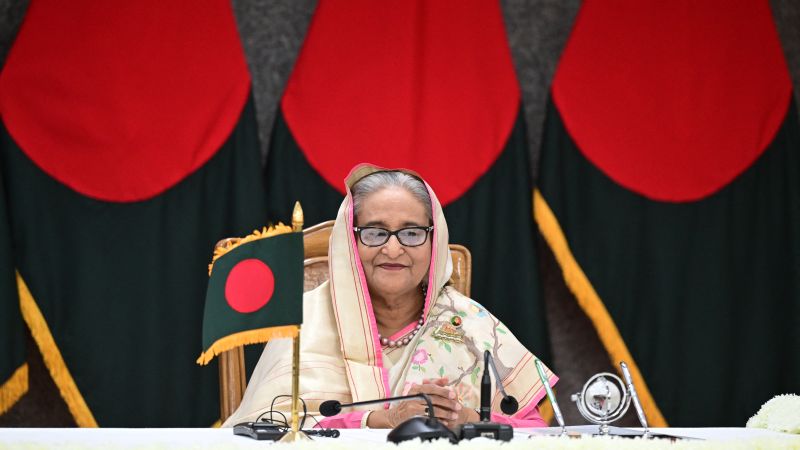
Former long-time Bangladeshi prime minister Sheikh Hasina, who fled to India last August after 15 years of increasingly authoritarian rule, has been tried in absentia by Bangladesh’s International Crimes Tribunal and sentenced to death for ordering the violent suppression of 2024 student protests that the UN says may have killed as many as 1,400 people; Dhaka has formally demanded her extradition. New Delhi, which sheltered Hasina and benefited from close security and economic ties under her government, has signaled a neutral stance and is likely to invoke legal and political‑offense exceptions to refuse return, complicating bilateral relations and creating a diplomatic standoff. The verdict and Hasina’s exile leave Bangladesh highly unstable ahead of February elections—with the Awami League banned and the political field open to rivals—heightening governance, security and policy uncertainty that investors and regional strategists should monitor closely.
Bangladesh’s former prime minister Sheikh Hasina, who fled to India last August after 15 years in power, has been tried in absentia by the International Crimes Tribunal and sentenced to death on charges that include inciting the murder of protesters and ordering lethal suppression using weapons, drones and helicopters; the UN human rights office estimated as many as 1,400 deaths in the 2024 crackdown. Dhaka has formally demanded her extradition, framing the sentence as accountability for crimes against humanity, and the courtroom reaction underscored deep domestic demand for retribution.
New Delhi has signaled a neutral stance and is positioned to invoke legal and political-offense exceptions in its extradition treaty, with Indian officials and commentators publicly doubting that it will return Hasina; the article notes she retains potential legal remedies in Bangladesh’s Supreme Court and could seek further international avenues. India’s prior security and economic cooperation with Hasina’s government, and its interest in border stability, are central to its likely reluctance to comply.
The verdict amplifies near-term political and security uncertainty ahead of Bangladesh’s February elections: the Awami League is banned, leadership is dispersed, and the interim government led by Muhammad Yunus faces a polarized field. Market sentiment is moderately negative with a material market-impact signal, implying elevated sovereign, policy and operational risks that could affect regional investor confidence and cross-border security dynamics.
AI-powered research, real-time alerts, and portfolio analytics for institutional investors.
Request DemoOverall Sentiment
moderately negative
Sentiment Score
-0.60
