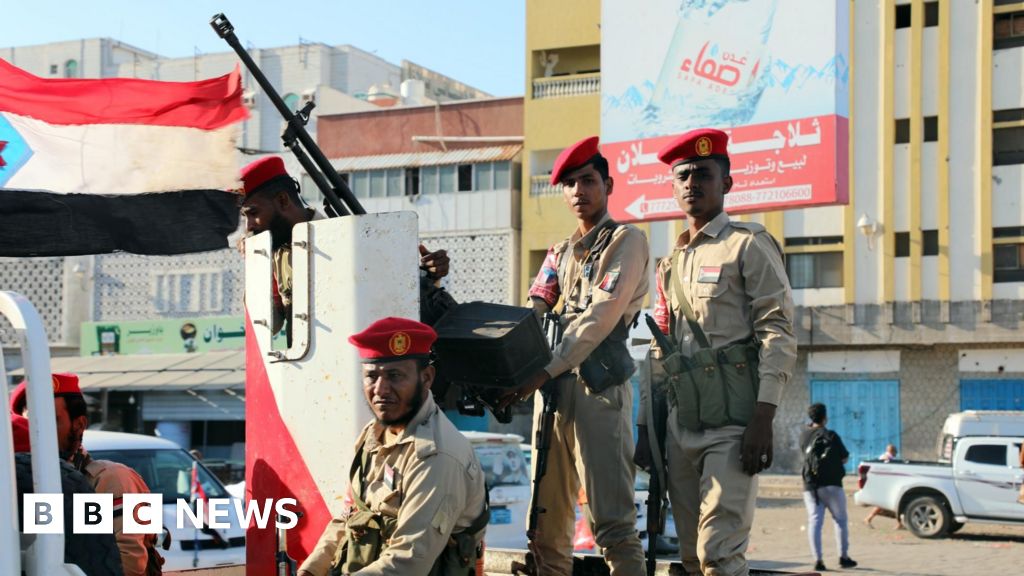
Saudi Arabia backed Yemen's presidential council demand that UAE forces withdraw within 24 hours after a Saudi-led coalition struck what it said were weapons shipments to UAE-backed Southern Transitional Council (STC) forces at Mukalla port. Presidental council head Rashad al-Alimi cancelled a joint defence pact with the UAE, declared a 90-day state of emergency and accused the STC of mutiny under UAE orders; the UAE denied the shipments contained weapons and condemned the allegations. The incident heightens Gulf-Yemen tensions and raises regional security risk around southern ports and military logistics, with potential second-order implications for investor sentiment in the region.
Market structure: The Saudi-UAE rupture raises localized geopolitical risk premium across energy, defense, and MENA assets. Expect immediate upward pressure on Brent/WTI (tactical +2–6% in days if Houthi attacks or port disruptions rise) and widening CDS/spreads for UAE-adjacent EM credit by 10–40bps if tensions persist beyond 30 days. Defense prime contractors (LMT, RTX) and energy service names (OIH components) pick up bargaining power from higher defence procurement and elevated offshore security spend; regional tourism and ports/operators lose pricing power.
Risk assessment: Tail risks include escalation to direct GCC military skirmish or Houthi closure of Bab al‑Mandeb causing 1–2% of global oil flow disruption — scenario moves Brent +$10–30 within weeks. Immediate (0–7 days) risk: volatility spikes and higher shipping insurance; short-term (1–3 months): oil and defence rerating; long-term (3–18 months): altered GCC security architecture increasing defense budgets by an incremental 5–15% vs. prior baseline. Hidden dependency: insurance and charter rates are a nonlinear amplifier — small attacks can sharply raise costs.
Trade implications: Tactical: go overweight energy (XLE) and defense (LMT/RTX) with defined option-backed exposure; short sectoral losers: travel/airline ETF (JETS) and MENA equities relative to global EM. Use 3–6 month call spreads to express volatility while limiting gamma risk; reduce EM sovereign bond (EMB) exposure by 2–4%.
Contrarian angles: Consensus prices this as contained; market underestimates asymmetric shipping-tail risk and procurement reallocation. If diplomatic de‑escalation occurs inside 30 days, oil and defence moves will be overdone — plan profit targets: trim energy at +10% and defence at +8–12% gains, or earlier if Brent spikes >$15.
AI-powered research, real-time alerts, and portfolio analytics for institutional investors.
Request DemoOverall Sentiment
moderately negative
Sentiment Score
-0.45
