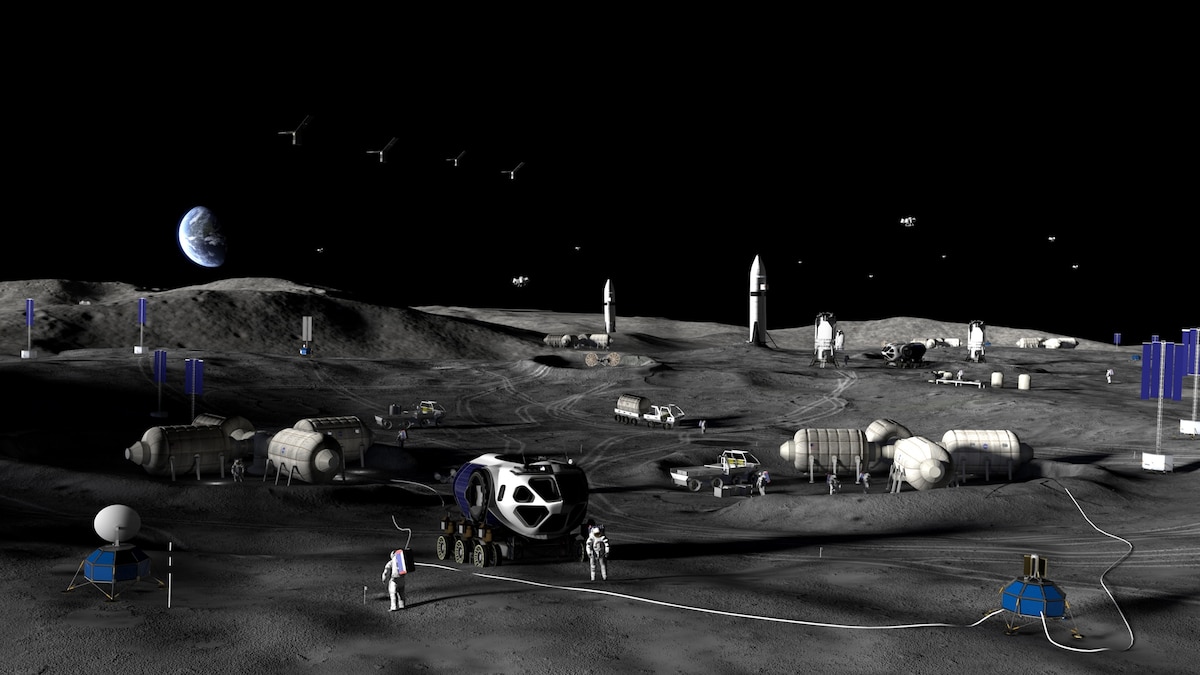
NASA is accelerating Artemis plans toward a lunar south pole base, with Artemis III slated for 2027, Artemis IV for early 2028, and Artemis V for late 2028. The article highlights nuclear power, lunar water, helium-3, rovers, satellites, and landing infrastructure as key enablers of a commercial cislunar economy and future Mars missions. The piece also underscores strategic competition with China and Russia, making the moon a geopolitical and industrial race with long-term policy implications.
The investable read-through is less about “moon exploration” and more about the emergence of a vertically integrated off-world infrastructure stack. If the cadence implied here even partially materializes, the first-order beneficiaries are not the mission prime contractors alone but the vendors that monetize every incremental launch, relay, rover, power, and autonomy layer. The second-order dynamic is that lunar logistics becomes a recurring-services market rather than a one-off capital program, which is the difference between a lumpy government contract and a durable ecosystem with higher multiple support.
The biggest underappreciated lever is power. A credible lunar buildout forces demand toward compact nuclear, thermal management, radiation-hard electronics, autonomy software, and robotics that can operate with minimal human intervention. That creates a potential “picks-and-shovels” halo for companies with dual-use government exposure, while pure lander names remain hostage to execution risk, program slippage, and binary contract outcomes. The market will likely overpay for any company tied to Artemis headlines but underprice the suppliers that benefit from a multi-year procurement wave even if the schedule slips 12-24 months.
The contrarian concern is that the bullish narrative depends on two fragile inputs: accessible water and political continuity. If extraction is harder than advertised, the economics of a permanent base degrade sharply and the entire supply chain shifts from scaling to survival mode, punishing the more levered commercial moon names first. Separately, a change in U.S. administration, budget priorities, or safety posture could push timelines right by years; that would compress near-term sentiment without eliminating long-dated strategic value. In other words, the best trades are on infrastructure enablement, not on a clean 2028 milestone.
AI-powered research, real-time alerts, and portfolio analytics for institutional investors.
Request DemoOverall Sentiment
mildly positive
Sentiment Score
0.35
Ticker Sentiment
