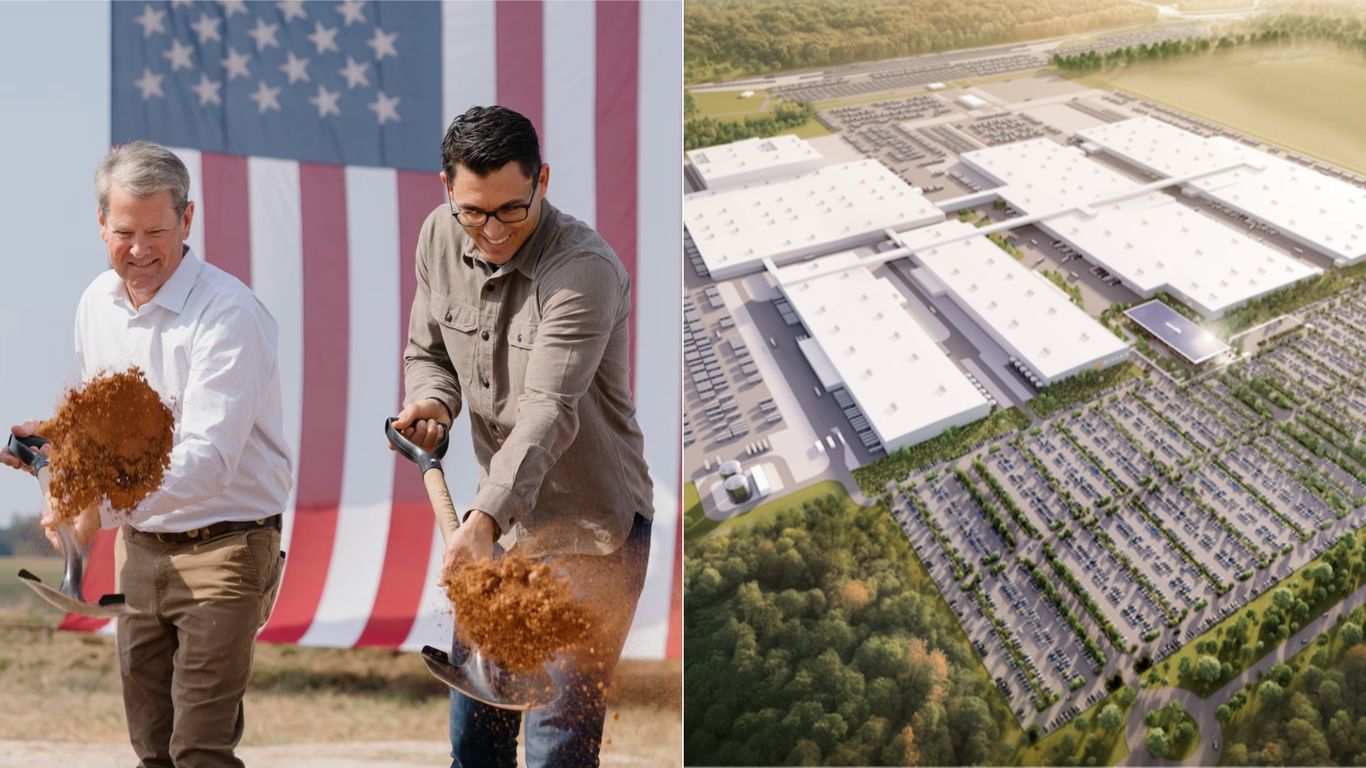
Rivian broke ground on its $5 billion electric vehicle assembly plant in Georgia, a facility projected to produce up to 400,000 R2 and R3 SUVs annually by 2028 and create 7,500 jobs. This substantial investment proceeds despite significant headwinds, including the impending expiration of a $7,500 federal tax credit, potential supply chain disruptions, and political opposition to EVs. CEO RJ Scaringe expressed strong confidence in the R2's market demand, asserting its appeal transcends government subsidies, signaling the company's long-term strategic commitment.
Rivian Automotive (RIVN) is proceeding with its substantial long-term growth strategy by breaking ground on a $5 billion assembly plant in Georgia, despite facing significant near-term headwinds. The facility, which is expected to begin production in 2028, is a major capital commitment aimed at producing up to 400,000 R2 and R3 models annually and creating 7,500 jobs by 2030. This forward-looking investment contrasts sharply with a challenging external environment, characterized by the imminent expiration of a $7,500 federal tax credit at the end of September, potential political hostility towards EVs, and supply chain vulnerabilities to tariffs. The company's CEO, RJ Scaringe, has expressed confidence that the product's intrinsic value will drive demand irrespective of subsidies, a crucial stance given the macro uncertainty. Furthermore, the company's up to $6.6 billion loan from the Department of Energy remains a point of political sensitivity, adding another layer of risk to the outlook. Rivian's concurrent expansion in Georgia with a retail storefront and an East Coast headquarters signals a deep, strategic commitment to its expansion plans, even as it navigates these considerable financial and political crosscurrents.
AI-powered research, real-time alerts, and portfolio analytics for institutional investors.
Overall Sentiment
mixed
Sentiment Score
0.15
Ticker Sentiment
