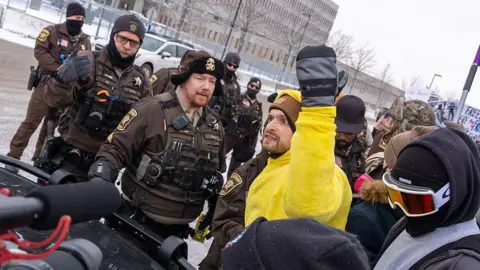
The US Justice Department has issued grand jury subpoenas to Minnesota officials including Governor Tim Walz, Attorney General Keith Ellison and Minneapolis Mayor Jacob Frey as part of an investigation into alleged obstruction of federal immigration enforcement amid intense protests. The escalatory backdrop includes the fatal shooting of Renee Good by an ICE agent, deployment of roughly 3,000 federal officers (with 1,500 troops reportedly on standby), DOJ threats of legal action over protest-related desecration claims, and state litigation seeking to block the ICE surge; the episode raises heightened legal and political risk for state and local governance and could increase regional policy uncertainty and reputational exposure for entities operating in Minnesota.
Market structure: Federal deployments and DOJ subpoenas shift demand toward federal contractors, private security/detention operators and technology providers that supply ICE/DHS (defense/security names gain pricing power for 3–12 months). Local governments, Minnesota munis and Minneapolis-centric consumer sectors are losers as legal costs, protests and potential tourism/retail weakness compress revenues and widen credit spreads by 20–100bp if unrest persists.
Risk assessment: Tail risks include invocation of the Insurrection Act or nationwide federalization of law enforcement (low probability, high impact) and legal rulings that could strip federal contracts (medium probability). Immediate window (days): headline-driven volatility and muni spread spikes; short-term (weeks–months): legal rulings and contract awards; long-term (quarters): potential reallocation of federal budgets and political backlash affecting contractors.
Trade implications: Expect modest flight-to-quality (US Treasuries rally, TLT could outperform) and muni outflows from Minnesota-specific paper; defense primes (LMT, NOC) are positioned to win near-term contracts while regional banks (USB) and local hospitality/retail suffer. Volatility catalysts (DOJ filings, court orders, arrest tallies) will create 1–3 trading opportunities per catalyst event.
Contrarian angle: Consensus treats this as purely local political noise; that underestimates tactical revenue upside for a small set of federal contractors over 6–12 months and convex options opportunities in detention/security names. Historical parallels (2017–19 enforcement spikes) show short, sharp revenue boosts followed by regulatory cycles — favor sized, hedged, event-driven positions, not outright large directional bets.
AI-powered research, real-time alerts, and portfolio analytics for institutional investors.
Request DemoOverall Sentiment
moderately negative
Sentiment Score
-0.35
