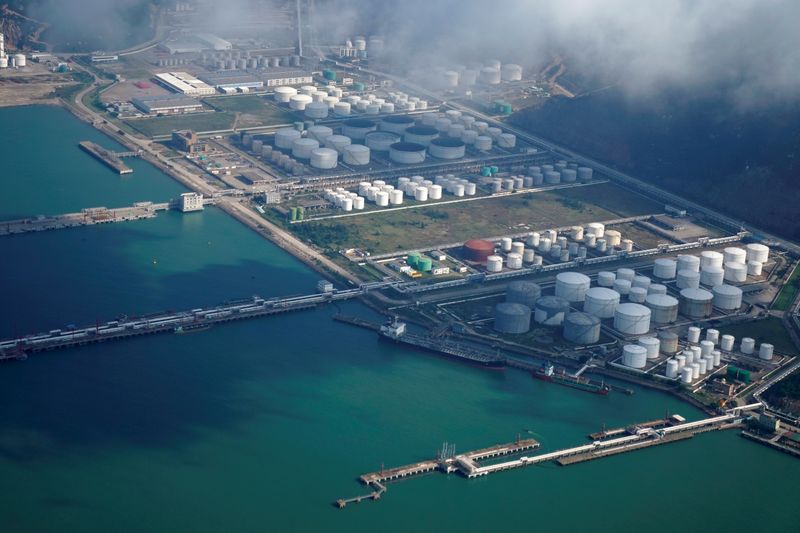
Oil prices jumped about 6% after Iran hit several ships in the Strait of Hormuz and set a UAE oil port ablaze, sharply escalating regional supply risk. Goldman Sachs said global oil stocks are nearing an eight-year low at 101 days of demand, with a possible decline to 98 days by end-May. Commercial refined products stocks have fallen to 45 days of demand from 50 days before the U.S.-Israeli war on Iran, signaling tighter buffers and higher volatility for energy markets.
This is less a directional oil call than a latency shock in the physical system: the market is repricing the probability that prompt barrels cannot move, even if headline supply is intact. The first-order winners are upstream producers with unhedged output and storage optionality; the bigger second-order winners may be midstream/shipping insurers and refiners outside the affected corridor if regional product scarcity widens crack spreads faster than crude rises. The more important read-through is to non-energy logistics and macro risk. A prolonged bottleneck in a critical choke point raises delivered input costs for airlines, petrochemical chains, and anything with just-in-time inventory, while also worsening inflation optics at a time when the market is already sensitive to central-bank reaction function. If the disruption lasts more than 1-2 weeks, expect a shift from “energy event” to “growth event,” with cyclicals and transports underperforming even if crude retraces on diplomacy. Goldman’s stock-depletion framing matters because low inventories amplify convexity: when buffer days fall, marginal supply interruptions move prices much more than usual. That means the trade is not about the average scenario but the tail—if shipping risk persists into month-end, the market may need to price a higher sustained risk premium rather than a one-day spike. Conversely, any credible naval escort, ceasefire signaling, or corridor reopening would likely trigger a sharp mean reversion because the move is being driven by scarcity psychology as much as physical shortages. The contrarian angle is that the market may be overpaying for immediacy while underpricing substitution and release valves. Strategic stock releases, rerouting, and deferred demand can blunt the impact if the disruption is real but localized; that makes near-dated volatility attractive, but outright long crude becomes riskier once headlines stabilize.
AI-powered research, real-time alerts, and portfolio analytics for institutional investors.
Overall Sentiment
strongly negative
Sentiment Score
-0.72
Ticker Sentiment
