Israel and Hamas have agreed to a US-brokered ceasefire framework, marking a significant de-escalation in the conflict, which includes the release of all hostages, Israeli troop withdrawal to a specified line, and the release of some Palestinian prisoners, with President Trump suggesting hostage releases could begin by Monday. While the Israeli government is set to ratify the agreement and international leaders welcome the development, key long-term issues such as Hamas disarmament, Gaza's future governance, and the specifics of prisoner exchanges remain unresolved, indicating potential for continued diplomatic efforts and regional volatility despite the immediate relief.
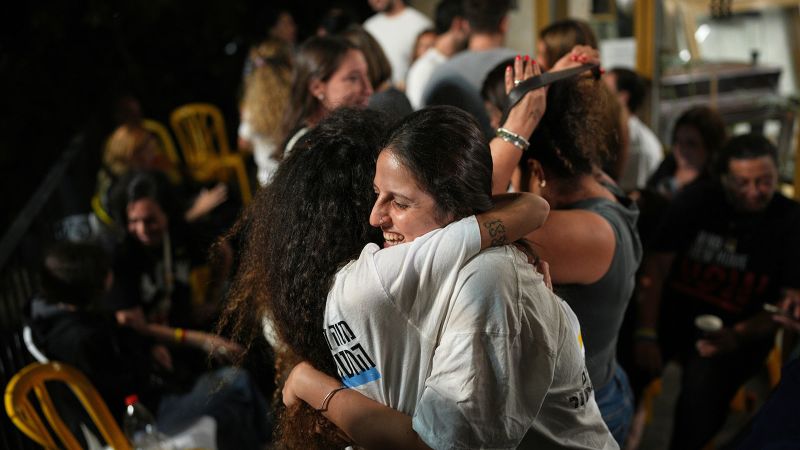
Where things stand • Israel and Hamas have agreed to the first phase of a US-brokered ceasefire framework that will allow for the swift release of all hostages held in Gaza, Israeli withdrawal to an agreed point and the release of some Palestinian prisoners. • President Donald Trump said the hostages are likely to be released on Monday. His announcement of the agreement did not address some sticking points in the proposal, including Hamas disarmament and the future governance of Gaza. • Israeli Prime Minister Benjamin Netanyahu said the agreement was a “diplomatic success and a national and moral victory” for his country. Hamas thanked Trump and all mediators involved: Qatar, Egypt, and Turkey. • The agreement was met with celebrations and joyous scenes in Gaza and Israel, though residents on both sides expressed trepidation that a deal may still fall through. Israeli security cabinet to meet Thursday afternoon, source tells CNN Israeli Prime Minister Benjamin Netanyahu is set to convene a security cabinet meeting at 5 p.m. local time on Thursday (10 a.m. ET), followed by a government vote, an Israeli official has told CNN. To “enable the return of the hostages,” Israeli forces will remain “positioned along the yellow line withdrawing from Gaza City and the Netzarim corridor, while still remaining in 53 percent of the Strip,” the source said. The yellow line is a reference to a proposed ceasefire map released by the White House late last month that showed multiple stages of withdrawal. On Thursday morning, an Israel Defense Forces spokesperson said the military had “begun operational preparations for the implementation of the agreement, including conducting preparations and a combat procedure for transitioning to adapted deployment lines in the near future.” Israel and Hamas have agreed to an initial Gaza ceasefire plan. What's next? Though Israel and Hamas agreed to the first phase of a US-brokered ceasefire plan, there’s more work to be done. Israeli Prime Minister Benjamin Netanyahu will convene his government today to ratify the agreement. Under law, after the cabinet votes in favor of the deal, there is a short window for petitions to be filed to challenge the releases; after that hurdle is cleared, the government can proceed with the hostage releases. Only after that can the hostage release proceed – which US President Donald Trump said could come by Monday. A senior White House official told CNN that it’s possible the timeline could change. “Once they vote yes, Israel has to withdraw to the line which should take under 24 hours,” the official said. “Then the 72 hour clock begins, and Hamas will try to go earlier if possible,” the official said — referring to the timeline outlined in the ceasefire plan. Trump also said he is likely to visit Israel and address its parliament in the coming days. But some details will have to be hammered out. It’s unclear which Palestinian prisoners will be released, though a Hamas official said Hamas and Israel have already exchanged lists of names. And Israeli sources have said Hamas may not be able to locate some hostage bodies. Beyond the next few days, a longer-term peace process will hopefully unfold – tackling the tricky questions of Hamas’ disarmament and Gaza’s governance. Trump had previously released a plan in which a Palestinian committee overseen by an international body would run Gaza until a reformed Palestinian Authority is ready to take over. That international body would be led by Trump himself, along with other heads of state. But the president made no mention of how Gaza would be governed when announcing the agreement. “Immense sense of joy” in Gaza after years of devastation, UNICEF says There is “an immense sense of joy, of relief here in Gaza,” UNICEF’s global spokesperson said, speaking from the enclave as people woke to news of the ceasefire agreement. In a video posted on Instagram, James Elder from the UN children’s agency described it as a “day of hope” – but pointed to the devastation wrought by two years of relentless war. A journalist had asked whether he ever thought it would get to this point of a ceasefire, he said. “No one ever thought it would get to this point – the devastation of homes, of agriculture, of education,” he added, pointing out that Palestinians in Gaza have been stripped of their ability to feed and protect their families. “People ask, do Palestinians have hope? Yes, they have hope! They have hope because it’s the one thing they have agency over,” he said. World leaders welcome Gaza ceasefire agreement Leaders from around the world are welcoming the ceasefire agreement between Israel and Hamas. Here’s what some have said: - Britain: “This is a moment of profound relief that will be felt all around the world, but particularly for the hostages, their families, and for the civilian population of Gaza, who have all endured unimaginable suffering over the last two years,” Prime Minister Keir Starmer said, as reported by Britain’s Press Association. - Canada: “Congratulations to (US) President (Donald) Trump for his essential leadership and thank you to Qatar, Egypt and Türkiye for their tireless work to support the negotiations,” Prime Minister Mark Carney said. “I am relieved that the hostages will soon be reunited with their families.” - India: Prime Minister Narendra Modi said he hopes the release of the hostages and increased humanitarian assistance to the people of Gaza would bring respite to them and pave the way for lasting peace. - Pakistan: “The announcement of an agreement that will bring an end to the genocide in Gaza is a historic opportunity to secure lasting peace in the Middle East,” Prime Minister Shehbaz Sharif said. - Australia: “After more than two years of conflict, hostages held and a devastating loss of civilian life, this is a much needed step towards peace” Prime Minister Anthony Albanese and Foreign Minister Penny Wong said in a joint statement. “We urge all parties to respect the terms of the plan.” - New Zealand: “President Trump’s announcement … is a watershed moment in a conflict that has killed too many,” Prime Minister Christopher Luxon said. “New Zealand welcomes the news and hopes this provides a platform for a lasting solution where future generations of Israelis and Palestinians live in peace and security.” - Argentina: President Javier Milei congratulated his US counterpart, calling the agreement historic and an “extraordinary contribution to international peace,” on X. Here's how Palestinians in Gaza are reacting to the ceasefire plan agreement Small crowds gathered and celebrated on the streets of Khan Younis in southern Gaza in the early hours of Thursday morning, singing and dancing in the dark after receiving news of the ceasefire plan agreement. Children can be seen clapping along, and music blares from a speaker in video obtained by news agency Reuters. The news spread slowly, with many only finding out as they woke up — thanks to the late hour and lack of internet connectivity. Still, by sunrise, there was a widespread sense of joy and relief, a UNICEF spokesperson in Gaza said. Another resident, Abdul Majeed Abd Rabbo, said “all of the Gaza Strip is happy” about the announcement. “All the Arab people, all of the world is happy with the ceasefire and the end of bloodshed,” he said, according to Reuters. Remember: More than 67,000 people – most of them women and children – have been killed in Gaza since the war began, the Palestinian health ministry said on Wednesday, with an additional 169,841 people injured. The true death toll is believed to be much higher, according to the ministry, the United Nations and multiple humanitarian organizations. In September, an independent UN inquiry declared for the first time that Israel had committed genocide against Palestinians in Gaza, a finding that echoes those of other genocide experts and human rights groups – but which the Israeli government has firmly rejected. Hamas and Israel have agreed to a ceasefire plan, but that's just the first step. Here's what to know Hamas and Israel have agreed to the first step of a ceasefire plan, proposed by US President Donald Trump, in a major breakthrough that many are celebrating with cautious optimism. The coming days will bring a flurry of diplomacy, with Trump himself planning a trip to Israel. But there are many thorny details that haven’t been addressed, which may require more rounds of negotiation. And there is still life-threatening action on the ground. The Israeli military said it had instructed its soldiers to “be ready for any scenario” and warned Palestinians not to return north or approach areas where forces are stationed. Here are the latest developments: - What has been agreed: The first phase of the ceasefire plan will include the release of all hostages, the withdrawal of Israeli troops from Gaza to an agreed-upon line, and the release of some Palestinian prisoners and detainees. Trump also announced that a “council of peace” was being created to maintain a lasting end to conflict in the region. - Hostage and prisoner release: The Israeli hostages will likely be released on Monday, Trump said. Hamas and Israel have already exchanged a list of hostages and prisoners to be released, one Hamas official said. But two prominent Palestinian prisoners – Marwan Barghouti and Ahmed Saadat, both serving life sentences for attacks that killed Israelis – are not expected to be released, according to a source. - What is still unknown: In announcing the agreement, none of the major parties addressed key sticking points, including the disarmament of Hamas and the future governance of Gaza. Three Israeli sources told CNN that Hamas may not know the location of, or be unable to retrieve, the remains of some of the 28 remaining deceased hostages. - What comes next? Israeli Prime Minister Benjamin Netanyahu will convene his government today to ratify the agreement. Under law, after the cabinet votes in favor of the deal, there is a short window for petitions to be filed to challenge the releases; after that hurdle is cleared, the government can proceed with the hostage releases. - Trump will head to Middle East: The president said he is likely going to visit Israel in the coming days, referencing the fact that Netanyahu had invited him to give a speech at the Knesset, Israel’s parliament. - Gaza reconstruction: Trump also said countries in the Middle East will help reconstruct Gaza, but did not offer further details. UN chief António Guterres said the agency “will scale up the delivery of sustained and principled humanitarian relief, and we will advance recovery and reconstruction efforts in Gaza.” - Celebrations on both sides: Joy filled the streets of both Israel and Gaza in the early hours of Thursday morning after the announcement, with relief and cautious optimism for what could finally be an end to two years of bloodshed. Released Israeli hostages and the families of remaining hostages rejoiced, while some Palestinian residents in Gaza took to the streets to sing and dance – though, without internet and in the middle of the night, many in the enclave are just getting news of the agreement. Hostage families and former hostages are celebrating the ceasefire agreement The families of Israeli hostages held in Gaza and former hostages have been celebrating the news of the ceasefire agreement reached between Hamas and Israel. Some in Washington, DC spoke with US President Donald Trump on the phone to thank him. In a video released by hostage families, a group can be seen saying “Thank you” as they gathered around the phone, held by Secretary of Commerce Howard Lutnick. “You did it!” Trump can be heard replying: In Tel Aviv’s Hostages Square, about 200 people gathered to celebrate the agreement last night. Former hostages joined the crowds, including Omer Shem Tov, Omer Wenkert, Eliya Cohen and Romi Gonen. Others posted on social media. “I can’t believe it,” said released hostage Ohad Ben Ami in a video on Instagram. Addressing several of the remaining hostages in Gaza by their first names, he said, “I’m waiting for you, can’t wait to hug you already. I’m dying to (hug you). Oh, what a day. Thank you, Trump.” Omer Shem Tov and Eliya Cohen, two other former hostages, posted a photo on Instagram of them kissing a Trump figurine. Liran Berman, whose twin brothers Gali and Ziv are still being held in Gaza after being abducted from Kfar Aza kibbutz in southern Israel, posted on X: The twins were last seen alive by witnesses in February, when the last hostage release was held during a fragile ceasefire that later fell apart. Speaking to CNN in June, Berman said he believed Gali and Ziv had been separated in the tunnels where they were being kept. Ruby Chen, father of Itay Chen, an Israeli soldier whose body is held by Hamas, thanked Trump and other US team members. “We are still nervous if and when Itay and the other hostages on the deceased list will be found and brought back to us,” he said. Itay Chen is a dual US citizen. Einav Zangauker, the mother of hostage Matan Zangauker, said: “These are the tears I prayed for,” she said. Israel and Hamas have reached an initial US-brokered ceasefire agreement, marking a significant de-escalation with provisions for the release of all Israeli hostages, Israeli troop withdrawal to a specified line, and the release of some Palestinian prisoners. President Trump projected hostage releases could begin as early as Monday, while Israeli Prime Minister Netanyahu lauded the accord as a "diplomatic success." The Israel Defense Forces have already commenced operational preparations for implementing the agreement, including adapting their deployment lines. Despite immediate celebrations across both territories, the agreement sidesteps critical long-term issues such as Hamas's disarmament and the future governance of Gaza, leaving substantial political complexities unresolved. Furthermore, details regarding specific Palestinian prisoner releases and the potential inability to locate the remains of all deceased hostages present immediate challenges. The overall market sentiment reflects a cautious tone, indicating that while a direct conflict pause is positive, the underlying geopolitical risks remain considerable. Global leaders have largely welcomed the ceasefire as a vital step towards stability following a conflict responsible for over 67,000 casualties. However, the deal's fragility is underscored by the short window for legal challenges to prisoner releases in Israel and the Israeli military's continued warnings against civilian return to northern Gaza. This suggests that while near-term humanitarian relief is expected, the path to enduring regional peace and security is fraught with operational and political hurdles.
AI-powered research, real-time alerts, and portfolio analytics for institutional investors.
Request DemoOverall Sentiment
mixed
Sentiment Score
0.15
Ticker Sentiment
