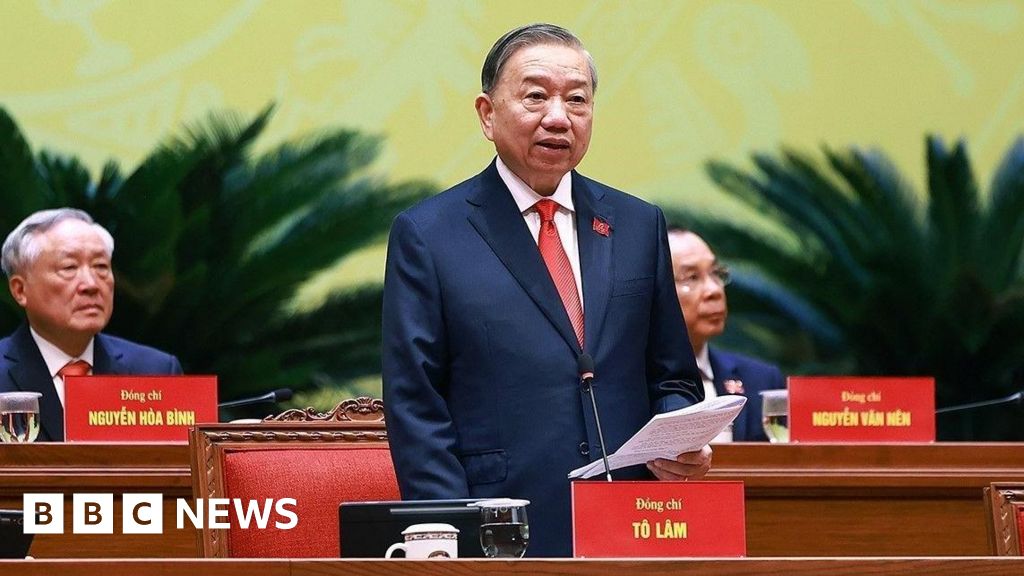
Vietnam reappointed Communist Party General Secretary To Lam for a five-year term as he pushes an ambitious economic program that includes halving provinces from 63 to 34, cutting at least 100,000 civil servants and pursuing double-digit growth, doubling private firms by 2030 and transitioning to an upper-income, tech-based economy by 2045. Policy shifts (Resolution 68) elevate the private sector as the “most important driving force,” but a subsequent Resolution 79 reasserted SOEs’ role, underscoring political push-and-pull; 671 state-owned enterprises still account for ~29% of GDP. The plan backs national “leading cranes” such as Vingroup/Vinfast (Vinfast reportedly lost up to $11bn since 2021) and growing tech player FPT (>$1bn revenue, 80,000 employees) while raising risks of politically‑connected rent-seeking, limited global competitiveness, and exposure to US trade/tariff uncertainty. Investors should weigh potential state-backed support for a few large private champions against structural constraints for SMEs, heavy SOE presence, and external demand/chain vulnerabilities.
Market structure: To Lam’s twin thrusts—explicit backing of "leading cranes" and simultaneous protection for SOEs—will concentrate market share in a small number (20–50) of large conglomerates (VIC, VFS) and a few tech exporters (FPT). Expect domestic pricing power to rise in property, infrastructure and politically-favoured EV/transport niches while mid‑market SMEs face compression; wage inflation and talent shortages will push unit labour cost up 5–10% over 2–3 years, pressuring low-margin assembly. Cross-asset: credible reform rhetoric should tighten sovereign spreads by 30–70bp and lift VN equity multiples near term, but increased geopolitical/trade risk (US tariffs) creates VND downside volatility and commodity/import-cost pressure.
Risk assessment: Tail risks include a policy reversal or factional backlash that re‑privileges SOEs (high impact, <20% probability) or a US tariff shock cutting Vietnam exports by 5–15% (10–30% probability under aggressive trade policy). Immediate (days) reaction will be politico-risk driven; short-term (weeks–months) will price earnings revisions for exporters; long-term (3–10 years) outcome depends on execution of value‑chain upgrading. Hidden dependency: private champions currently rely on foreign components/clients (Samsung chain); without domestic upstream innovation, revenue gains will be margin‑light. Catalysts: next 90 days of implementing decrees, major FDI announcements, US tariff rulings and Vinfast quarterly cash burn reports.
Trade implications: Tactical longs: high-conviction exposure to FPT (FPT:HOSE) and Vietnam export‑oriented small caps/IT services via Vietnam ETF (VNM) on any 5–12% pullback; target 12–36 month total return +30%. Defensive shorts/hedges: VinFast (VFS:NASDAQ) equity — buy 9–12m ATM put protection or short 1–2% notional given >$10bn historic losses and weak global product reception. Pair idea: long FPT (2–3% NAV) / short Vingroup (VIC:HOSE, 1–2% NAV) to capture potential rerating of genuine exporters vs leveraged conglomerates. Options: use 9–12 month protection (puts) on VFS and 12m covered call overlays on long VNM if VN index rallies >12%.
Contrarian angles: Consensus underestimates that political backing can create short-term winners but long-term value destruction if crony capitalism crowds out SMEs — expect dispersion to widen 400–800bp between state‑backed conglomerates and agile exporters. The market may be underpricing FPT’s services moat: one or two $100–300m global contracts in 12–24 months could re-rate FPT by 30–50%. Conversely, VinFast’s narrative is likely overdone: if cumulative cash burn exceeds $12bn or US/Europe sales miss targets, equity could de-rate 40–70%. Historical parallel: 1970s–90s chaebol growth in Korea produced winners but also systemic risk; Vietnam’s weaker institutions raise probability of crony outcomes.
AI-powered research, real-time alerts, and portfolio analytics for institutional investors.
Request DemoOverall Sentiment
moderately negative
Sentiment Score
-0.30
