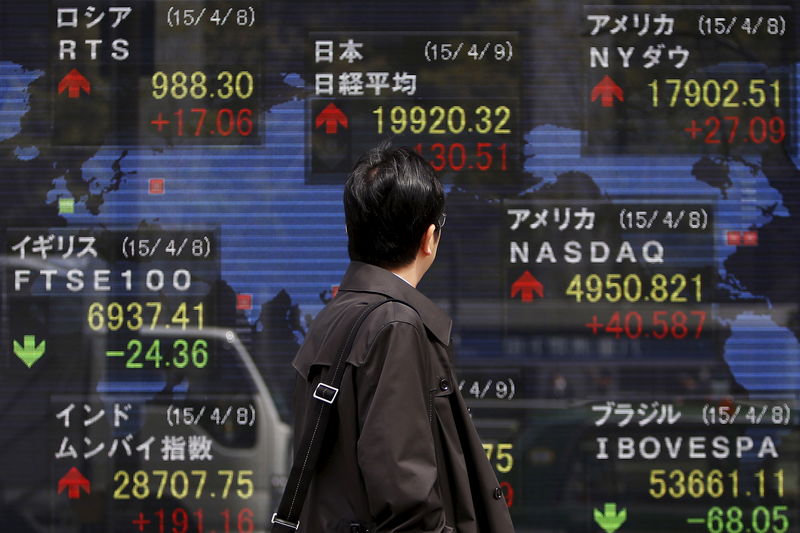
Asian markets mostly fell on Monday, with Japan's Nikkei 225 down 1%, Hong Kong's Hang Seng down 1.7%, and Australia's S&P/ASX 200 down 1.6% as oil prices rose and Middle East tensions escalated. Investors are waiting for Nvidia's earnings on Wednesday, while U.S. futures also slipped and Wall Street ended lower Friday on inflation worries tied to surging oil. China data disappointed, with April industrial output up 4.1% year-on-year versus 6.0% expected and retail sales up just 0.2% versus 2.0% forecast.
The market is treating this as a classic cross-asset de-risking event, but the more important signal is that the AI trade is becoming crowded enough that any exogenous macro shock now forces indiscriminate profit-taking in semis. That makes NVDA less about a single print and more about whether guidance can de-anchor the tape from a macro-driven multiple reset; if not, the whole AI basket can underperform even on decent numbers because positioning is already extended. The first-order loser is hardware-heavy AI exposure, but the second-order loser is every supplier priced for a synchronized capex upswing over the next 2-3 quarters.
Energy is the near-term hedge, but the bigger issue is whether higher crude starts feeding into rates expectations fast enough to keep financial conditions tight. That matters because the market has been leaning on a softer-Fed narrative; a durable oil shock would push breakevens up and delay any easing in real yields, which is a headwind for long-duration tech and growth factor exposures. On the other side, any de-escalation or reopening of shipping lanes would likely unwind a meaningful portion of the risk premium within days, so this is a very event-driven trade rather than a clean months-long thesis.
The China data adds a third leg to the risk-off move: weak domestic demand reduces the buffer for global industrials and commodity cyclicals, meaning upside from any energy spike is less likely to be offset by a reflationary China impulse. That is negative for Asia exporters and for semicap equipment names with high China sensitivity, even if the immediate catalyst is geopolitics. The contrarian point is that some of the AI pullback may be mechanically overdone if investors are using macro fear as a proxy for fundamentals; a clean NVDA guide could trigger violent short covering because the stock is still the market’s preferred growth liquidity valve.
AI-powered research, real-time alerts, and portfolio analytics for institutional investors.
Request DemoOverall Sentiment
mildly negative
Sentiment Score
-0.35
Ticker Sentiment
