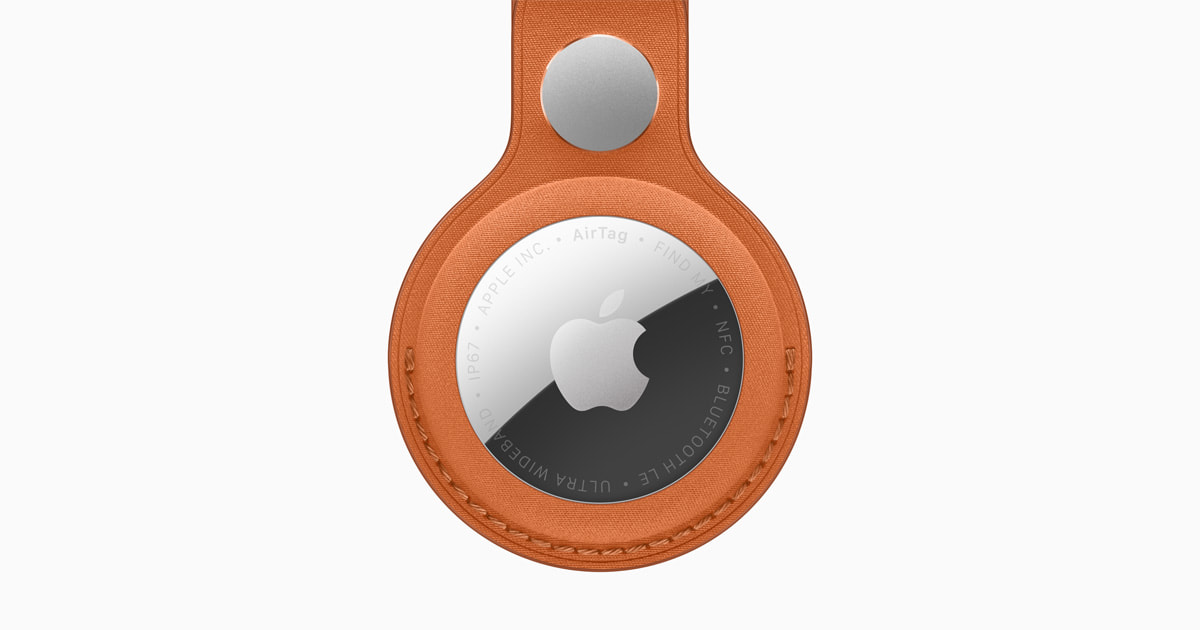
Apple launched a second-generation AirTag featuring its new Ultra Wideband chip (same as iPhone 17 line and recent Apple Watches) that extends Precision Finding range by up to 50%, an upgraded Bluetooth range, and a redesigned internals making the speaker ~50% louder (audible up to 2x farther). The product is priced unchanged at $29 for a single unit and $99 for a four-pack, requires iOS 26/iPadOS 26 and supports Precision Finding on Apple Watch Series 9/Ultra 2 with watchOS 26.2.1; it also adds Share Item Location partnerships with 50+ airlines (SITA-reported baggage delays down 26% and unrecoverable luggage down 90%). This is an incremental hardware refresh with environmental credentials (85% recycled plastic enclosure, 100% recycled rare earths and gold plating) that likely has limited near-term revenue impact but strengthens the Find My ecosystem and services integrations.
Market structure: Apple (AAPL) is the primary beneficiary — new AirTag strengthens hardware attach rates, Find My network value and wrist-based use cases (watchOS 26.2.1), supporting modest pricing power for accessories while keeping unit price unchanged at $29/$99. Direct losers are third-party tracker makers (Tile/Life360) and lower-end Bluetooth-only players; Samsung’s differentiation narrows if UWB becomes table stakes. Supply/demand will favor suppliers of UWB/Bluetooth components and recycled-material processors in the near term, but incremental revenue is small versus iPhone/Services (expect <1–2% EPS uplift over 12 months absent broader adoption). Cross-asset: small positive for AAPL equity and credit; negligible commodity impact, muted FX moves, and marginally lower equity volatility in short term as product-cycle uncertainty eases.
Risk assessment: Tail risks include regulatory intervention on tracking/privacy (EU/UK data rules) or a high-profile misuse lawsuit triggering recalls — both could shave multiple percentage points off accessory sales and add legal costs. Near-term (days–weeks) impacts are reputational; short-term (1–6 months) risks are supply constraints for UWB chips; long-term (1–3 years) is ecosystem lock-in or forced interoperability mandates. Hidden dependencies: adoption requires iOS 26/watchOS 26.2.1 and partner onboarding (50+ airlines); slow OS upgrade cycles or limited airline rollouts would blunt benefits. Catalysts: iPhone 17/Watch sales, airline integration progress, and any privacy rule proposals in next 60–180 days.
Trade implications: Tactical overweight AAPL (size 1.5–3% incremental) to capture ecosystem momentum over 3–12 months; consider a funded options sleeve to control downside. Pair trade: long AAPL vs short Life360 (LIFE) small-size 0.5–1% — Tile’s value proposition erodes as Apple tightens UWB/Find My exclusivity. Options: buy a 3-month AAPL bull-call spread (buy 2% OTM, sell 6% OTM) sized to risk 0.5–1% of portfolio to play continued feature adoption without paying full premium. Rotate modestly into Consumer Electronics and Services exposure, trim non-UWB-dependent tracker names.
Contrarian angles: The market may overstate AirTag’s revenue impact—unit economics and price parity mean headline product launches often move sentiment > fundamentals; expect actual EPS impact <2% in 12 months. Conversely, underappreciated is the long-term value of a denser Find My network: a 10–20% increase in network utility could raise iPhone switching costs materially over 2–4 years. Historical parallel: Apple Watch’s early accessory ecosystem moved valuations disproportionately before earnings caught up; if regulators force interoperability, that upside compresses. Unintended consequence: greater AirTag deployment could accelerate standards push (regulatory or industry) toward cross-platform UWB, reducing Apple’s moat over multiple years.
AI-powered research, real-time alerts, and portfolio analytics for institutional investors.
Request DemoOverall Sentiment
mildly positive
Sentiment Score
0.35
Ticker Sentiment
