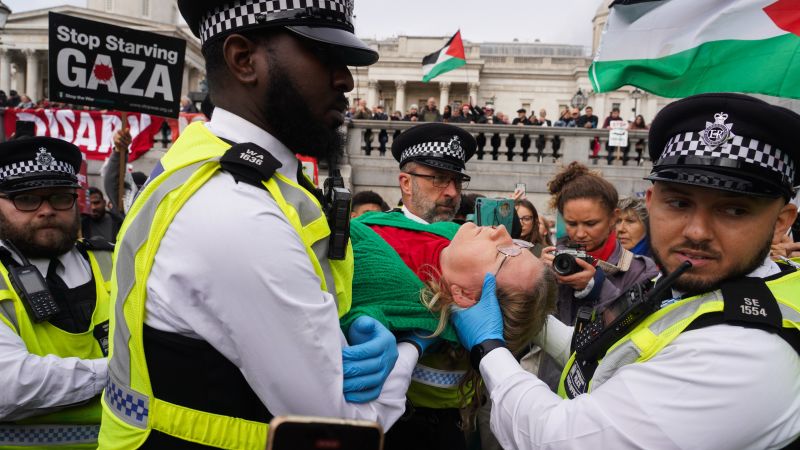
The UK Home Office announced enhanced police powers to regulate 'repeated protests,' allowing senior officers to ban or relocate demonstrations based on their 'cumulative impact,' following the arrest of nearly 500 pro-Palestinian activists supporting the proscribed group Palestine Action in London. This policy shift, intended to address public safety and community concerns, particularly within the Jewish community, is poised to be implemented via an addition to the Public Order Act. However, the move faces significant criticism from civil liberties advocates who warn of a substantial erosion of protest rights and potential for increased social unrest.
British police are set to be granted greater powers to clamp down on repeated protests, the UK Home Office announced Sunday, after hundreds of pro-Palestinian activists were arrested in central London for supporting the banned activist group Palestine Action. Nearly 500 people were arrested Saturday in Trafalgar Square in central London for demonstrating in support of the group, according to London’s Metropolitan Police. The Home Office announcement comes after police and lawmakers asked organizers to call off Saturday’s “Lift the Ban” protest, which came just days after the Manchester synagogue attack where two people were killed on Yom Kippur, Judaism’s holiest day. Protest organizers Defend Our Juries rejected those calls, saying “canceling peaceful protests lets terror win.” Jewish activists were among the 493 people arrested Saturday, including Elizabeth Morley, a 79-year-old daughter of a Holocaust survivor who was arrested for the third time, and a 79-year-old Jewish man with a terminal illness, organizers said. Like most of the other demonstrators arrested, the Jewish activists carried signs that read: “I oppose genocide, I support Palestine Action.” The 83-year-old Reverend Sue Parfitt, an Anglican priest, was also among those arrested for a third time Saturday. Video from the protest showed the elderly and people with disabilities among those arrested, including a blind man using a mobility cane and two people in wheelchairs. Citing Saturday’s mass arrests in its announcement, the Home Office said the expanded police powers – which will be brought in “as soon as possible” – would allow extra conditions to be put on what they called “repeat protests.” The powers will give senior police officers the authority to ban or relocate protests based on their “cumulative impact.” Since Palestine Action was designated a terror organization in July, more than 2,000 people have been arrested at similar demonstrations across the United Kingdom. The group, which aims to disrupt the operations of weapons manufacturers supplying the Israeli government, was proscribed after two of its activists broke into Britain’s largest air base and damaged two military aircraft. Defend Our Juries estimated Saturday that more than 1,000 people had gathered to oppose the ban on the group, in line with previous “Lift the Ban” demonstrations. At a September protest in London’s Parliament Square, more than 890 activists were arrested. At a demonstration in August, 532 people were arrested, with nearly half aged 60 or older, according to police figures. And almost 100 of the people arrested were in their 70s, while 15 were in their 80s, police said. Pro-Palestinian demonstrations led by various other groups have taken place frequently in London since Hamas’ attack on Israel on October 7, 2023, and Israel’s subsequent war in Gaza. The greater powers for police will be introduced via an addition to an existing policing law, the Public Order Act, which will need to be debated and approved in parliament before becoming law. The Home Office said the new rules, if brought in, would give police the authority to “instruct organisers to hold the event somewhere else” if “a protest has taken place at the same site for weeks on end, and caused repeated disorder.” “Anyone who breaches the conditions will risk arrest and prosecution,” it said. The government’s proposal has been met with fierce criticism from civil liberties advocates and a handful of opposition lawmakers, many of whom have already slammed the terror designation of Palestine Action as an assault on freedom of speech and warned that applying terrorism laws to such a group sets a dangerous precedent for protest rights. ‘A ludicrous proposal’ Amnesty International UK’s Law and Human Rights Director Tom Southerden slammed the announcement Sunday, calling it “ludicrous” and the latest step the government has taken to restrict peaceful protest. “Is the government seriously suggesting that people protesting its decisions should only be able to do that a limited number of times? If it is, it is a ludicrous proposal and, if not, this announcement is just a cynical attempt at looking tough,” he said, adding: “This government will always find yet another way to restrict this basic human right.” The Metropolitan Police said Friday that arresting protesters “supporting a terrorist organization” as required would use resources that could otherwise be directed to protecting Jewish people from violence. Protest organizers agreed, urging the police to “choose to prioritize protecting the community, rather than arresting those peacefully holding signs in opposition to the absurd and draconian ban of a domestic direct-action group.” British Home Secretary Shabana Mahmood said in a statement Sunday that repeated protests “can leave sections of our country, particularly religious communities, feeling unsafe, intimidated and scared to leave their homes.” “This has been particularly evident in relation to the considerable fear within the Jewish community, which has been expressed to me on many occasions in these recent difficult days,” she added. In a statement, British human rights organization Liberty said police already have “huge powers to restrict protests” and that “handing them more would undermine our rights further while failing to keep people safe from violence like the horrific and heartbreaking anti-Semitic attack in Manchester.” “In times of fear people understandably want action – but restricting protest could fuel tensions by removing legal and safe ways for people to be heard. Being able to use protest to challenge governments and stand up for what we believe in is central to our democracy. It must be upheld,” Liberty said. Defend Our Juries called the government’s Sunday move an “extraordinary new affront to our democracy” and said that in response they are planning days of “mass civil disobedience” in the lead-up to the court hearing in November challenging the ban on Palestine Action. CNN’s Max Saltman contributed to this report. The UK government's proposal to grant police enhanced powers to restrict 'repeated protests' signifies a notable escalation in the state's response to public dissent, directly spurred by ongoing pro-Palestinian activism. The move, framed by the Home Office as a measure to protect communities feeling intimidated, follows the arrest of nearly 500 demonstrators supporting the banned group Palestine Action and over 2,000 similar arrests since July. While the proposed addition to the Public Order Act aims to mitigate disorder by allowing police to ban or relocate events based on 'cumulative impact,' it introduces significant political and social risk. The policy is met with fierce opposition from civil liberties organizations like Amnesty International and Liberty, who decry it as an erosion of democratic rights and warn it could paradoxically fuel tensions. For investors, this development is not a direct market-moving event for specific equities but serves as a key indicator of rising domestic instability and a more interventionist regulatory environment in the UK. The government's hardline stance, contrasted with protest groups' plans for 'mass civil disobedience,' points to a potentially volatile social landscape, particularly in London, with the Metropolitan Police already citing a significant resource drain from managing these events.
AI-powered research, real-time alerts, and portfolio analytics for institutional investors.
Request DemoOverall Sentiment
neutral
Sentiment Score
0.00
