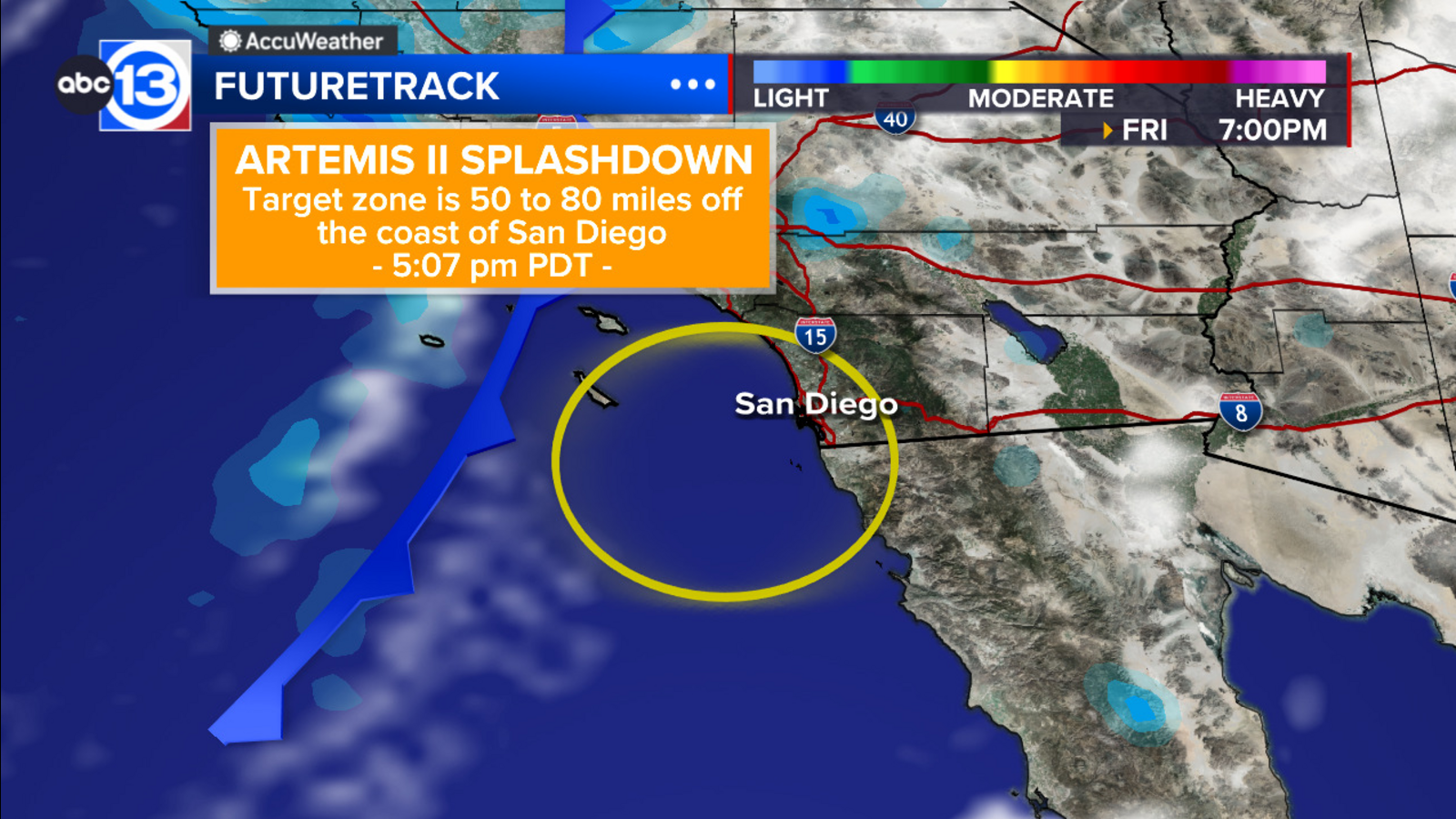
Splashdown of Artemis II's Orion capsule is scheduled for 5:07 p.m. PDT on April 10, targeting a site about 50-80 miles offshore of San Diego; recovery criteria require wave heights <6 ft, winds <28 mph, and no thunderstorms/lightning within 35 miles. Forecasts currently favor the planned window despite an approaching Pacific storm and an offshore cold front; NASA will confirm exact time and approximate location on Thursday. The capsule will slow to roughly 17 mph on water via parachutes and may generate an audible sonic boom along the San Diego coast.
Successful crewed reentries are small but high-visibility de-risking events for prime NASA contractors — they shorten perceived program risk timelines and materially improve political cover for follow-on awards and funded add-ons. That dynamic trickles down to mid-tier suppliers who win follow-on integration and test work 3–12 months after a clean mission; expect incremental backlog recognition rather than immediate revenue, concentrated in MRO, avionics and parachute/thermal protection vendors.
The dominant near-term operational risk is weather-driven schedule slip (hours–days) which mostly creates optionality cost for contractors and incremental short-term charter/ship hire for recovery operations; a real structural negative would be any anomaly on reentry that forces a program-wide redesign (a binary tail risk with multi-quarter to multi-year impact). Separately, the public-relations halo from a flawless human-return disproportionately benefits diversified primes (LMT/NOC/RTX) because they can convert goodwill into domestic political capital and budget resilience.
From a market-structure perspective the event amplifies liquidity into small-cap space/launch equities (sentiment flow) rather than instantly moving large-cap defence multiples; retail and thematic funds re-allocate into ‘space’ exposures within 1–6 weeks after visible success. That creates a tactical window: front-run the sentiment uplift into smaller launch/space names while using option structures or pairs to hedge binary mission risk and broader market beta.
Contrarian read: the market underprices the fiscal multiplier of a high-profile human spaceflight success on appropriation momentum over the next 12–24 months. The consensus treats this as PR; in reality, clean execution raises the baseline probability of additional NASA-funded contracts and Congress-level funding tailwinds, which benefits primes disproportionately versus pure-play tourism names that trade on retail narratives.
AI-powered research, real-time alerts, and portfolio analytics for institutional investors.
Request DemoOverall Sentiment
neutral
Sentiment Score
0.05
