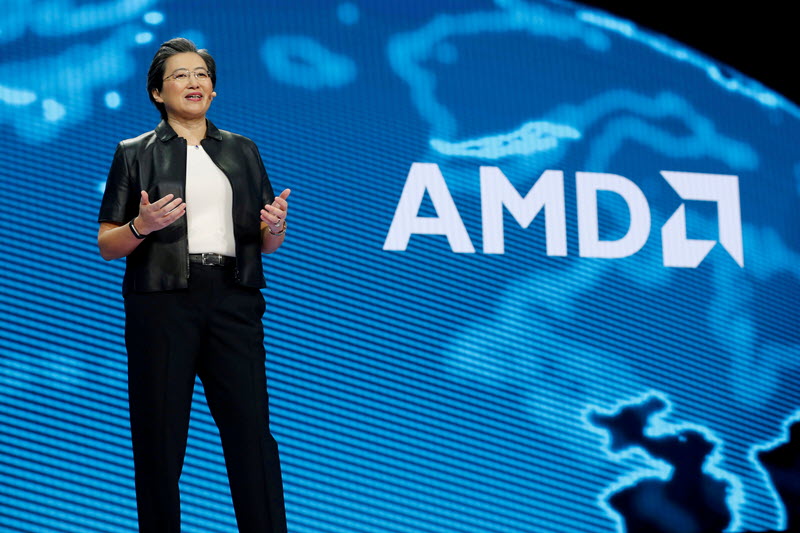
HSBC downgraded AMD to Hold from Buy while lifting its price target to $340 from $335, implying limited upside versus the current $360.54 share price near its 52-week high of $362.79. The call reflects concerns that AMD has already re-rated sharply, with the stock trading at 33x 2027 earnings versus 19x previously, and that capacity constraints could cap further earnings upside. Other broker updates remain constructive, but the near-term tone is cautious amid a broader semiconductor selloff.
The key takeaway is not the downgrade itself but the shift in what is driving AMD’s valuation: the market has already priced in a substantial share of the near- to medium-term AI/server upside, so incremental earnings beats may no longer move the stock meaningfully unless they come with evidence of supply unlocks. Capacity constraints are the real bottleneck here; that means even strong demand can fail to translate into faster EPS compounding, which is exactly when high-multiple names become vulnerable to compression. In other words, the risk is less about a demand collapse and more about a “good-but-not-good-enough” setup into the next several quarters. The second-order winner may be the broader semiconductor complex that can still grow through mix or supply elasticity, not necessarily the most crowded AI beneficiary. If AMD is constrained, hyperscaler demand does not disappear—it reallocates toward peers with more available capacity, stronger packaging access, or better foundry priority. That creates a relative-value opportunity in semis with cleaner operating leverage and lower multiple risk, especially names where estimate revisions can still outpace valuation expansion. The contrarian angle is that consensus may be over-focusing on the headline AI narrative and underweighting cycle duration. When a stock is already trading near peak technical levels and at a rich earnings multiple, the market tends to punish any sign that growth is being “pulled forward” rather than extended. The event risk is that guidance or product enthusiasm does not overcome capacity math, and the stock de-rates before any 2027/2028 upside becomes visible. Near term, this is a setup for volatility around catalysts rather than a clean fundamental break. A strong guide or AI-event enthusiasm could squeeze shorts for a few sessions, but over 1-3 months the path of least resistance is sideways-to-lower unless checks show accelerating unit availability or materially improved gross-margin leverage. The market is effectively asking whether AMD can convert strategic relevance into scalable earnings; until that answer improves, the stock’s downside skew remains asymmetric.
AI-powered research, real-time alerts, and portfolio analytics for institutional investors.
Request DemoOverall Sentiment
mildly negative
Sentiment Score
-0.15
Ticker Sentiment
