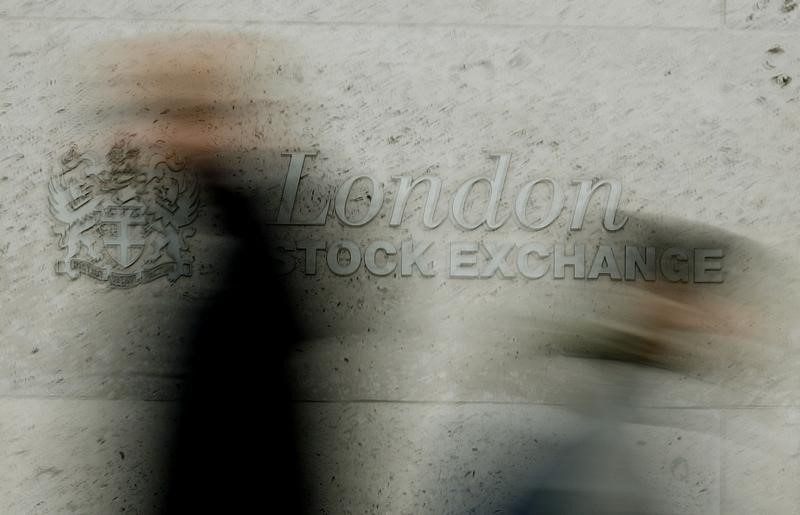
U.K. stocks fell 0.74% at the London close, with declines led by Automobiles & Parts, Pharmaceuticals & Biotech, and Aerospace & Defense. Mondi dropped 11.12% to a 5-year low, while Antofagasta fell 3.79% and AstraZeneca lost 3.70%; advancers trailed decliners 637 to 1,115. Commodities were mixed, with June gold up 0.30% to $4,738.34 and June crude oil down 2.02% to $93.91, while GBP/USD was unchanged at 1.35.
The tape looks like a classic risk-off rotation where the market is punishing anything with cyclical leverage and rewarding defensives, but the more important signal is the broad repricing of future cash flow quality. The sharp weakness in paper/packaging and autos suggests investors are no longer treating the recent commodity and freight relief as durable; if China-linked demand stays soft, second-order pressure should spill into industrial inputs, logistics, and equipment orders over the next 1-2 quarters.
For FLUT and IHG, the move is less about immediate fundamentals than balance-sheet and positioning dynamics. FLUT can keep outperforming if discretionary spending holds, but its recent strength makes it vulnerable to any reversal in consumer confidence or broad de-risking; IHG is the cleaner defensive growth proxy because travel demand is sticky and less exposed to input-cost swings. The real relative loser in the group is AZN: a weak tape plus a higher-duration healthcare name often means factor outflows, and that can persist for days even if the fundamental story is intact.
The bigger macro tell is the conjunction of softer oil, firm gold, and a stable pound: that combination usually reflects slower growth expectations rather than inflation relief. If crude continues to leak lower, it becomes a margin tailwind for transport and leisure, but a warning sign for cyclicals, which is why the next leg is likely cross-sector dispersion rather than outright index direction. Consensus is likely underestimating how quickly passive and systematic flows can amplify this, especially if the London market keeps making lower highs while breadth deteriorates.
Near term, the highest-probability setup is continuation in quality defensives and underperformance in economically sensitive names. The contrarian angle is that the AZN selloff may be overdone relative to its defensiveness, but only if broader factor de-risking stabilizes; otherwise, it can stay weak longer than fundamentals justify.
AI-powered research, real-time alerts, and portfolio analytics for institutional investors.
Request TrialOverall Sentiment
mildly negative
Sentiment Score
-0.15
Ticker Sentiment
