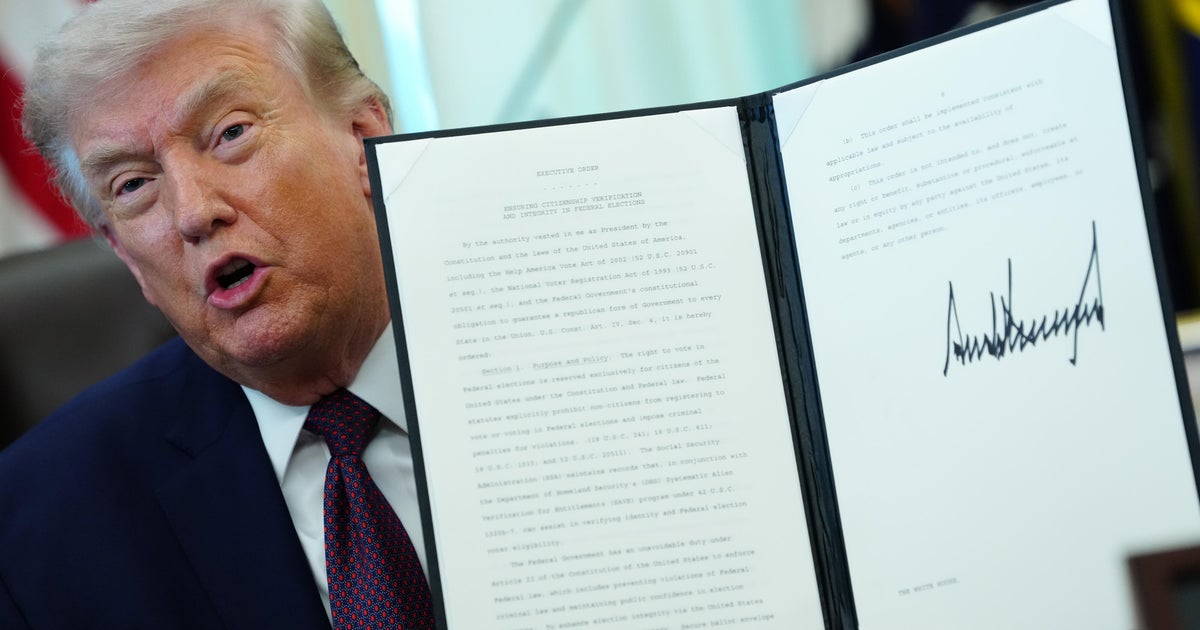
23 states and the District of Columbia filed suit in U.S. District Court in Massachusetts to block President Trump's executive order that seeks to restrict mail voting and impose new federal requirements. The EO would require DHS to compile 'State Citizenship Lists', limit USPS ballot mailings to those lists, mandate barcoded mail ballot envelopes, and threaten federal funding for noncompliance; plaintiffs say this violates the Elections Clause and federalism. Expect prolonged litigation and possible injunctions that make implementation uncertain ahead of the November midterms; near-term market impact is limited but political risk increases.
The immediate market consequence is uncertainty, not a sustained structural shift — courts tend to issue preliminary rulings within 30–90 days on high-profile separation-of-powers disputes, and appeals can stretch into the midterm calendar. That creates a discrete window where states accelerate procurement and campaigns reallocate budgets to work around the ambiguity, producing concentrated revenue opportunities for a handful of vendors and a short-term volatility spike in politically exposed equities.
Operationally, mandated envelope-tracking, unique barcodes, and state-level “citizen list” projects force procurement cycles that are lumpy and front-loaded: expect multiple state-level contracts in the $5–50m range each rather than a single federal program. Vendors with existing state election contracts or scale in mail/print/security printing can convert RFPs to booked revenue within 2–6 months, while smaller, one-off providers face cash timing stress and potential margin compression.
Behaviorally, campaigns will shift spend toward digital targeting, field operations and logistics (transport and local outreach) as a hedge against mail uncertainty, amplifying ad rev and micro-targeting demand for large platforms. The main market catalysts to watch are (1) preliminary injunction(s) from district courts (days–weeks), (2) circuit court decisions and emergency appeals (weeks–months), and (3) any DoJ/OSG position or congressional action — each can swing implied volatility and re-rate winners/losers quickly.
AI-powered research, real-time alerts, and portfolio analytics for institutional investors.
Request DemoOverall Sentiment
neutral
Sentiment Score
0.00
