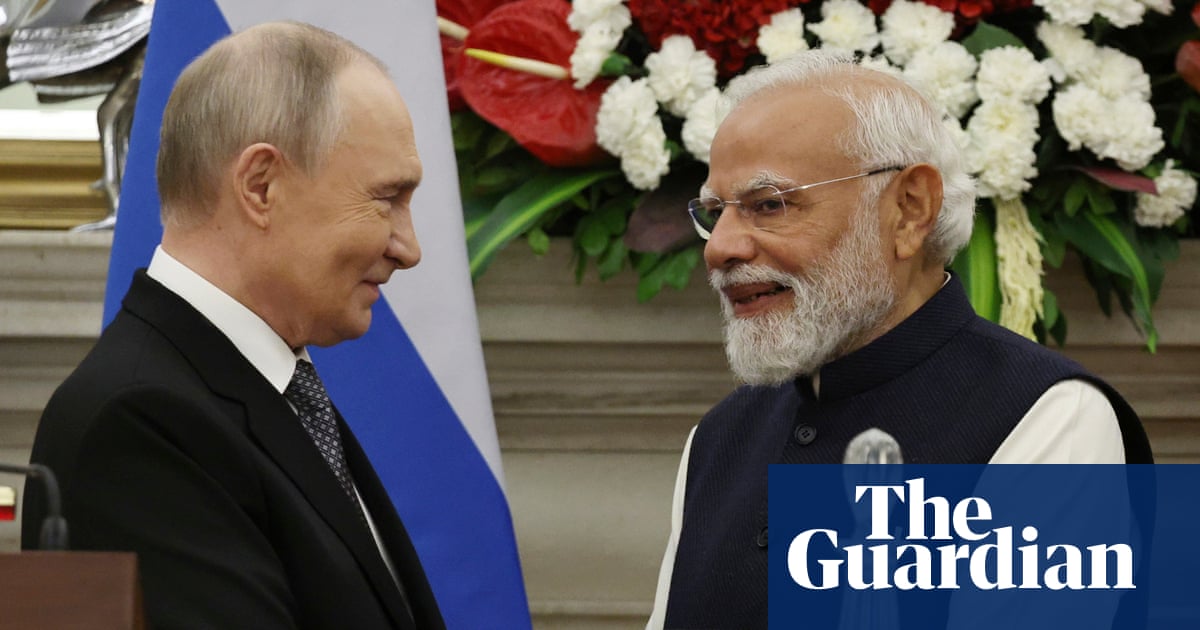
Russian president Vladimir Putin told Prime Minister Narendra Modi that Russia will continue ‘uninterrupted’ oil shipments to India, signaling defiance of Western pressure after the US imposed a 25% tariff on Indian imports over purchases of discounted Russian oil. The two leaders agreed a bilateral economic cooperation programme through 2030 targeting trade of $100bn a year and expanded defence collaboration including joint production of advanced platforms, underscoring strengthened energy security and strategic ties that could undermine the effectiveness of Western sanctions and influence energy and defence sector flows.
Market structure: India continuing to take discounted Russian crude is a win for Russian upstream and seaborne sellers and for Indian refiners/exportable product margins; expect incremental Indian crude imports to substitute ~0.3–0.6 mbpd of other seaborne volumes over 3–12 months, exerting 3–8% downward pressure on Brent relative to a sanctions-tight baseline. US energy exporters and European buyers lose pricing power and market share; shipping and insurance firms handling Russia-India routes (tankers, P&I clubs) see volume upside but higher reputational/regulatory risk. Competitive dynamics favor cash-and-carry crude arbitrageurs and refiners with export capacity in India, compressing margins for US crude producers if differential narrows.
Risk assessment: Tail risks include rapid US secondary sanctions on Indian buyers or service providers (low probability, high impact: >20% drawdown for exposed Indian banks/companies within weeks) and a Russian operational cutoff from infrastructure or insurance restrictions (risk of short squeezes in months). Near-term (days–weeks) volatility spikes on headlines; medium-term (3–12 months) depends on whether tariffs are enforced or softened; long-term (years) trade realignment toward Russia/India/China persists. Hidden dependencies: tanker insurance, SWIFT/payment workarounds, and INR liquidity create second-order credit/FX exposures.
Trade implications: Tactical: buy India exposure (INDA or EPI) to capture defence/economic program upside — 2–3% portfolio weight, horizon 6–18 months, stop -8%. Hedge commodity risk by buying a 3-month USO/Brent put spread (buy ~30-delta put, sell ~15-delta) sized 0.5–1% to profit from a 5–10% crude downside. Pair trade: long INDA (2%) / short XLE (1.5%) for 6–12 months to express India outperformance versus US energy. Consider 3-month USDINR forwards or NDFs to capture potential 1–2% INR appreciation; allocate 0.5–1%.
Contrarian angles: Markets may underprice India’s willingness to bear short-term US friction to secure energy — Indian refiners’ margins could widen 50–200 bps over 6 months, a mispricing versus consensus fear of full US coercion. Conversely, the consensus may understate sanction escalation risk; size positions small and use options/forwards to cap drawdowns. Historical parallels (post-1970s geopolitical oil realignments) show durable supplier diversification: position for multi-quarter structural flows, but cap exposure until regulatory signal clarity (next 30–90 days).
AI-powered research, real-time alerts, and portfolio analytics for institutional investors.
Request DemoOverall Sentiment
neutral
Sentiment Score
0.15
