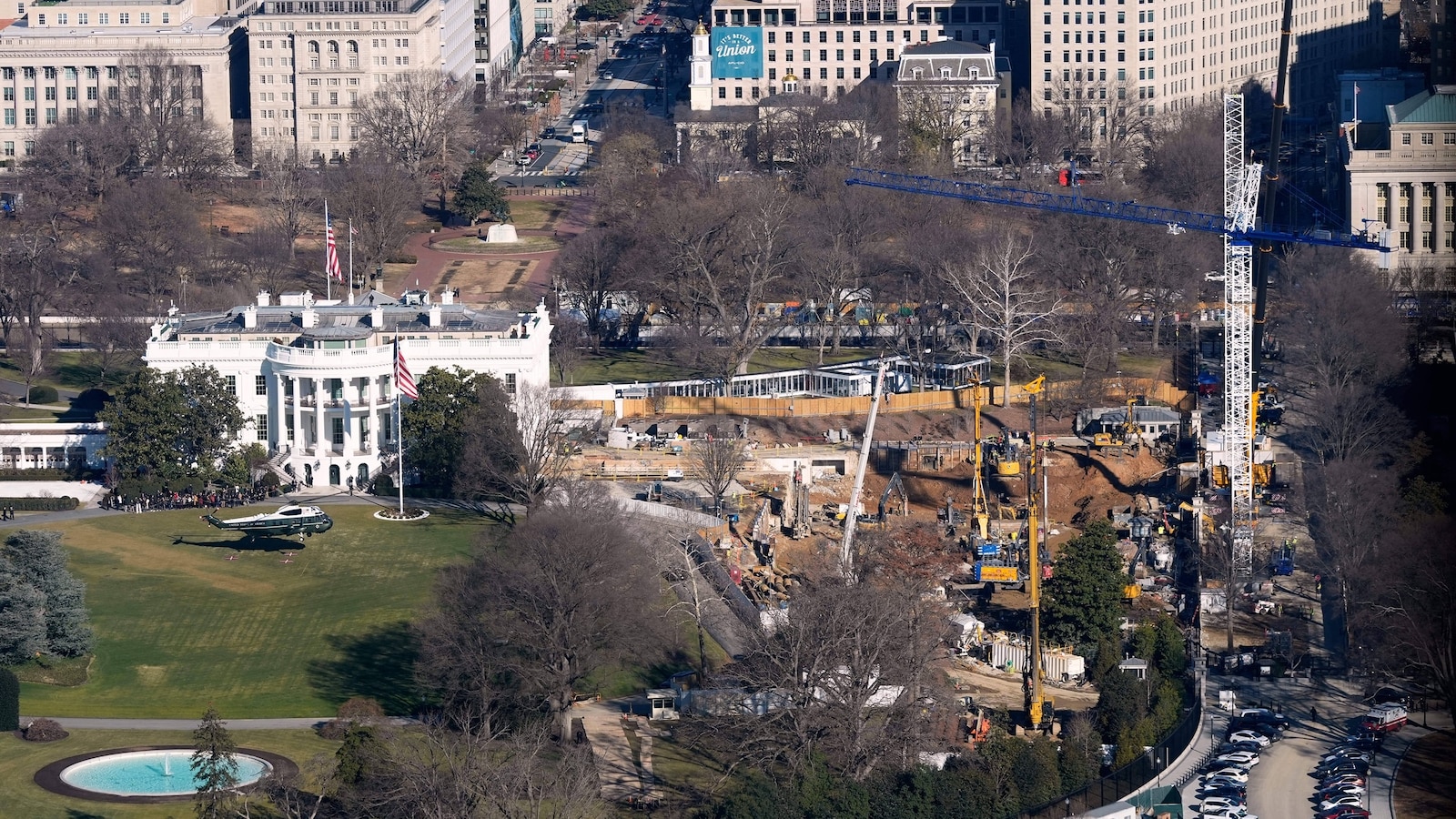
A federal judge signaled deep skepticism of the Trump administration's legal authority to demolish part of the White House East Wing and to finance a newly announced 90,000-square-foot ballroom with private donations, a project whose estimated cost has increased to $400 million from $200 million. The National Trust for Historic Preservation sued to halt construction until required federal review and public comment are completed; Judge Richard Leon focused on whether the president can use the National Park Service's gift authority to evade congressional appropriations (noting a recent $2.5 million maintenance appropriation) and indicated a likely decision in February, with an appeal expected by the losing side.
Market structure: This litigation is a localized political-legal shock with asymmetric beneficiaries — boutique federal contractors and building-systems integrators (J, ACM, JCI, HON) stand to win if the administration previves and the $400m scope is awarded; preservation groups and any small vendors already on-site risk write-offs. Pricing power is negligible for blue-chips but material for niche firms that can mobilize quick, high-margin retrofit work in the DC federal pipeline (2–4 firms that win could see near-term EBITDA uplift of +3–8% on incremental $50–200m contracts).
Risk assessment: Tail risks include a judge-ordered halt that forces remediation costs, donor withdrawal, and multi-year appeals that create stranded costs—low probability but >$100m write-off potential for project-level contractors. Time horizons: immediate (court ruling likely by late Feb), short (appeal activity 1–3 months), long (legal precedent shaping gift-authority for federal builds over years). Key hidden dependency: whether Congress reacts with statutory clarifications within 90–180 days, which would change the investment case.
Trade implications: Direct plays are small, event-driven allocations to contractors with DC federal credentials (long J/ACM 1–3% positions) and tactical optionality on building-systems names (buy 3-month JCI/HON call spreads sized 0.5–1% of equity). Pair trade: long J (1.5%) / short TPC (1%) as relative-risk — J has larger diversified backlog, TPC higher leverage and reputational exposure if litigation expands. Entry window: wait for judge’s ruling (target: add on favorable ruling within 7 trading days; cut or reverse within 48 hours of injunction).
Contrarian angles: The market underprices policy precedent — a government-allowed $400m private-funding mechanism, if upheld, could unlock a boutique pipeline of federally adjacent privatized renovations worth $1bn+ across agencies over 3 years, benefiting wealth-management arms (MS, BAC) that service donor networks. Conversely, the consensus underestimates congressional backlash risk; a mid-case outcome (appeal upholding injunction) is the highest-probability pain point for contractors and should be hedged. Historical parallel: ad hoc White House projects (Ford-era) were tolerated at small scale; scaling to $400m is unprecedented and creates both regulatory risk and concentrated alpha for quick-response contractors.
AI-powered research, real-time alerts, and portfolio analytics for institutional investors.
Request DemoOverall Sentiment
neutral
Sentiment Score
0.00
