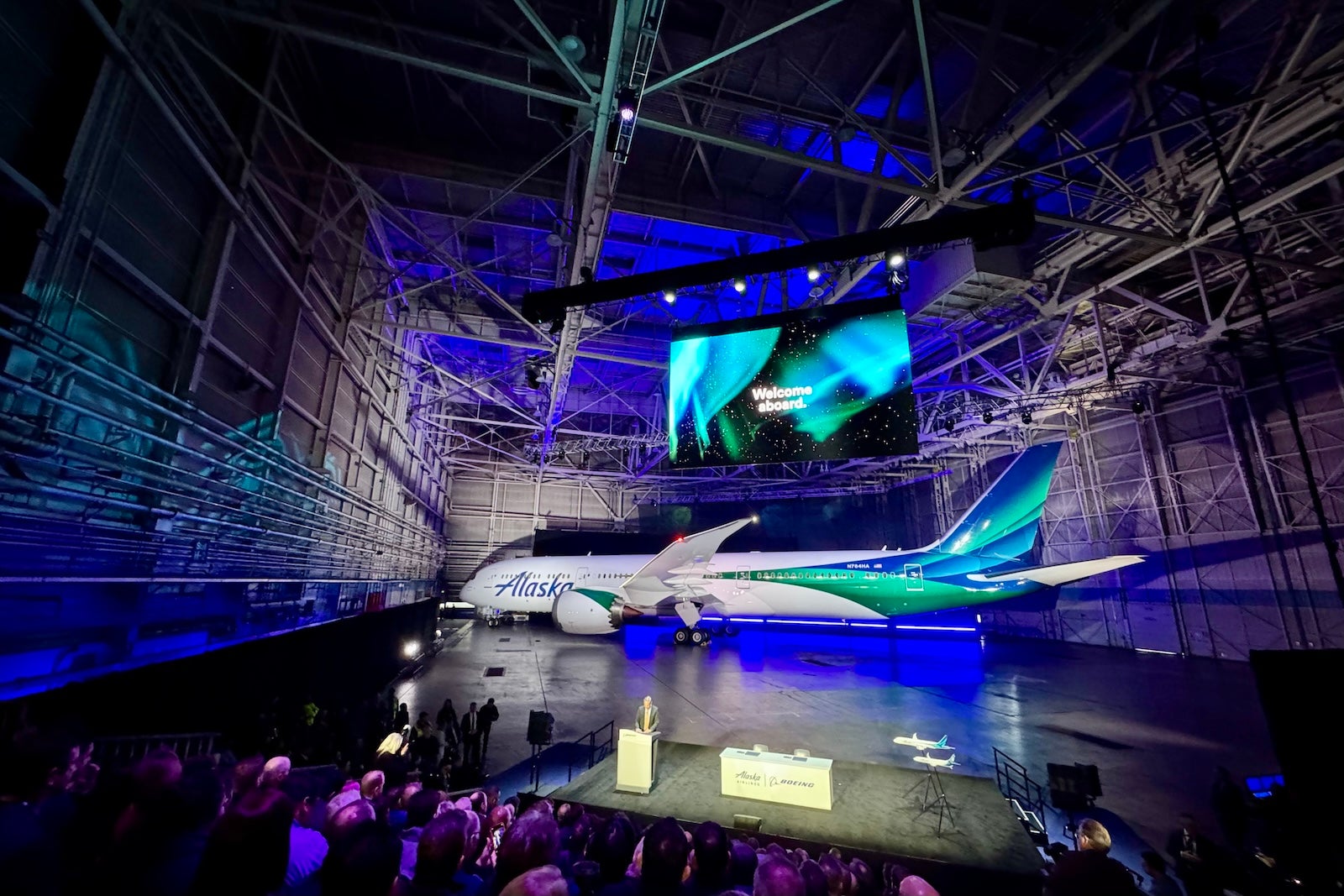
Alaska Airlines unveiled its first branded Boeing 787-9 Dreamliner following its 2024 acquisition of Hawaiian Airlines and confirmed fleet and product plans that accelerate its long-haul international push. The 787-9 will begin transpacific service Seattle–Seoul immediately and is slated for new Seattle–Rome (Apr 28) and Seattle–London (May 21) routes; Alaska also plans to repaint inherited Hawaiian 787s and will receive future Dreamliners including five 787-10s as part of a 110-aircraft Boeing order. Management confirmed a premium economy cabin will be introduced on Alaska 787s by 2028, and Hawaiian will retrofit A330 cabins with new business seats and premium economy starting 2028, signaling coordinated fleet and product investment across the combined carriers.
Market structure: Boeing (BA) is a clear direct beneficiary — a confirmed 110-aircraft order and immediate 787 deliveries tighten Boeing’s revenue visibility and support supplier aftermarket. Alaska (ALK) gains strategic route diversification (Seattle→Seoul/Rome/London) that should lift long‑haul RASM but increases unit cost volatility versus its single‑aisle base; incumbent long‑haul carriers (legacy transatlantic/Asia players) face incremental competition on city pairs and premium inventory.
Risk assessment: Near term (days-weeks) market reaction will be muted; medium term (3–12 months) tail risks include Boeing delivery delays, regulatory scrutiny of the Hawaiian/Alaska integration, and ALK leverage rising if growth capex outpaces cash flow — watch net debt/EBITDA >4x as a stress threshold. Low‑probability/high‑impact scenarios: 787 groundings or major labor disruptions that could wipe 10–30% of expected international capacity for quarters.
Trade implications: Favor suppliers and BA exposure via options to cap downside while owning upside into multi-year backlog conversion (6–18 month horizon); favor selective ALK exposure to capture mix shift to higher-yield international traffic but size for execution risk (12–36 months). Cross‑asset: expect modest tightening in BA credit spreads and potential widening of mid‑tier airline high‑yield spreads if ALK finances fleet aggressively; oil sensitivity remains primary macro lever for airline margins.
Contrarian: Consensus overstates seamless upside — integration and long‑haul ops are high fixed‑cost with slow payback; premium economy by 2028 is a revenue lever but also a capital and yield‑management risk if rollouts misprice demand. If market assumes flawless execution, short convexity through defined‑risk option sells (e.g., BA/ALK sell premium around event windows) can capture overpricing; conversely, buy LEAPs where execution risk is already priced in.
AI-powered research, real-time alerts, and portfolio analytics for institutional investors.
Request DemoOverall Sentiment
mildly positive
Sentiment Score
0.30
Ticker Sentiment
