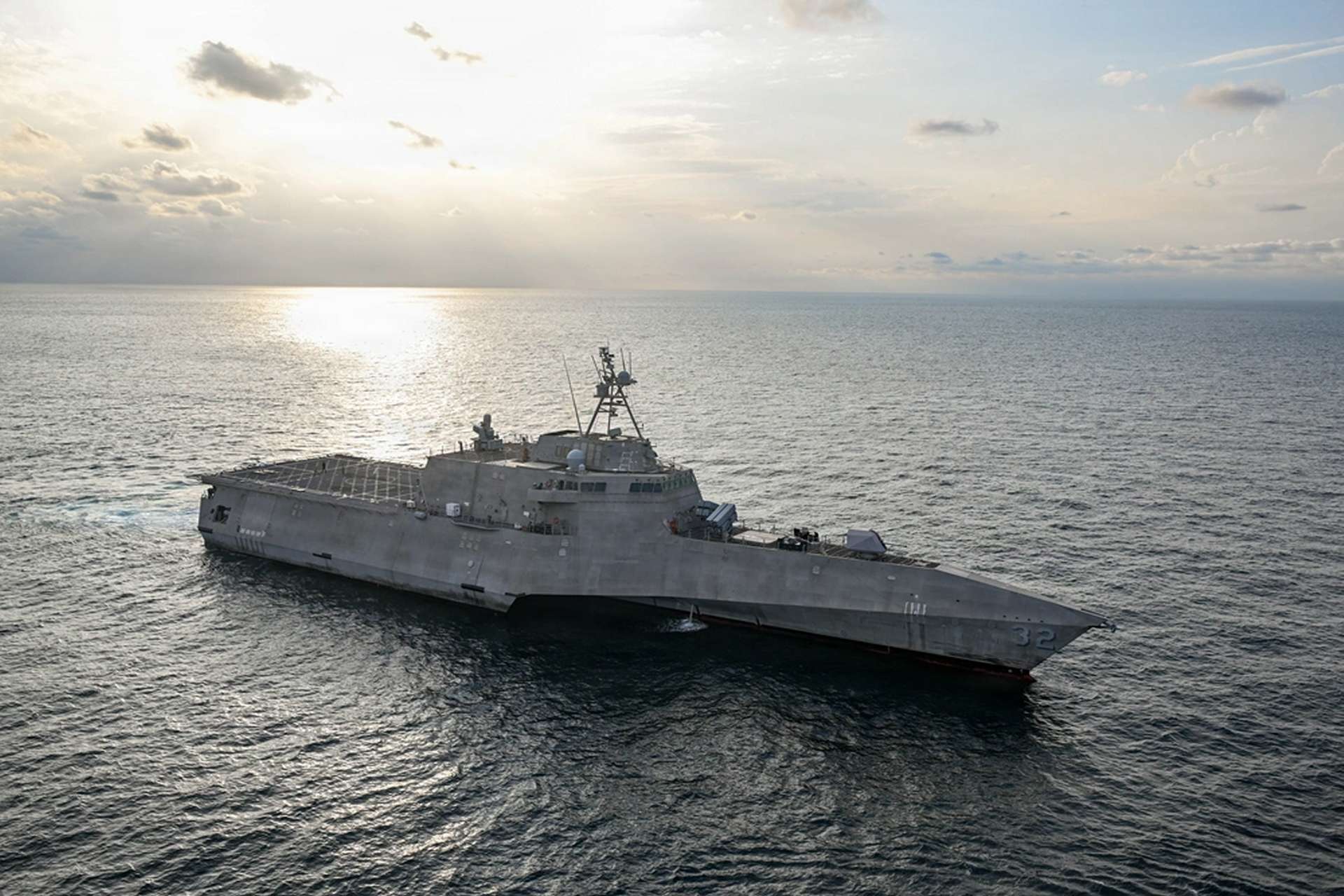
The U.S. Navy retired its last forward-deployed Avenger-class mine hunters in September 2025 and shifted Bahrain-based mine-countermeasure duties to Independence-class LCSs using modular MCM packages, MH-60S helicopters, and unmanned surface and airborne systems. Given that the Strait of Hormuz accounted for >25% of global seaborne oil trade and roughly 20% of global oil/petroleum and LNG flows in 2024–Q1 2025, mine threats can cause outsized economic and shipping disruption; the LCS standoff/unmanned concept is strategically logical but its credibility hinges on demonstrated reliability, availability, and survivability in threat-saturated Gulf waters.
The Navy’s move to a distributed, unmanned mine-countermeasure construct amplifies demand not just for hardware (USVs, towed sonars, airborne sensors) but for rapid systems integration, software/AI payloads, and sustainment at forward bases; expect procurement dollar flow to shift toward modular vendors and integrators rather than steady-state hull production. Over the next 12–36 months this creates a two-speed market: large primes with integration and avionics depth can win recurring service-and-software contracts, while specialist small- to mid-caps that actually produce missionized USVs and towed arrays will see lumpy, event-driven revenue spikes tied to operational deployments.
Operational credibility will hinge on reliability and Mean Time Between Failure for unmanned sensors under Gulf environmental stressors (high silt, salinity, biofouling) and contested-communications resilience; if availability <70% in trials, expect urgent stop-gap buys of low-signature platforms and accelerated investment in cyber-hardened C2 within 6–18 months. Conversely, sustained >85% availability in real ops would relegate purpose-built mine hunters to niche roles and compress long-term capex for hull production—a regime change that favors software/maintenance annuities over capital ship orders.
Second-order macro effects are actionable: increased war-risk premiums and convoy rerouting raise tanker time-charter rates and short-sea logistics costs, pressuring refiners’ feedstock logistics and boosting incentive for inventories to be held ashore. The contrarian risk is that politicized procurement cycles or a single high-profile operational failure could reverse momentum quickly, triggering reallocations back into traditional low-signature hull programs and benefiting shipbuilders and specialized EOD outfits over software-focused integrators.
AI-powered research, real-time alerts, and portfolio analytics for institutional investors.
Request DemoOverall Sentiment
mildly negative
Sentiment Score
-0.15
