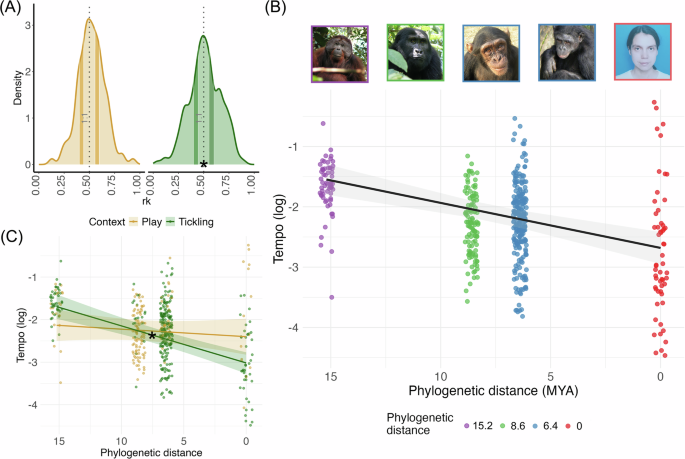
The study finds that laughter in great apes is isochronous and that human laughter has evolved toward faster, more variable, and more context-sensitive rhythms over roughly 15 million years. Humans were the only species in the sample to modulate laughter tempo by context, with faster laughter during tickling than play. This is academic research with no direct market implication.
SONY is not a direct beneficiary of the science result, but the article reinforces a broader moat around audio signal processing, voice AI, and affect detection: as human vocal timing is shown to carry richer behavioral state information than simple amplitude/keyword content, demand should shift toward models that extract micro-rhythm, prosody, and turn-taking features at scale. That is incremental support for Sony’s semiconductor/audio stack and consumer devices with on-device inference, where differentiated microphones, low-power DSP, and latency control matter more than raw model size. The second-order winner is the edge-AI supply chain, not the research publisher category. If this type of biomarker-style vocal analysis gets productized, it expands use cases in telehealth, pediatric monitoring, eldercare, and mental-health screening, which favors sensor-rich devices and embedded compute over cloud-only transcription. The key commercial implication is that “speech understanding” can broaden into “emotion/timing understanding,” creating a new premium tier for hardware platforms that capture cleaner, higher-SNR vocal data. Contrarian view: the market may underappreciate how hard it is to monetize this outside controlled environments. The data suggests timing signatures matter, but real-world noise, multilingual variation, device heterogeneity, and regulatory scrutiny around inferred emotion could delay adoption by 18–36 months. That reduces near-term revenue upside for SONY while preserving optionality; any multiple expansion should come from proving recurring software attach or medical-grade sensing, not the academic result itself.
AI-powered research, real-time alerts, and portfolio analytics for institutional investors.
Overall Sentiment
neutral
Sentiment Score
0.15
Ticker Sentiment
