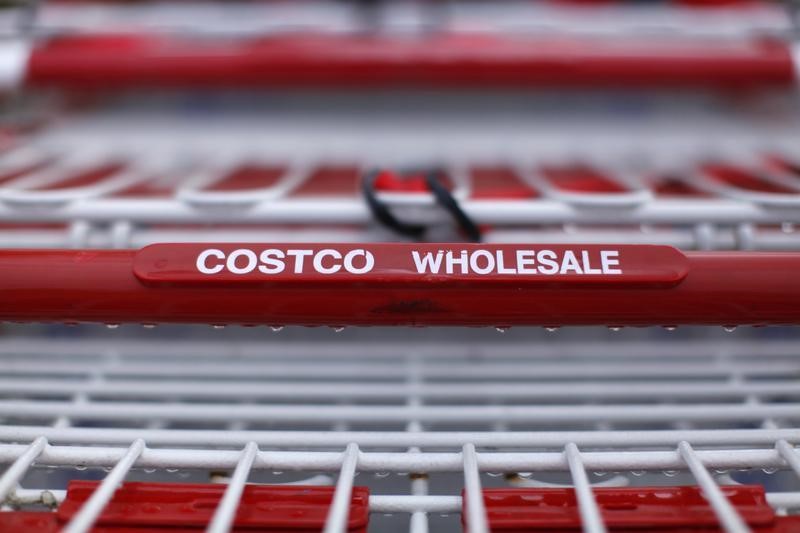
Truist reiterated a Hold on Costco with a $977 price target, citing higher gas prices that helped accelerate store volume and support ancillary business growth in the mid-30% range. Costco also raised its quarterly dividend to $1.47 per share from $1.30, lifting the annualized payout to $5.88. Multiple brokers remain constructive on sales momentum, but valuation near 46x earnings keeps the risk/reward balanced.
Costco is still the cleanest expression of “trade-down but pay-up” consumer behavior: when households feel pressure, they consolidate wallet share into the highest-trust value platform rather than necessarily cutting spend outright. That tends to help not just top-line volume but also ancillary mix, which is important because it cushions margins at a time when the core basket is under promotional pressure elsewhere in retail. The second-order effect is that Costco can pull demand from mid-tier grocers and specialty discounters without needing a true recession, which makes the stock’s operating resilience look better than the macro backdrop would suggest.
The market is likely underpricing how much of the current throughput is cyclical rather than secular. Fuel-driven traffic is helpful, but it is also low-quality demand: it can fade quickly if energy eases or if commodity disinflation reduces the comparative advantage versus smaller-format competitors. That means the near-term setup is more fragile over 1-2 quarters than the headline sales trajectory implies, especially with valuation already discounting a long runway of durable comp strength.
The contrarian view is that the consensus is treating Costco as a bond proxy with embedded inflation protection, when in reality the multiple is still being supported by a relatively narrow set of drivers: traffic, membership stickiness, and defensive rotation. If gasoline normalizes and the consumer rotation broadens back toward lower-priced omnichannel retailers, the incremental upside likely compresses faster than earnings estimates do. The dividend increase improves capital return optics, but it is not enough on its own to de-risk a high-40s/low-50s earnings multiple.
For competitors, the main losers are not the obvious premium retailers but the mid-price grocers and club-adjacent formats that lack Costco’s purchasing power and membership moat. The longer this traffic migration persists, the more procurement leverage Costco can extract, which can further pressure vendor economics and widen the gap versus chains with weaker scale. That said, if management ever leans harder into price to defend share, the stock could de-rate quickly because the market is currently paying for stable unit economics, not for aggressive reinvestment.
AI-powered research, real-time alerts, and portfolio analytics for institutional investors.
Request DemoOverall Sentiment
mildly positive
Sentiment Score
0.25
Ticker Sentiment
