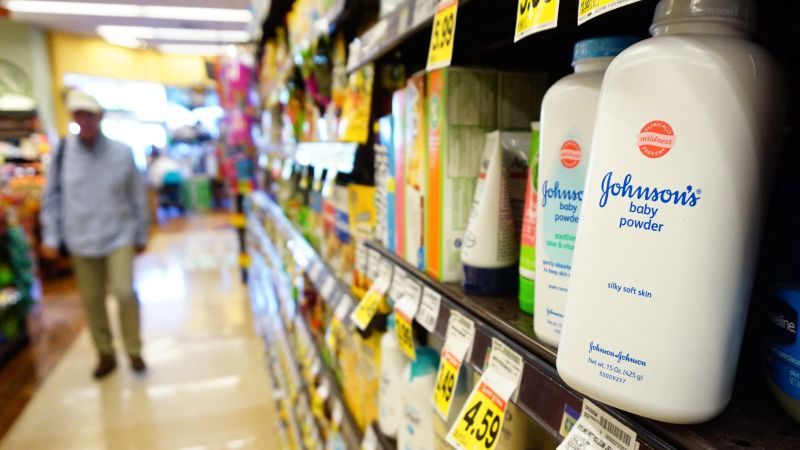
Johnson & Johnson (JNJ) has been ordered by a Los Angeles jury to pay $966 million ($16 million compensatory, $950 million punitive) to the family of a woman who died from mesothelioma, with the jury finding the company liable for asbestos in its talc products. J&J plans an immediate appeal, calling the verdict "egregious and unconstitutional" and noting that punitive damages are often significantly reduced on appeal. This substantial verdict, among the largest recently, highlights the continued litigation risk for J&J, which faces over 67,000 talc-related lawsuits and has seen prior attempts to resolve claims through bankruptcy rejected.
A Los Angeles jury ordered Johnson & Johnson to pay $966 million to the family of a woman who died from mesothelioma, finding the company liable in the latest trial alleging its talc products cause cancer. The family of Mae Moore, a California resident who died at age 88 in 2021, sued the company the same year, claiming J&J’s talc baby powder products contained asbestos fibers that caused her rare cancer. The jury late on Monday ordered J&J (JNJ) to pay $16 million in compensatory damages and $950 million in punitive damages, according to court filings. The verdict could be reduced on appeal as the US Supreme Court has found that punitive damages should generally be no more than nine times compensatory damages. Erik Haas, J&J’s worldwide vice-president of litigation, said in a statement that the company plans to immediately appeal, calling the verdict “egregious and unconstitutional.” “The plaintiff lawyers in this Moore case based their arguments on ‘junk science’ that never should have been presented to the jury,” Haas said. The company has said its products are safe, do not contain asbestos and do not cause cancer. J&J stopped selling talc-based baby powder in the United States in 2020, switching to a cornstarch product. Mesothelioma has been linked to asbestos exposure. Trey Branham, one of the attorneys representing Moore’s family, said after the verdict that his team is “hopeful that Johnson & Johnson will finally accept responsibility for these senseless deaths.” J&J is facing lawsuits from more than 67,000 plaintiffs who say they were diagnosed with cancer after using baby powder and other talc products, according to court filings. The number of lawsuits alleging talc caused mesothelioma is a small subset of these cases, with the vast majority involving ovarian cancer claims. J&J has sought to resolve the litigation through bankruptcy, a proposal that has been rejected three times by federal courts. Lawsuits alleging talc caused mesothelioma were not part of the last bankruptcy proposal. The company has previously settled some of those claims but has not struck a nationwide settlement, so many lawsuits over mesothelioma have proceeded to trial in state courts in recent months. In the past year, J&J has been hit with several substantial verdicts in mesothelioma cases, but Monday’s is among the largest. The company has won some of the mesothelioma trials, including last week in South Carolina, where a jury found J&J not liable. The company has been successful in reducing some of the awards on appeal, including in one Oregon case where a state judge granted J&J’s motion to throw out a $260 million verdict and hold a new trial. A Los Angeles jury ordered Johnson & Johnson (JNJ) to pay $966 million ($16 million compensatory, $950 million punitive) to the family of a mesothelioma victim, finding its talc products liable for her cancer. This substantial verdict, among the largest recently, highlights the ongoing litigation risk for the company. J&J has announced an immediate appeal, labeling the ruling "egregious and unconstitutional." The punitive damages, approximately 59 times the compensatory award, are highly susceptible to reduction on appeal, as US Supreme Court precedent typically suggests a nine-fold limit. This verdict exacerbates the legal overhang from over 67,000 talc-related lawsuits globally, despite J&J having ceased talc-based baby powder sales in the US in 2020. J&J's repeated attempts to resolve these claims via bankruptcy have been rejected three times by federal courts, indicating prolonged legal battles. While the company has won some mesothelioma trials and successfully reduced awards on appeal, the persistent volume of litigation continues to pose significant financial and reputational headwinds, impacting company fundamentals and capital allocation.
AI-powered research, real-time alerts, and portfolio analytics for institutional investors.
Request DemoOverall Sentiment
strongly negative
Sentiment Score
-0.80
Ticker Sentiment
