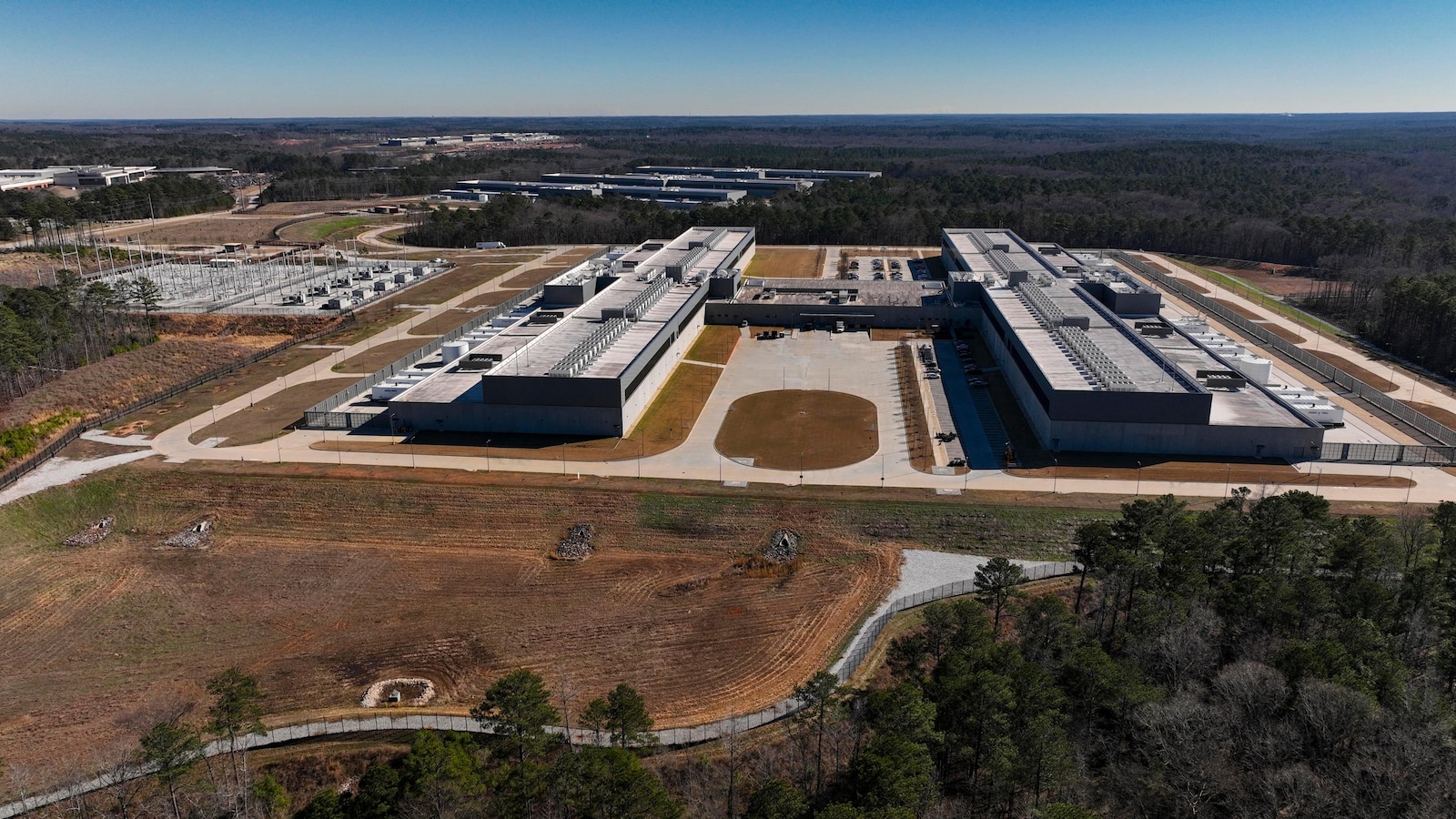
The White House and a bipartisan group of governors are pressuring PJM Interconnection to hold a power auction enabling tech companies to contract to build new plants to meet surging AI-driven data center demand, and will sign a statement of principles supporting that push. PJM was not invited to the White House event, and consumer advocates warn ratepayers in the mid-Atlantic (covering parts of 13 states and DC) are already underwriting billions for data-center power without seeing corresponding generation added; gas and electric utilities sought or won more than $34 billion in rate increases in the first three quarters of 2025. Potential regulatory intervention or mandated auctions ahead of pivotal elections could reallocate costs between utilities, data-center operators and consumers and materially affect utility revenue recovery, project economics for new generation and political risk for market participants.
Market structure: Short-term winners will be merchant generators, fast-build gas peakers, energy storage providers and transmission/upgrade contractors because policy pressure (White House + governors) increases the probability of capacity auctions and expedited interconnection — beneficiaries could see 20–40% incremental margin expansion if they capture near-term capacity contracts. Losers are data-center REITs and hyperscalers with heavy PJM footprints (higher P50 power costs), plus residential ratepayers who face bill inflation; expect passthrough disputes and margin compression for cloud infra in the next 6–18 months.
Risk assessment: Tail risks include federal compulsion of PJM to force auctions or retroactive cost allocation (high-impact, <20% probability) and simultaneous moratoria on new data centers in battleground states (mid probability near elections). Immediate (days) volatility will hinge on announcements; short-term (1–6 months) on PJM rule changes and auctions; long-term (1–3 years) on actual plant builds and transmission upgrades. Hidden dependencies: interconnection queue delays, supply-chain for turbines, and local permitting — each can flip outcomes or extend shortages by 12–36 months.
Trade implications: Direct plays: favor merchant generators (NRG, VST) and PJM-focused utilities (EXC) and battery/storage contractors (AES) while trimming data-center landlords (EQIX, DLR) exposure. Use pair trades (long EXC or NRG, short EQIX/DLR) and buy 6–12 month call spreads on generators; add a 1–2% tactical long in nat-gas (UNG) as a 3–9 month hedge against price-driven plant economics.
Contrarian angles: Consensus assumes AI demand is insatiable; missing is that transmission and interconnection are rate- and time-limited — so generator equities may be underpriced for near-term scarcity. Reaction could be overdone if regulators socialize costs (rate caps or utility rate-base treatment), which would help large regulated utilities (NEE, D) and hurt merchant-focused names; hedge accordingly with regulated-utility longs if policy language leans toward consumer protections.
AI-powered research, real-time alerts, and portfolio analytics for institutional investors.
Request DemoOverall Sentiment
moderately negative
Sentiment Score
-0.40
