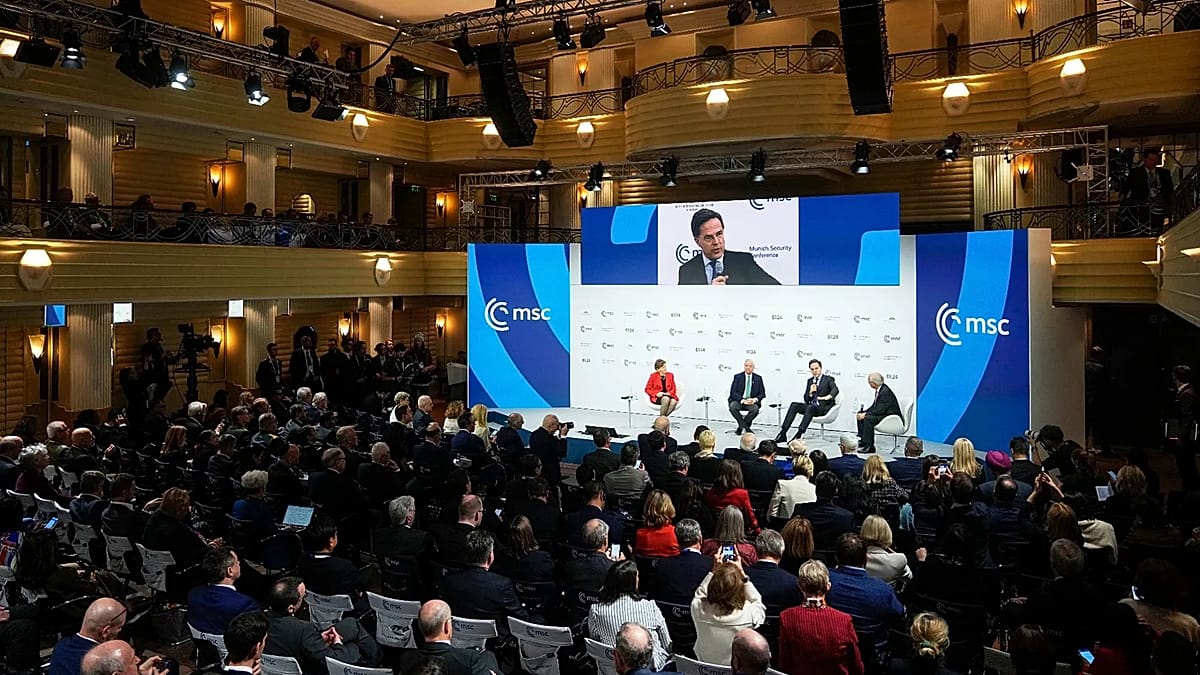
At the Munich Security Conference (13-15 February) a 2026 MSC report warns the international order is under growing pressure—describing a shift toward 'wrecking-ball politics' driven in part by changes in US policy—and expects around 65 heads of state and some 450 delegates to attend. The report highlights weakening transatlantic trust, heightened risks from Russia and China, and a European dual-track response of deeper engagement with the US while accelerating rearmament and new trade, security and technology partnerships, trends that imply upside for defense spending and increased strategic decoupling risks for investors.
Market Structure: The shift described accelerates a multi-year reallocation toward defense, security software, energy and critical-minerals suppliers. Expect defense primes (LMT, RTX, NOC) and cybersecurity vendors (PANW, FTNT) to gain pricing power as procurement cycles expand; a sensible base case is Europe increasing defense spend +5–15% annually over next 12–36 months, tightening supply vs demand for components and skilled labor. Conversely, long-duration growth (QQQ constituents) faces multiple headwinds — higher fiscal deficits and rising real yields compressing multiples by 10–25% if real yields normalize higher.
Risk Assessment: Tail scenarios include an escalation in Ukraine or a Taiwan crisis that could spike Brent >$30/bbl in 30 days and widen European peripheral spreads by 100–300bp; opposite tail is a US recommitment calming markets and deflating defense rerating. Time horizons: immediate (days) = volatility events around Munich and NATO statements; short-term (weeks–months) = procurement/budget announcements and export-control updates; long-term (quarters–years) = structural re-shoring of defense/tech supply chains.
Trade Implications: Direct plays: overweight LMT/RTX and PANW, underweight long-duration tech (QQQ) and select international cyclicals reliant on US support. Use 6–9 month call spreads on LMT/PANW to cap cost and buy 3–6 month puts on QQQ as insurance; rotate 1–3% into GLD/GDX as convex tail hedges. Fixed income: shorten duration (move to SHY) and add TIPS (TIP) if inflation surprises on rearmament-driven deficits.
Contrarian Angles: Consensus may overpay for large defense primes while underweighting mid-cap MRO, component suppliers, and semiconductor-equipment names (ASML, LRCX) that enable re-shoring — these could re-rate 20–40% over 12–24 months if industrial backlog rises. Also, a sustained defense/capex cycle could paradoxically push up rates and hurt highly levered contractors; monitor 10y Treasury >3.75% as a stop-loss trigger.
AI-powered research, real-time alerts, and portfolio analytics for institutional investors.
Request DemoOverall Sentiment
moderately negative
Sentiment Score
-0.45
