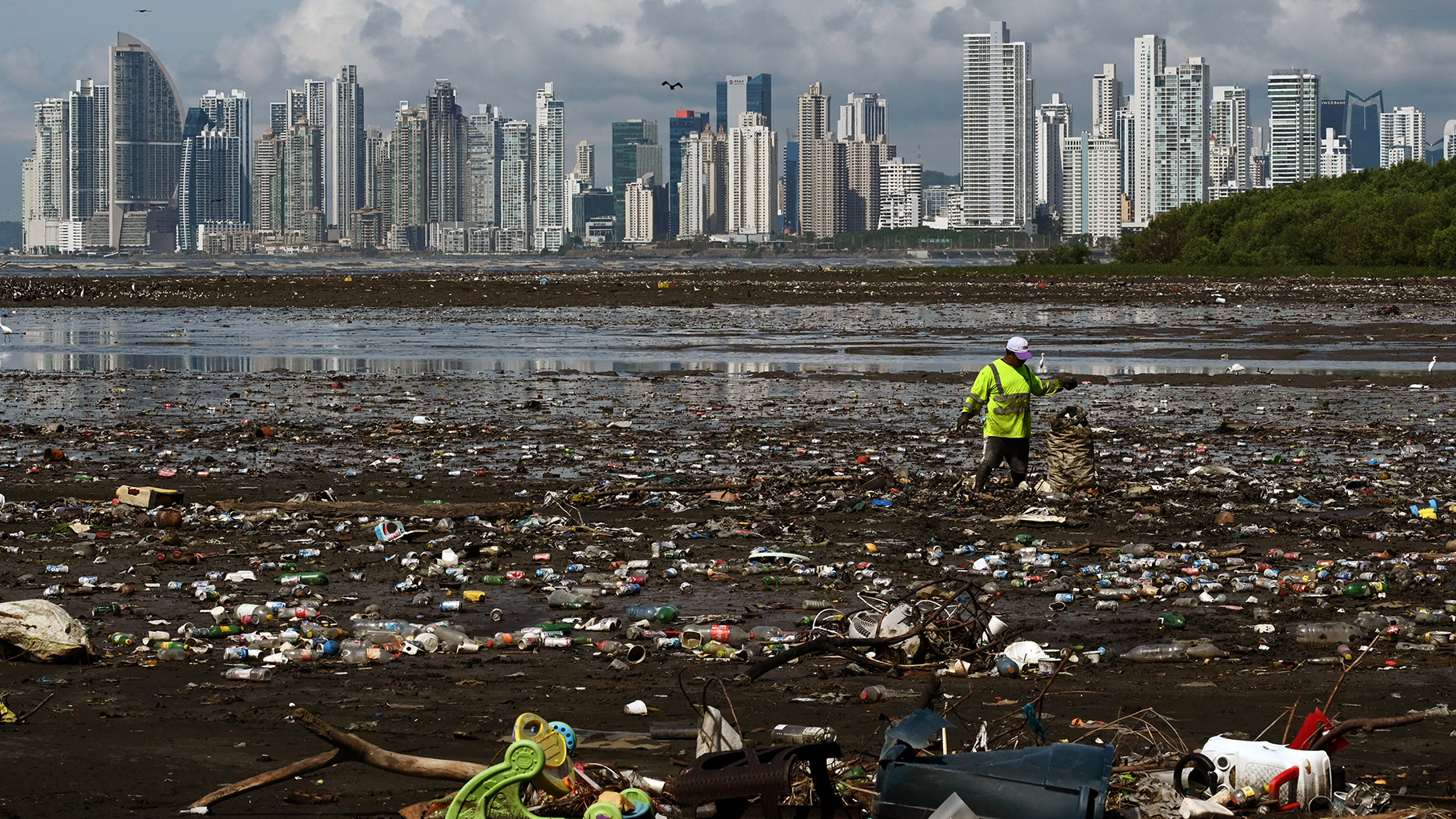
The report projects global plastic pollution rising from roughly 130 Mt/year in 2025 to 280 Mt/year by 2040 under Business-as-Usual, with primary plastic production increasing from 450 Mt to 680 Mt and annual GHG emissions from the plastic system growing from ~2.7 GtCO2e to 4.2 GtCO2e. An alternative “System Transformation” pathway (existing policy and technology levers deployed at scale) could cut annual pollution by 83%, reduce primary production to ~390 Mt by 2040 (‑44% vs BAU), lower annual GHGs by 38% vs BAU and create ~8.6 million net jobs, but would require major capital shifts (eg. ~$430bn capex modeled for open-loop recycling and incineration over 15 years that may become stranded). Key investor takeaways: meaningful regulatory and stranded‑asset risk to petrochemical/plastics and incineration investments, upside in reuse/recycling/filtration and safer‑chemicals supply chains, and material policy-driven demand shifts across packaging, transport and textiles over the next decade.
Market structure: The report crystallizes a structural bifurcation—winners will be firms providing collection, filtration, reuse logistics and service-based consultancy (environmental engineers, wastewater filtration, deposit/refill systems), while large integrated petrochemical and single‑use packaging producers face demand-policy risk. Quantitatively, System Transformation implies a potential 44% downshift in primary plastic production by 2040 (vs BAU) and a 97% reduction in packaging pollution — a revenue reallocation from commodity polymers to services, circular materials and capex for collection (global public spending on collection estimated to reach ~$140bn/yr by 2040 under BAU). Pricing power shifts to specialist recyclers, equipment makers and municipal service contractors; commodity polymer oversupply risk compresses margins for refiners/chem majors.
Risk assessment: Tail risks include an early global treaty (binding production caps ≥20–40% by 2030), mass litigation for chemical harms, or rapid tech obsolescence (>$400bn open-loop recycling/incineration capex stranded). Time horizons: immediate (0–3 months) — rising policy headlines and CDP disclosure momentum; short (3–12 months) — capex reallocation decisions and EPR rollouts; long (1–5 years) — structural demand declines for virgin polymers. Hidden dependencies: informal waste pickers’ integration affects recycling throughput and social license; substitution (glass/metal) increases logistics carbon and local capex needs. Catalysts: INC treaty votes, EU Packaging Regulation enforcement, large FMCG reuse commitments, and major litigation verdicts.
Trade implications: Tilt long into environmental consultancies and operators of collection/reuse infrastructure and filtration (ICFI, WM, XYL), and underweight/hedge large petrochemical/packaging names (LYB, DOW, AMCR) via put spreads. Cross-asset signals: muni/infra bonds in waste-heavy jurisdictions should rerate higher for capex; petrochemical credit spreads widen on treaty risk; oil demand growth for petrochemicals faces structural uncertainty, pressuring integrated energy equities. Options: use calendar call spreads on WM/XYL to capture multi‑quarter capex reacceleration while selling premium on cyclical cyclicals.
Contrarian angles: Consensus assumes slow, fragmented policy — but delay is costly: a five-year inaction costs ~5.3 GtCO2e and 540 Mt extra pollution, creating upside for early movers in reuse/recycling. Reaction may be overdone on chemicals: not all polymers are targeted; companies that pivot rapidly to certified-safe recyclates can capture pricing power (mechanical closed‑loop advantage ~$420–$610/ton lower GHG externality). Historical parallel: tobacco/asbestos liability cycles show long-tail legal risk but also carve-outs for compliant producers; beware overinvestment in chemical-to-plastic plants that may be stranded if reuse scales faster than expected.
AI-powered research, real-time alerts, and portfolio analytics for institutional investors.
Request DemoOverall Sentiment
moderately negative
Sentiment Score
-0.30
Ticker Sentiment
