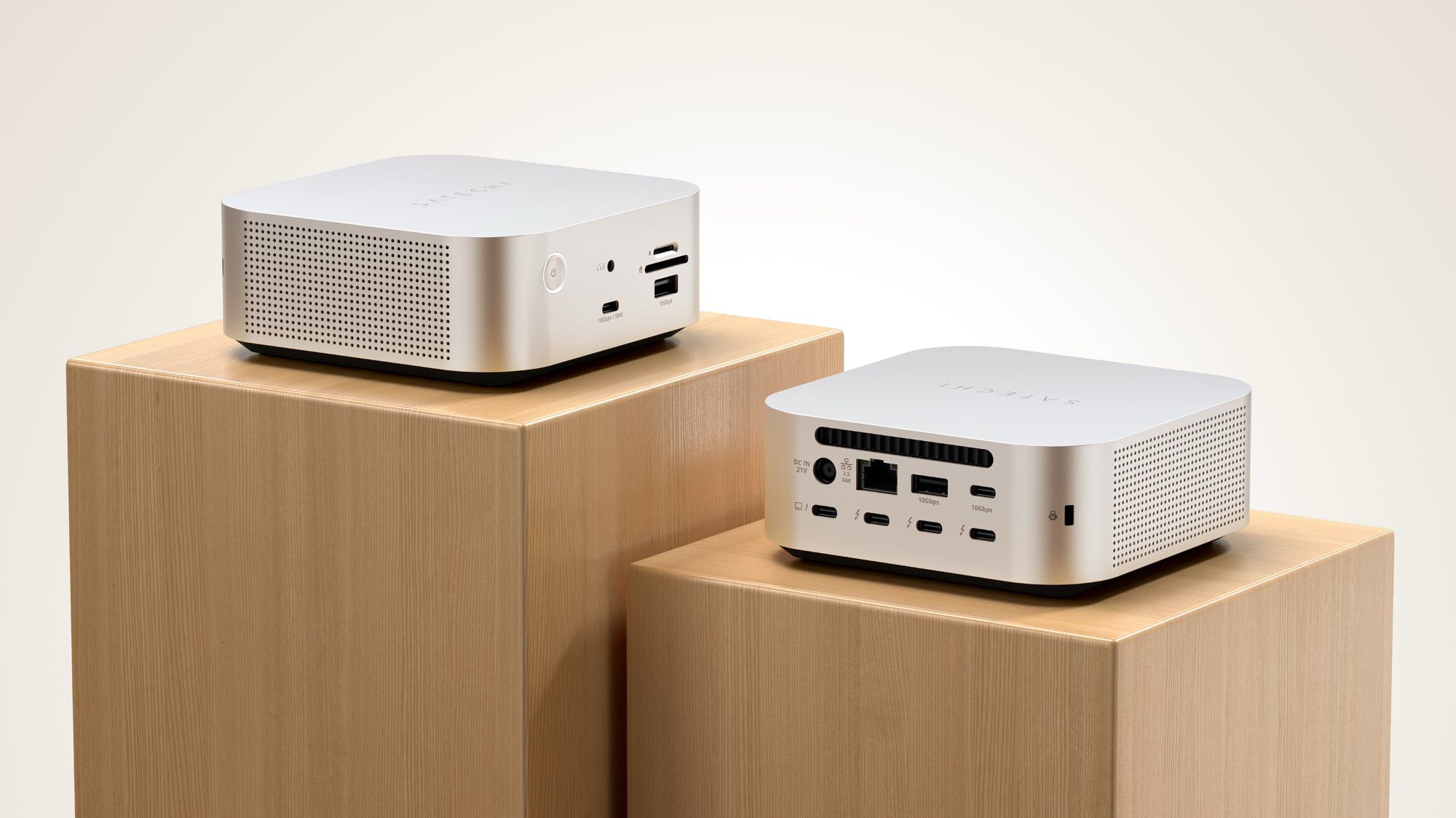
Satechi announced the Thunderbolt 5 CubeDock, its first Thunderbolt 5 dock featuring an integrated NVMe SSD enclosure (up to 8TB, 6000MB/s), 80Gb/s bi-directional bandwidth with a 120Gb/s boost, a 180W power supply with 140W host charging, and support for up to three 8K60 displays on Windows (two 6K60 on Macs). The CubeDock (5x5x2 in, aluminum) includes multiple high-speed ports, 2.5Gb Ethernet, active cooling, and is available for pre-order at $400 with shipments in Q1 2026; Satechi also launched a Thunderbolt 5 Pro cable ($40) supporting 80Gb/s and 240W PD. The product signals early ecosystem adoption of Thunderbolt 5 and incremental revenue/positioning upside for accessory vendors, but the announcement is unlikely to move broader markets.
Market structure: Thunderbolt 5 docks with integrated high‑performance NVMe (80Gb/s bi‑dir, 6,000MB/s, up to 8TB) shift value into premium accessory makers, high‑end NAND suppliers and power/PD silicon vendors. Winners: premium SSD/NAND names (Western Digital WDC, Micron MU), PMIC/cable chip vendors (Texas Instruments TXN), and Apple (AAPL) via higher Mac accessory spend; losers: low‑end external SSD enclosure makers and smaller dock OEMs with no hardware integration. If adoption scales to even 5–10% of premium laptop users over 12 months, incremental NAND demand could tighten high‑end supply and lift ASPs ~3–7% for enterprise/consumer NVMe segments.
Risk assessment: Tail risks include adoption failure if Apple or major OEMs delay Thunderbolt 5 support, firmware/thermal recalls for integrated SSDs causing warranty hits, or a NAND oversupply that reverses price gains. Immediate effect (days) is sentiment; short term (0–3 months) centers on Satechi preorders and initial shipments (Q1 2026); medium term (3–12 months) depends on WWDC/Apple announcements and NAND spot moves. Hidden dependency: Satechi’s economics hinge on third‑party 8TB NVMe supply and controller availability—bottlenecks or margin squeeze at the component level would compress accessory margins and cap upside.
Trade implications: Tactical plays are small, targeted positions: overweight AAPL by 1–2% into WWDC (June 2026) to capture accessory ecosystem lift; establish a 1–1.5% long in WDC (6–12 month horizon) to play high‑end NAND demand; express asymmetric upside in MU via a 6‑9 month call spread ~20–30% OTM sized to 0.5–1% portfolio risk to limit premium spend. Pair trade: long WDC (1.5%) / short BBY (1%) for 3–6 months to capture relative outperformance if premium accessory sales disintermediate retail margins.
AI-powered research, real-time alerts, and portfolio analytics for institutional investors.
Request DemoOverall Sentiment
mildly positive
Sentiment Score
0.28
Ticker Sentiment
Contrarian angles: The market may overestimate immediate AAPL hardware upside—histor USB/Thunderbolt transitions were multi‑year adoption curves—so avoid large directional bets; conversely, the market may underprice concentrated upside for NAND suppliers if multiple accessory makers adopt integrated SSDs. Historical parallel: USB‑C ecosystem premium took 12–24 months to materialize into sustained NAND ASP recovery; monitor for similar lag. Watch triggers: if NAND spot prices move >+5% in 60 days or Apple confirms TB5 support at WWDC, scale longs by 50%; if integrated SSD returns/firmware advisories appear, cut exposure by 50%.
