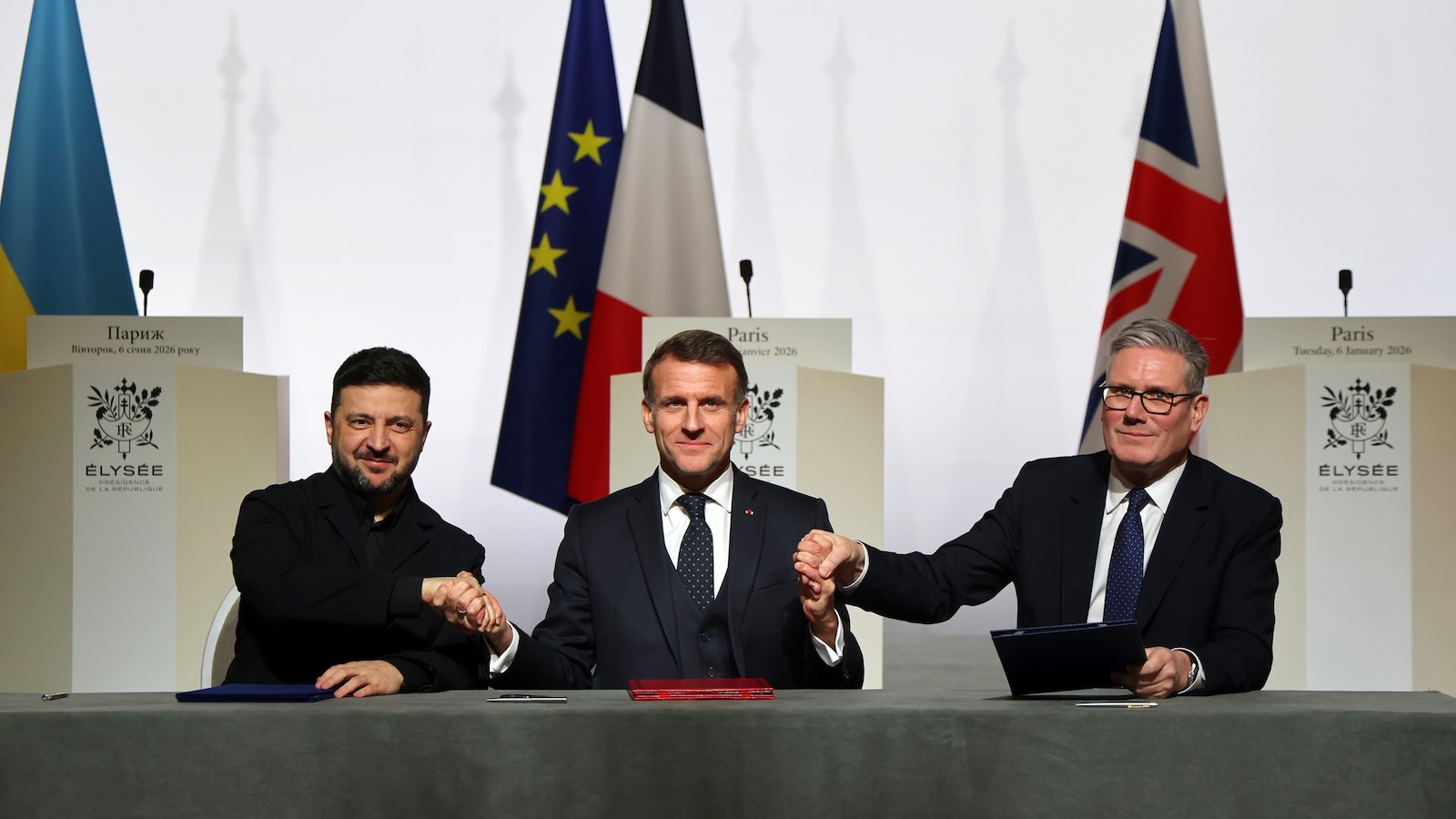
France and the U.K. signed a Declaration of Intent with Ukraine to deploy British, French and partner forces to establish protective "military hubs" inside Ukraine contingent on a ceasefire, with Germany saying it could place forces on neighboring NATO territory following a truce. The pledge—announced alongside leaders and U.S. envoys including Jared Kushner—signals greater Western alignment on security guarantees but risks complicating negotiations given the Kremlin's categorical rejection of NATO forces in Ukraine, raising geopolitical risk that could pressure risk assets and influence defense and energy sector positioning.
Market structure: The near-term winners are defense and security suppliers (Lockheed LMT, Raytheon RTX, BAE Systems BA.L, Thales HO.PA) and integrated oil majors (XOM, CVX) because a credible promise of foreign troops raises the probability of formal security guarantees and multi-year procurement (estimate +10–20% revenue tail over 12–24 months for prime contractors). Losers are Europe-facing travel/leisure and regional banks with EM/Russia exposure (IAG.L, RYA.L, selected CE/EE banks) due to elevated flight restrictions, sanctions risk and higher funding costs.
Risk assessment: Tail risks include Russia rejecting guarantees and escalating operations (low-probability but high-impact) which could push Brent >$100/barrel within 30–90 days and widen EUR sovereign spreads by 50–100bps. Immediate (days) reaction will be volatility spikes; short-term (weeks–months) will be sector rotation into defense/energy; long-term (quarters–years) depends on formal procurement cycles and reconstruction spending. Hidden dependencies: German policy shifts or U.S. domestic politics can flip outcomes; watch NATO summit language as a catalyst.
Trade implications: Tactical: establish modest conviction longs in defense (2–4% portfolio, split LMT/RTX/BA.L) and energy (2–3% XOM/CVX) using 3–9 month call spreads to limit capital at risk; hedge with 1–2% long TLT if risk-off pushes USD stronger. Relative: pair long BA.L (defense) vs short IAG.L (airlines) sized 1–2% each. Use options: buy 3–6 month OTM calls on ITA (A&D ETF) or LMT and 1–3 month puts on European airline ETFs to asymmetrically capture spikes.
Contrarian angles: Consensus assumes troop commitments make peace likelier; missing point—commitments are conditional and could empower hardline bargaining, prolonging war and commodity shocks. If markets front-run procurement, defense equities may be overbought; consider partial profit-taking on >20% rally and use realized-volatility thresholds (VIX>28 or MOVE>120) to add hedges. Historical parallel: post-2014 defense re-rate took 6–18 months to embed into earnings, so time positions for 6–12 month windows.
AI-powered research, real-time alerts, and portfolio analytics for institutional investors.
Request DemoOverall Sentiment
moderately negative
Sentiment Score
-0.35
