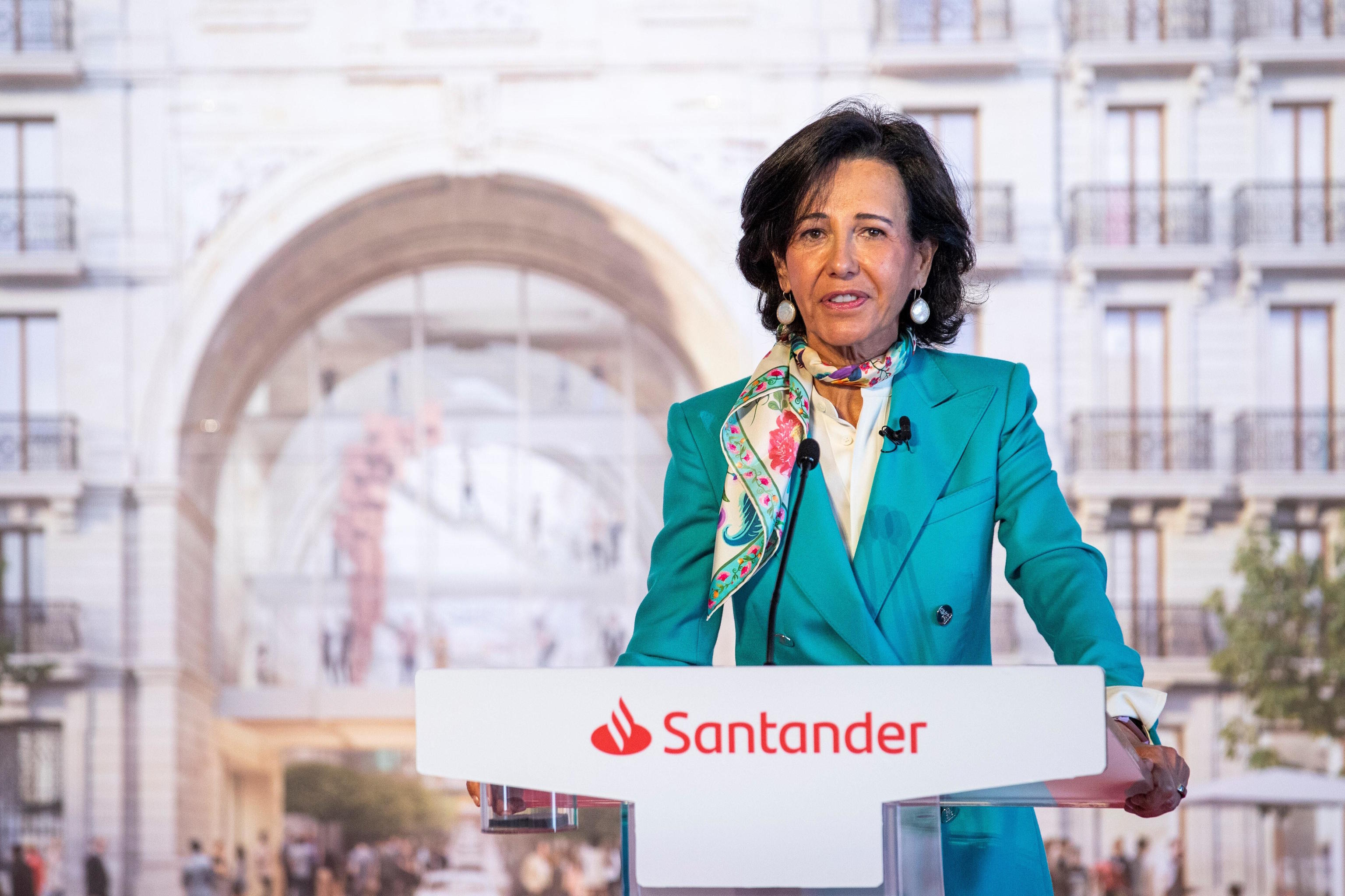
Banco Santander agreed to acquire Webster Bank for $12.2 billion (€10.3 billion) to significantly expand its U.S. retail and business footprint, targeting top-ten scale nationally and top-five deposit positions in the Northeast; the deal is expected to close in the second half of the year and management forecasts $800 million (€667 million) of synergies. Webster shareholders will receive $48.75 in cash plus 2.0548 Santander ADS per Webster share (article reports a total of $26.25 per share); Santander said the acquisition complements its U.S. consumer franchise and that it intends to integrate Webster's management. Santander reported record 2024 profit of €14.1 billion (+12%) on revenues of €62.39 billion (nearly flat year-on-year) with €13.66 billion in commission income (+5%), added eight million customers to reach 180 million, and approved a €5 billion buyback (€1.8bn from H2 2025 profits and €3.2bn tied to the Poland sale).
Market structure: Santander (SAN) gains immediate scale in the U.S. retail/business banking market, improving deposit share in the Northeast and cross-sell economics (consumer financing + Webster business lending). Direct winners: SAN shareholders (EPS upside from €5–8bn capital redeployment incl. €5bn buyback and $800m synergies) and US customers benefiting from broader product set; losers: mid‑tier US regionals (KRE constituents) facing higher competition for deposits and commercial lending in the Northeast. Cross‑asset: SAN credit spreads should tighten on proof of capital (Poland sale + buyback) but could widen if markets doubt integration; EUR/USD sensitivity increases modestly as SAN’s USD assets grow.
Risk assessment: Tail risks include regulatory delays/conditions (Fed, FDIC, CFIUS-style reviews) or realization shortfalls vs $800m synergy target creating a >10% EPS miss in year-1 post close. Immediate risk (days): deal arbitrage spread and SAN reaction; short-term (weeks–months): regulatory approvals and integration lead announcements; long-term (12–36 months): ROE accretion and deposit mix shifts. Hidden dependencies: cross-border operational integration, IT migration, and deposit retention rates — a 5–10% deposit attrition would materially lower NIM accretion.
Trade implications: Primary trade is a constructive overweight in SAN ADS (ticker: SAN) sized 2–3% of capital targeting 12–18% total return in 12 months, increasing to 4–5% on a >10% drawdown. Consider a conservative merger‑arb (long WBS, short 2.0548 SAN ADS delta‑hedge) sized 0.5–1% capital to capture the spread, and short the SPDR S&P Regional Banking ETF (KRE) 1–2% to express pressure on US regionals. Use options: buy 9–12 month SAN call spreads 15–25% OTM (pay small premium, cap risk) or sell short dated implied vol if it spikes post‑announcement.
Contrarian angles: Market may underprice the survivability of Webster deposits and cross‑sell upside — SAN could realize >$800m synergies if cross‑sell lifts fee income by 3–5% in 24 months, implying >15% upside. Conversely, consensus may be optimistic on regulatory ease; a protracted approval or mandated divestitures could create a 15–25% downside in SAN ADRs. Historical parallel: European acquirers of US banks (HSBC/MBNA era) show integration can take 18–36 months to prove ROE; position sizing should reflect that horizon and regulatory binary risk.
AI-powered research, real-time alerts, and portfolio analytics for institutional investors.
Request DemoOverall Sentiment
moderately positive
Sentiment Score
0.55
Ticker Sentiment
