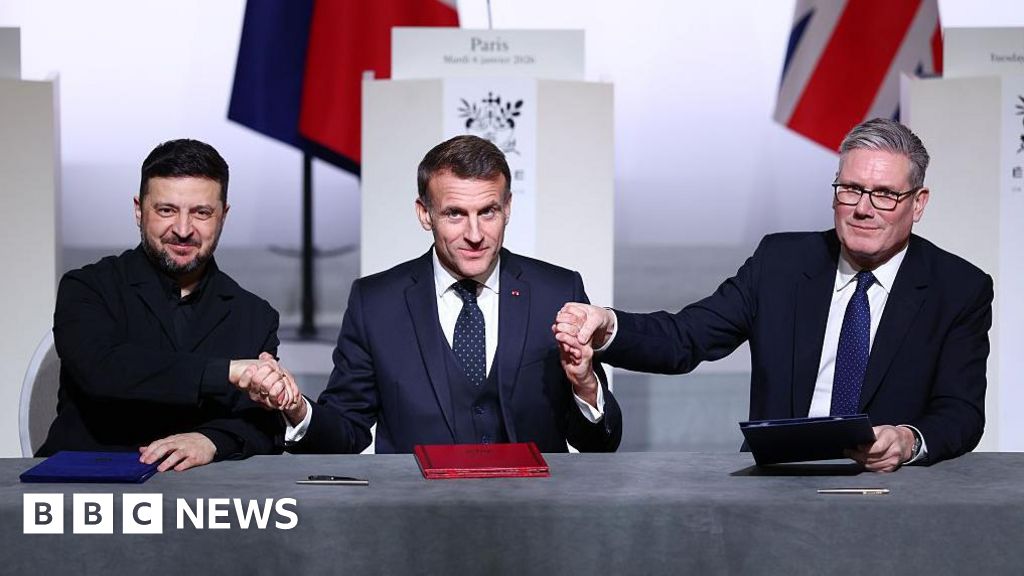
The UK and France signed a declaration of intent to deploy British, French and partner forces on Ukrainian soil if a peace deal with Russia is reached, establishing military hubs to secure skies and seas and to help regenerate Ukraine's armed forces; France indicated thousands of troops could be deployed and the US would lead truce monitoring. Key negotiating items remain unresolved—most importantly territorial lines—while Russia, which controls roughly 20% of Ukraine (about 75% of Donetsk and 99% of Luhansk), warns foreign forces would be legitimate targets. The announcement raises geopolitical risk and potential implications for defense spending, European security arrangements and market uncertainty pending the terms of any ceasefire and Moscow’s response.
Market structure: Deployment-intent by UK/France materially skews near-term winners to large defense primes (Lockheed LMT, Raytheon RTX, Northrop NOC, General Dynamics GD) and ammunition/engine suppliers; expect a 5–15% demand shock for munitions/heavy equipment over 6–18 months if procurement commitments follow. Energy and agricultural commodity markets are second-order winners: a persistent security premium could push Brent $5–15/bbl higher and European gas spreads 10–30% on winter supply risk. Sovereign-credit and FX winners: USD and core sovereign bonds as safe-havens; RUB downside pressure remains if tensions escalate.
Risk assessment: Tail risk includes direct Russian strikes on foreign contingents (low-probability, high-impact) that could trigger NATO market shocks — equities down >15% and oil >$100/bbl within days. Immediate (days) — headline-driven volatility; short-term (weeks–months) — defense rerating and commodity spikes; long-term (quarters–years) — sustained reconstruction cashflows and reshoring of critical suppliers. Hidden dependencies: US political shifts (Trump administration language on “protocols” vs guarantees), legal status of troops, and munitions supply-chain bottlenecks (semiconductors, specialized metallurgy).
Trade implications: Tactical: establish 2–3% long positions in LMT and RTX (US large caps) and a 2% long in CAT for reconstruction equipment; hedge with 6–9 month 15% OTM puts sized to limit downside to 8–10%. Relative-value: overweight ITA (aerospace/defense ETF) +3% vs short SPY -2% to capture sector re-rating. Commodity plays: buy 3–4% exposure to USO (oil) or 3–4% to UNG (gas) via call spreads (6–12 months) to capture volatility upside.
AI-powered research, real-time alerts, and portfolio analytics for institutional investors.
Request DemoOverall Sentiment
moderately negative
Sentiment Score
-0.35
Contrarian angles: Market consensus prices prolonged high-intensity conflict; miss is a negotiated peace that includes NATO-led verification — this would unwind much defense upside (20–40% downside risk vs recent re-ratings). Historical parallels (post-Gulf/ Balkans) show defense spikes then mean-reversion over 6–18 months while construction/reconstruction stocks outperform later; unintended consequence: a European onshoring push could shift contract winners from US primes to EU contractors (BAE/CRH/HCMLY) over 12–36 months, so avoid full concentration in US names without geographic hedges.
