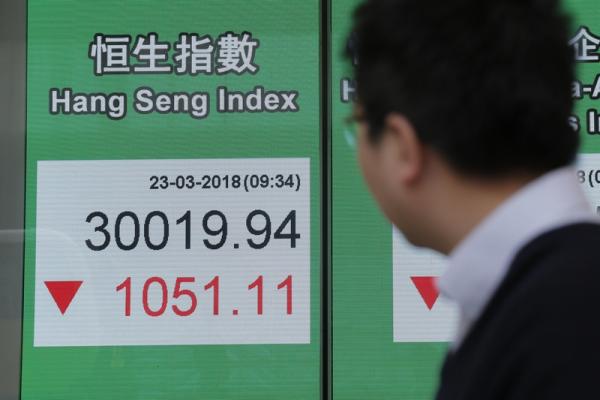
Asian stocks declined Friday amid renewed concerns over U.S.-China trade relations and reinstated Trump-era tariffs. Chinese markets led the losses after Treasury Secretary Bessent indicated trade talks with Beijing had stalled, overshadowing positive sentiment from a prior ruling that initially blocked the tariffs. Japanese stocks also fell following stronger-than-expected Tokyo inflation data, fueling speculation of a potential interest rate hike by the Bank of Japan in July.
Asian financial markets experienced a broad decline on Friday, primarily driven by resurgent concerns over U.S. trade policy and specific regional macroeconomic factors. The reinstatement of U.S. tariffs by an appeals court and comments from Treasury Secretary Scott Bessent indicating stalled trade negotiations with Beijing significantly dampened investor sentiment, leading to Chinese markets, including the Shanghai Shenzhen CSI 300 and Shanghai Composite (down 0.5%-0.7%) and Hong Kong's Hang Seng (down 1.5%), spearheading regional losses. This development overshadowed a prior court ruling that had blocked the levies and kept President Trump's 90-day trade deal deadline active, with S&P 500 Futures declining 0.3% in Asian trading. Concurrently, Japanese equities, with the Nikkei 225 and TOPIX falling 1.3% and 0.7% respectively, were pressured by stronger-than-anticipated May Tokyo consumer inflation data, which has historically served as a bellwether for nationwide figures, thereby increasing expectations for a Bank of Japan interest rate hike, potentially 25 basis points in July. Despite this, other Japanese data showed resilience, with industrial production shrinking less than expected and retail sales growing more than anticipated, contributing to a firmer yen. Elsewhere in Asia, technology stocks, including NVIDIA where initial optimism from strong earnings appeared to fade, contributed to declines in markets like South Korea's KOSPI (down 0.5%) and Singapore's Straits Times index (down 0.3%). In contrast, Australia's ASX 200 remained flat, influenced by softer retail sales data that spurred bets on further interest rate cuts by the Reserve Bank of Australia, while India's Gift Nifty 50 futures indicated a slightly positive opening. Market participants are now keenly awaiting U.S. PCE price index data, the Federal Reserve’s preferred inflation gauge, which will be critical for future market direction.
AI-powered research, real-time alerts, and portfolio analytics for institutional investors.
Request DemoOverall Sentiment
strongly negative
Sentiment Score
-0.70
Ticker Sentiment
