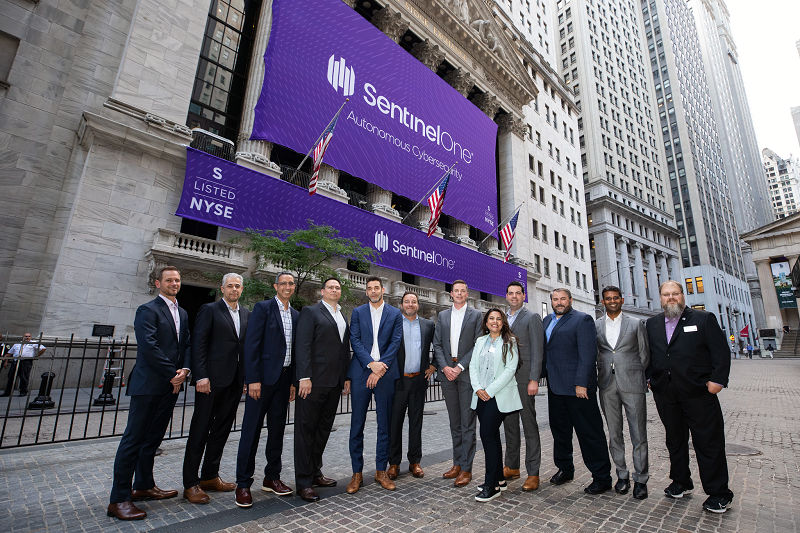
SentinelOne director Ana G. Pinczuk sold 16,042 shares at $13.41 on April 6, 2026 for $215,123 and now directly holds 587,608 shares; S trades at $13.38 and is down ~11% YTD. TD Cowen reiterated a Buy with a $22 PT and Cantor Fitzgerald kept an Overweight after SentinelOne reported record net new ARR of $64M and launched new AI security products (Prompt AI Agent Security, Prompt AI Red Teaming). Sherritt closed a non‑brokered placement raising ~$43.5M via ~207M shares at $0.21 (Seymour Schulich bought 68.6M for $14.4M) and plans an additional raise up to $50M via up to 238M shares at $0.21. Overall news supports positive investor sentiment around SentinelOne's AI/cyber momentum but includes insider selling and YTD share weakness; Sherritt's financing is dilutive but secures near‑term funding.
SentinelOne’s push into autonomous AI-attack prevention is a tactical pivot that changes RFP dynamics: security buyers evaluating AI model integrity will treat prevention-as-a-feature, not a bolt-on, shortening the sales cycle for vendors who can demonstrate live efficacy. If S converts pilot wins into enterprise contracts at a 15–25% higher ARPU versus legacy endpoint deals, ARR trajectory could re-accelerate materially within 12–24 months while competitors without comparable automation face longer, costlier proofs-of-concept.
Second-order winners include MSSPs and channel partners who can white-label autonomous defenses—these partners will capture service margins and accelerate deployment, creating a distribution advantage for the vendor that locks in sticky recurring revenue. Conversely, large cloud-native platform providers and entrenched firewall vendors could undercut growth by embedding basic AI-guardrails for free, forcing exports of higher-value features into premium tiers and pressuring gross margins over a 2–4 year window.
Key catalysts to track: two measurable inflection points will move the stock—(1) multi-terabyte scale production deployments announced via large enterprise or MSP contracts within 3–9 months, and (2) reproducible red-team outcomes from independent third parties within 6 months. Tail risks are binary: an independent exploit that defeats claimed autonomous protection or an extended enterprise freeze on AI purchases would compress multiples quickly; both could flip sentiment in 30–90 days.
The market is rewarding feature leadership but underpricing execution risk. That asymmetry creates a favorable skew for option structures that cap downside while preserving upside to binary adoption events, and it favors relative-value pairs against incumbents with more expensive valuations and slower upgrade cycles.
AI-powered research, real-time alerts, and portfolio analytics for institutional investors.
Request DemoOverall Sentiment
mildly positive
Sentiment Score
0.30
Ticker Sentiment
