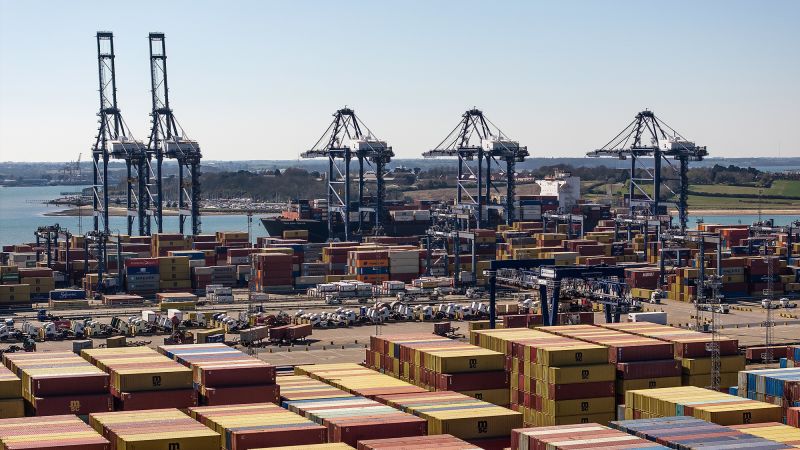
The UK economy contracted by 0.3% in April, the largest monthly decline since October 2023, primarily due to a services sector slowdown following the end of a tax break. A record £2 billion drop in UK goods exports to the US, attributed to President Trump's newly implemented tariffs, also contributed to the economic downturn, with the finance minister citing "huge uncertainty about tariffs" as a factor weakening exports and production. While the UK has secured some tariff concessions from the US, tariffs on UK exports to America remain higher than pre-April levels, posing a medium-term headwind for UK trade.
The United Kingdom's economy experienced a notable contraction in April, with Gross Domestic Product shrinking by 0.3%, marking the most significant month-on-month decline since October 2023. This downturn was primarily driven by a contraction in the services sector, which was adversely affected by the termination of a government tax break for home buyers. Compounding this domestic weakness, new tariffs imposed by the United States under President Trump led to a record £2 billion fall in UK goods exports to the US in April compared to March, the largest such drop since records began in 1997, which the Office for National Statistics linked to the tariff implementation. Britain's finance minister, Rachel Reeves, highlighted "huge uncertainty about tariffs" as a key factor weakening both exports and production. While the UK has secured some concessions, such as the application of only the baseline 10% US tariff and an agreement to scrap duties on UK steel and aluminum, alongside a framework for a trade deal, overall tariffs on British goods exported to the US remain higher than pre-April levels. Consequently, as noted by KPMG UK, these elevated tariffs are expected to act as a "headwind for UK trade in the medium term," despite the US-UK accord offering a degree of policy certainty. The reported "strongly negative" sentiment and "pessimistic" tone, coupled with a market impact score of 0.65, underscore the severity of these combined domestic and trade-related challenges.
AI-powered research, real-time alerts, and portfolio analytics for institutional investors.
Overall Sentiment
strongly negative
Sentiment Score
-0.65
