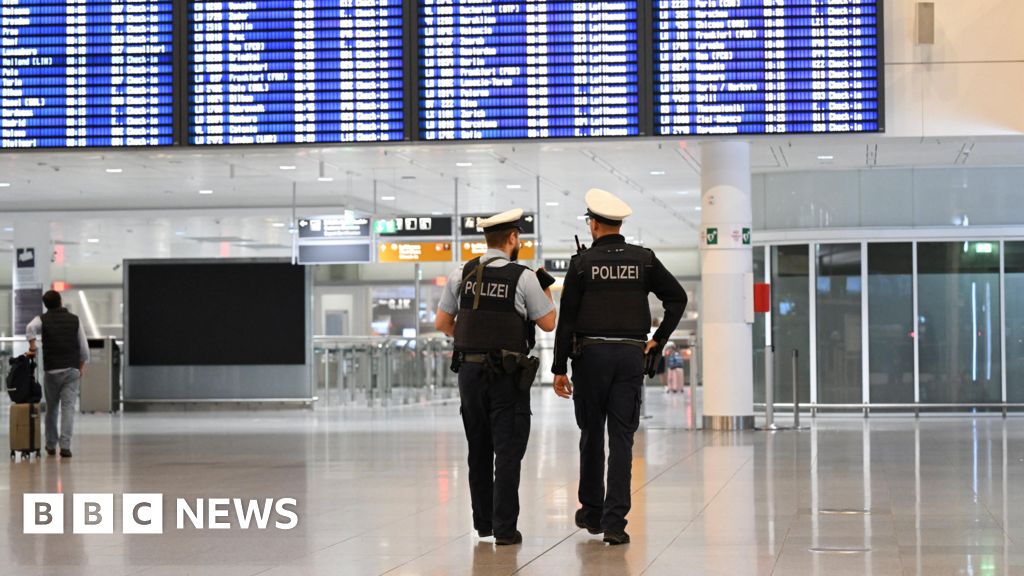
Munich airport experienced two closures within 24 hours due to suspected drone sightings, affecting 6,500 passengers and highlighting escalating operational risks for European aviation. This incident, part of a broader trend of drone disruptions across the EU, is prompting German officials to push for enhanced anti-drone defenses and legislation, signaling potential for increased security spending and heightened geopolitical tensions amid unconfirmed suspicions of Russian involvement in recent airspace incursions.
Munich airport resumes flights after suspected drones force second closure in 24 hours Flights have resumed at Germany's Munich airport after unconfirmed drone sightings forced it to suspend operations for the second time in 24 hours. In a statement on Friday evening, the airport said that flights were stopped at 21:30 local time (20:30 GMT), with around 6,500 passengers affected. At least 17 flights were also grounded in Munich on Thursday evening due to multiple drone sightings in nearby airspace. It was the latest in a series of incidents involving drones that have disrupted aviation in Europe in recent weeks. On Saturday morning, Munich airport said flights had been "gradually ramped up", but warned that delays were expected throughout the day. In a statement on its website, it urged passengers to continue to check the status of their flight before travelling to the airport. On Thursday, authorities in Belgium were also investigating sightings of 15 drones above the Elsenborn military site near the German border, according to Belgian media. After the sighting, the drones reportedly flew from Belgium to Germany, where they were also observed by the police in the small town of Düren, in western Germany. Officials have been unable to identify where the drones originated or who operated them. Germany's Interior Minister Alexander Dobrindt has said he will raise the matter of anti-drone defences on Saturday at a meeting of European interior ministers, originally billed as a migration summit. Earlier on Friday, the minister also promised to bring forward proposed legislation to make it easier for police to ask the military to shoot down drones. Recent drone sightings across the European Union prompted a leaders' summit in Copenhagen earlier this week. Several EU member states have backed plans for a multi-layered "drone wall" to quickly detect, track and destroy Russian drones. Twenty Russian drones crossed into Poland and Russian MiG-31 jets entered Estonian airspace in separate incidents recently. Copenhagen and Oslo airports were forced to close after unidentified drones were spotted near airport and military airspaces. German Chancellor Friedrich Merz said ahead of the summit that airspace incursions were getting worse and that it was "reasonable to assume the drones are coming from Russia". Russia has denied any involvement, while Danish authorities say there was no evidence Moscow was involved. Speaking to a summit in the Black Sea resort city of Sochi on Thursday, Russian President Vladimir Putin laughed off suggestions he ordered drones to Denmark. "I won't do it again. I won't do it again - not to France or Denmark or Copenhagen," Putin said. Recurring drone sightings, which forced Munich airport to suspend operations twice in 24 hours affecting 6,500 passengers, highlight a significant and escalating operational risk for European aviation infrastructure. This event is not isolated, but part of a broader pattern of disruptions recently seen at airports in Copenhagen and Oslo, and near a Belgian military site, signaling a systemic vulnerability across the continent. The incidents are amplifying geopolitical tensions, with German Chancellor Friedrich Merz suggesting Russian involvement, a claim that remains unconfirmed and is officially denied by Moscow. In response, German officials are fast-tracking legislation to enhance anti-drone defenses, and a multi-state EU coalition is considering a 'drone wall'. This policy momentum indicates a probable acceleration in public spending on airspace security, creating a new demand catalyst for the defense and security technology sectors while imposing new potential costs and uncertainties on the travel and logistics industries.
AI-powered research, real-time alerts, and portfolio analytics for institutional investors.
Request DemoOverall Sentiment
moderately negative
Sentiment Score
-0.50
