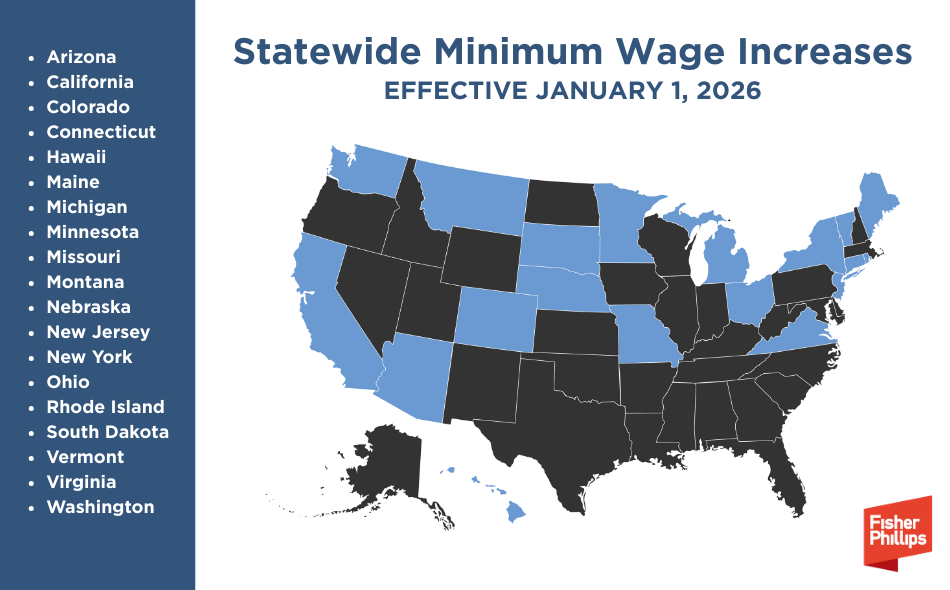
More than 50 state-level workplace laws take effect Jan. 1, 2026 — spanning more than half the states — that will raise labor costs and compliance burdens for employers: at least 19 states will increase minimum wages (with Arizona, Colorado, Hawaii, Maine, Missouri and Nebraska reaching or exceeding $15/hr), while new paid-leave programs and expansions (Minnesota launch, Delaware PFML benefits begin, Washington and Colorado expansions) will add payroll and administrative obligations. States are also moving aggressively on AI and data rules (Illinois restrictions on discriminatory AI use and notice requirements, Texas AI governance, California’s frontier-model transparency plus a 30-day breach-notification window), workplace safety (Nevada wildfire-smoke monitoring, Oregon healthcare workplace-violence rules, Washington protections for isolated workers) and other labor protections — alongside federal “Big Beautiful Bill” benefit provisions — creating a patchwork of region-specific mandates. For investors and allocators, expect upward pressure on labor-related operating costs, heightened compliance and legal risk (including an NLRB challenge to California’s labor enforcement changes), and uneven sectoral impacts that should be incorporated into cost forecasts and due diligence.
More than 50 state-level workplace laws take effect January 1, 2026 across more than half the states, creating a material compliance wave for employers; at least 19 states will raise minimum wages beginning that day, with Arizona, Colorado, Hawaii, Maine, Missouri and Nebraska reaching or exceeding $15/hour. New paid-leave regimes will drive near-term payroll and administrative costs — Minnesota launches a paid leave program, Delaware’s PFML benefits begin (payroll contributions already started in 2025), and Washington and Colorado enact significant PFML expansions including NICU-related leave in Colorado. States are also accelerating regulation of AI and data: Illinois will bar discriminatory uses of employment AI and require notice for certain AI uses, Texas is enacting a Responsible AI governance law with a softer approach, and California introduces frontier-model transparency plus a 30-day breach-notification window and stricter opt-out rules in Delaware and Tennessee. Targeted safety and labor protections (Nevada wildfire-smoke monitoring, Oregon healthcare workplace-violence rules, Washington protections for isolated workers) and rising litigation risk (notably the NLRB suit against California and expanded unemployment eligibility for striking workers in Oregon and Washington) increase legal and operational uncertainty, implying uneven sectoral cost impacts for healthcare, hospitality, retail, construction and tech that investors should bake into forecasts and due diligence.
AI-powered research, real-time alerts, and portfolio analytics for institutional investors.
Request DemoOverall Sentiment
mildly negative
Sentiment Score
-0.30
