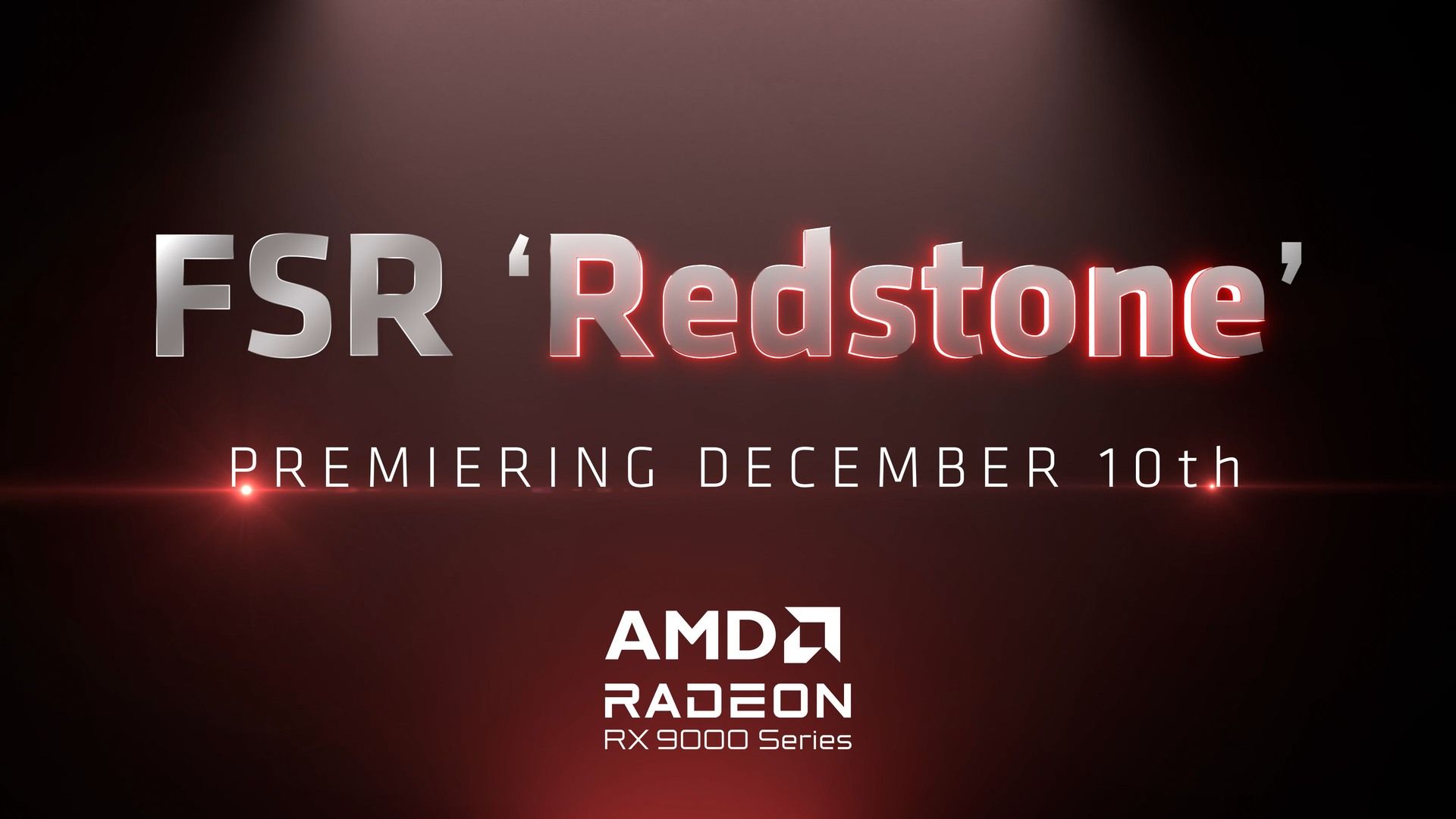
AMD is rebranding its FidelityFX suite to the shorthand 'FSR' and has renamed Fluid Motion Frames to FSR Frame Generation, consolidating multiple post-processing technologies under the FSR umbrella. The company plans to ship parts of its FSR 'Redstone' stack—including FSR 4 upscaling in games and a preview of Ray Regeneration—with a December 10 release, but adoption depends on game developers integrating the features; comparisons with Nvidia's DLSS Ray Reconstruction and competing neural radiance-cache approaches suggest differing visual outputs rather than a clear technical superiority.
Market structure: AMD’s rebrand and FSR Redstone signal a software-led attempt to sustain GPU relevance; winners are middleware integrators, game engines (Unreal/Unity) and memory/fab suppliers if adoption scales, while incumbents selling premium ML-tuned silicon (NVDA) retain pricing power. Near-term share shifts are likely modest — developer adoption is the gating factor — but if FSR reduces perceptible delta vs DLSS in competitive titles, it could blunt NVIDIA’s premium and compress ASPs for top-end GPUs over 6–18 months.
Risk assessment: Tail risks include developer rejection (low probability, high impact) or consumer backlash from inconsistent frame-generation quality which could materially damage AMD GPU demand; regulatory/interoperability suits are low-probability but would be material to licensing revenue. Time horizons: expect market noise around Dec 10 (immediate), measurable adoption signals in 1–3 months, and structural GPU demand/ASP effects over 6–24 months. Hidden dependencies are developer toolchain support, console OEM roadmaps (PS6 signals), and real-world benchmarks from AAA titles.
Trade implications: Tactical trade is capture of asymmetric optionality: favor NVDA exposure for sustained ML advantage while hedging AMD execution risk. Expect elevated implied vol around major game patches/releases; use defined-risk option structures to express views. Cross-sector tilt: modest overweight in memory (MU) and foundry exposure (TSM) on a 6–12 month view if adoption drives incremental memory/fab demand.
Contrarian angles: Consensus underestimates the delay between SDK release and real revenue — if major engines ship native Redstone support within 90 days, AMD’s social-media noise converts to measurable GPU demand lift and FSR becomes a moat for lower-tier GPUs, not a threat to NVDA. Conversely, market may be under-pricing NVDA’s ability to keep ML lead via silicon-accelerated features; the mispricing window is likely 30–90 days as benchmarks emerge.
AI-powered research, real-time alerts, and portfolio analytics for institutional investors.
Request DemoOverall Sentiment
neutral
Sentiment Score
-0.10
Ticker Sentiment
