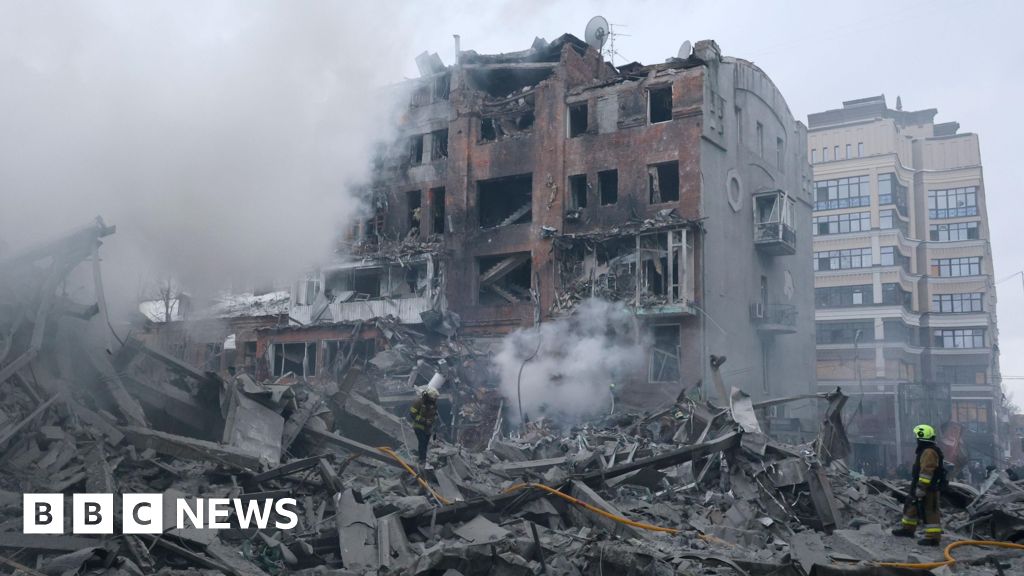
A dual missile strike on a Kharkiv residential block killed two people, including a three-year-old, and injured about 28 others (16 hospitalized), with a six-month-old among the wounded; the attack nearly destroyed a multi-story apartment building and prompted an ongoing search-and-rescue operation. Kyiv blamed Russian forces while Moscow denied responsibility and opened its own probe, and the incident arrives ahead of high-level talks in Kyiv and a planned coalition leaders' meeting in France, raising the prospect of heightened geopolitical tensions that could sustain risk-off positioning in regional assets.
Market structure: Immediate winners are defense primes and commodity exporters; losers are regional consumer-facing services (airlines, travel) and Ukrainian reconstruction-sensitive sectors. Expect 3–8% near-term risk premia baked into defense equities and commodities (oil, gas, wheat) if strikes persist, tightening financing for Eastern European borrowers and widening CDS by 20–50bp on vulnerable sovereigns. Cross-asset: expect safe-haven flows into USD, JPY, gold (GLD), and USTs (TLT) over 48–72 hours; European banks and EUR likely underperform versus USD by 0.5–1.5% intraday on renewed escalation risk.
Risk assessment: Tail risks include a larger Russian offensive or major Western sanctions escalation that could spike Brent >20% and disrupt grain exports for months; low probability but high impact for 6–12+ months. Near-term (days) volatility spikes; short-term (weeks–months) increased defense spending flows; long-term (quarters) structural supply-chain reconfiguration for European energy and food. Hidden dependencies: winter weather, NATO logistics, and diplomatic windows (next 30 days) can amplify or reverse markets rapidly. Key catalysts: Kyiv talks outcome within 7 days, France coalition meeting Jan 6, and any credible ceasefire or new sanctions package.
Trade implications: Favor concentrated, size-limited exposure to defense: LMT/NOC/RTX (2–3% total portfolio, equal-weight) and gold (GLD 1–2%) as tail-hedge; add TLT 1–2% to capture flight-to-quality. Pair trade: long LMT (2%) vs short DAL or AAL (1% each) to express defense upside vs travel sensitivity. Use options: buy 3-month 25-delta call positions on LMT and NOC (caps risk) and a 1–2% notional 3-month GLD call as convex insurance.
Contrarian angles: Consensus will overprice perpetual escalation; if Kyiv talks yield incremental de-escalation within 30 days, defense equities can pull back 10–20% from peak—so size options to limit carry. Historical parallel: 2014–15 saw defense names +15–25% over 12 months but with 10–15% 3–6 month mean reversion; therefore prefer option-skewed exposure, not large cash longs. Unintended consequence: higher commodity-driven inflation could force tighter Fed policy in 2026, pressuring growth names—avoid increasing cyclicals until commodity risk abates.
AI-powered research, real-time alerts, and portfolio analytics for institutional investors.
Request DemoOverall Sentiment
moderately negative
Sentiment Score
-0.50
